Read this discussion.
Explicit dynamics calculates a maximum time step according to the formula shown. The two ways you can speed up the computation are
(1) Increase the size of the minimum characteristic edge length in the mesh. You do this by using mesh controls in order to prevent small elements from forming. You might also do this by adjusting the geometry, merging faces, etc. If you double the characteristic edge length, the maximum time step will double and the solution will take approx. half as long.
(2) Increase the density of the material. This will change the physics of the problem, but if you want to get faster results, doubling the density will double the maximum time step and cut the solution approx. in half. Just like finding the smallest element described above, there is a trick called Mass Scaling that finds the smallest elements and increases the density of material only in those small elements. This is much better because you get the benefit of a larger maximum step size without significantly changing the physics of the problem.
Those two changes combine, so if you get a factor of two for the element size and a factor of two from increasing density, the solve time will be faster by a factor of four.
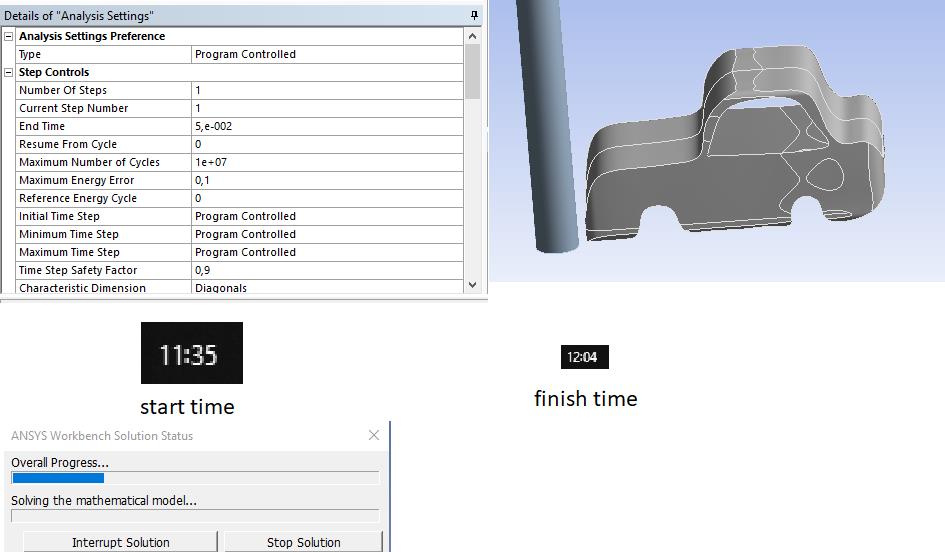
I would not call a 30 minute solution a long time to wait for an Explicit Dynamics model. I have seen models that run for tens of hours.


















 You are navigating away from the AIS Discovery experience