Ansys Assistant will be unavailable on the Learning Forum starting January 30. An upgraded version is coming soon. We apologize for any inconvenience and appreciate your patience. Stay tuned for updates.
General Mechanical

General Mechanical

Topics related to Mechanical Enterprise, Motion, Additive Print and more.

Modal Analysis, Mechanism

    • VigneshKC
      Subscriber

      Hi,


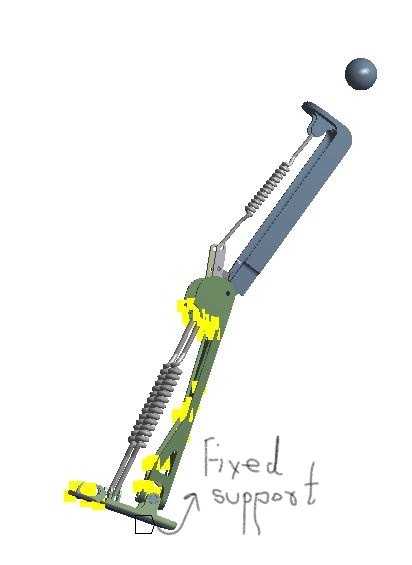
      I completed the design of a mechanism and did static analysis to verify it is safe. Now when I am checking the dynamic characteristic I am facing a problem.


      This is the geometry and boundary condition , When I perform a modal analysis the first mode frequency comes to be very small as shown below.


      about 3 Hz only. Am I doing something wrong? Should I redesign my entire mechanism?


      Thanks and Regards,


      Vignesh K.C.

    • jj77
      Subscriber

      OK - why is 3 Hz not acceptable, and why you need to redesign then?


      In some industries (civil/bridges), there are some requirements e.g., on foot/pedestrian bridges that certain modes need to be above say ~ 3 Hz (e.g., AASHTO or Eurocode), and that comes from the fact that 3 Hz and above is outside our running/walking pace, so thus we can not really excite the bridge that well above that frequency (while if the frequency of the bridge is 1.5 Hz then that could be excited by pedestrians walking).


      So you need to think why you need to have higher frequencies - where is that requirement from - in bridge design this is a requirement by the national codes and standards so it needs to be met, but you are not doing a bridge.


      Finally this mode seems to be related (hard to say exactly without more details) to the upper spring and the arm vibrating in phase - so I assume the stiffer you make the spring the higher that frequency will get.

    • VigneshKC
      Subscriber

      Hi @jj77,


      You are right that 3 Hz can be a good enough design . What I am trying to design is the lower leg of a humanoid robot. The springs you see are the equivalent model of linear actuators The upper link in the Thigh link and the lower limb is the shank link. 


      The frequency of walking is generally 2 Hz so you can say it is acceptable though close. But I was recommended by the Controls team to keep the natural modes 2 times the control frequency which comes to about 15 Hz.


      Even though I can't increase the stiffness of the spring ( since it is derived from the actuator properties ) , I increased the value to see if there was any change. But it didn't seem to work. 


      The individual natural frequencies of the shank link is 57 Hz and the thigh link is 67 Hz. But when I assemble them together and add a point mass at the CoM of the Humanoid  the frequency reduces to 3 Hz. 


      I think the length increases from .5 m to 1 m after assembling hence the natural frequency reduces. Secondly I feel I have to redesign the links to make it much more stiffer in order to increase the stiffness of the entire mechanism. 


      I am wondering now if there is any flaw in my approach. When I look at references I seem to find only individual components being analysed for natural frequency. Any leads on how to do modal analysis for assemblies/mechanisms or any fault in my approach will help me out a lot 


      Thanks and Regards,


      Vignesh K.C.



    • peteroznewman
      Subscriber

      Hi Vignesh,


      If this mechanism is one of two legs under a humanoid robot, you should evaluate the natural frequency of the leg from the perspective of the body, especially when the leg is not in contact with the ground.  Move the fixed support to the hip end of the leg. That way, you can evaluate the natural frequency of the leg when it is in motion between footfalls. Since there is no large Point Mass, the natural frequency will go up.


      There is also the control problem of standing.  A design change that should affect the natural frequency is to have a larger distance from the axis of the revolute joint to the line of action of the actuator (spring).  For the same axial spring rate, a larger distance to the line of action will produce a higher effective rotational spring rate around the axis, raising the first natural frequency.


      Regards,
      Peter

    • VigneshKC
      Subscriber

      Hi Peter,


      Thank you for your response. But what about the condition during walking. There is phase called "stance' phase where one leg will swing and the other leg supports the body. That is the phase I was trying to simulate. So during stance phase won't the design fail dynamically?


      Thanks and Regards,


      Vignesh

    • peteroznewman
      Subscriber

      Hi  Vignesh,


      In the stance phase, where one foot is on the ground and the other leg is swinging, the foot is not glued to the ground, it is more like a hinge to ground.  If the bottom of the foot is a cylindrical face, model the foot connection to ground as a revolute joint at the center of that cylinder.  Now the Modal analysis will have a zero frequency mode, rotation about that axis, and all the higher modes support the body through the leg with the foot on the ground.


      When a human or humanoid robot is walking, it is in fact falling forward with each step, and the leg that swings forward stops the fall, while the momentum carries the body over that new foot placed on the ground and the falling forward repeats.  It is the control system that keeps this system in dynamic balance.


      Regards,
      Peter

Viewing 5 reply threads
  • The topic ‘Modal Analysis, Mechanism’ is closed to new replies.
[bingo_chatbox]