-
-
December 27, 2018 at 2:02 pm
NTAKMAT
SubscriberHello guys, i would like to analyse the railway track by assigning the wheel a speed. how can i do it in ansys workbench. And also how to assign the material damping and stiffness coefficient. cause when i go to engineering data they give me only damping ratio. how can i insert the damping an stiffness coefficient with their specif units
-
December 27, 2018 at 2:11 pm
peteroznewman
SubscriberThe stress at the point of contact between the rail and the wheel doesn't change significantly whether the wheel is stationary or moving. If the wheel has spokes, then only the angle of the wheel relative to the rail makes a difference. I suggest you perform a Static Structural analysis.
Please reply with more detail about what exactly you want to model. You say a railway track. That is a complex assembly and some of the components are the rail that sits on ties. Are you including the ties or just the rail? The wheel is also supported by an axle. Are you including the axle or just the wheel?
Regards,
Peter -
January 3, 2019 at 7:43 am
NTAKMAT
SubscriberActually I would like to study the influence of speed on rail fastening system (railpad,rail clip,abrasion pale). but i failed to make rail move so that i can difference speeds to wheel.
I would also to change the damping and stifness coefficient. U can also guide me how to write force in form of function in ansys workbench.
-
January 3, 2019 at 1:15 pm
peteroznewman
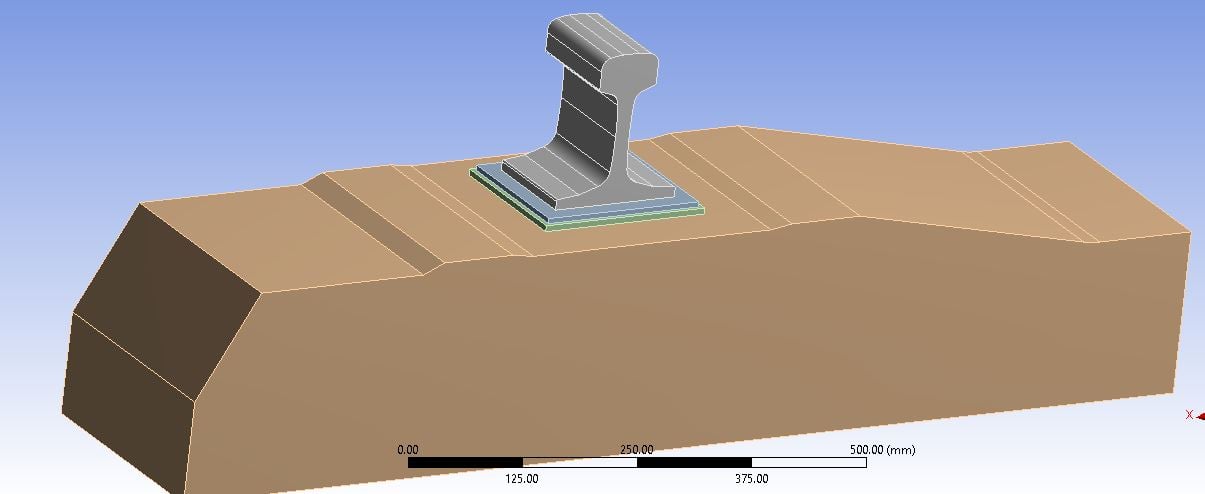
SubscriberPlease insert a diagram of the rail fastening system.
-
January 3, 2019 at 1:49 pm
jj77
SubscriberHiÂ
Not sure what you are trying to do exactly, but it looks like what you need is a moving load along the track. some software have this capability, but are more used for the design of bridges, say according to specific vehicle loads, and not for detailed 3D contact/stress analysis.
Â
In ansys perhaps the easiest way to do what you want is to use a rigid/flexible body for the wheel, and a flexible body for the rail and push it along the rail at (enforced displacement say), at different speeds, using a contact between the rigid body (wheel) and flexible body (rail).
Of course if the model is a large then this could take long time to solve.Â
Â
Thus if one does not care about the wheel, but just needs the force from the wheel on the rail, one could approximate it is a pressure force and apply it at different locations on the rail. See this link that shows how this can be done on a different structure. The ideas is the same though. (--
-- ) -

January 4, 2019 at 8:11 am
NTAKMAT
SubscriberThank you for the above video, it really helped me. but again i need to assign the speed of that moving load. And also give me the procedure to change the damping and stiffness coefficients of materials
-
January 4, 2019 at 9:26 am
jj77
SubscriberIn the above video the peaks in the time tables defined for the pressure forces will come at different times depending on the speed, so that is the way the speed comes in. Thus say the speed is 10 m/s, and we are applying a pressure force for the wheel load on a face at 10 m along the rail, then the peak pressure will be at 1 sec. If now the speed is 20 m/s instead, then the peak pressure there will occur at 0.5 sec. Hope this is clear.
Â
As for the damping, see a very good post from peteroznewman that explains how to set the damping in transient analysis:
/forum/forums/topic/material-damping-and-modal-analysis/
-
January 8, 2019 at 1:47 pm
NTAKMAT
Subscriber -
January 8, 2019 at 1:55 pm
-
January 13, 2019 at 10:56 am
NTAKMAT
SubscriberI am still waiting anyone to comment on my questions above. Thx
-
January 13, 2019 at 10:58 am
NTAKMAT
Subscriber -
January 13, 2019 at 7:04 pm
peteroznewman
SubscriberI would draw the following figure to create a model to represent the data in the table you show.
Only the Rail gets a mesh and its material properties are assigned as shown. The bottom of the rail has a translational joint with a spring with stiffness and damping to represent the Rail pad. The Sleeper is represented by a Point Mass on a translation joint connected to ground with a spring with stiffness and damping to represent the Ballast.
-
January 14, 2019 at 6:53 am
NTAKMAT
SubscriberI would like to model the rail pad as solid not as spring-damper. With the above suggestion cant work for railpad modeled as solid
-
January 14, 2019 at 1:59 pm
peteroznewman
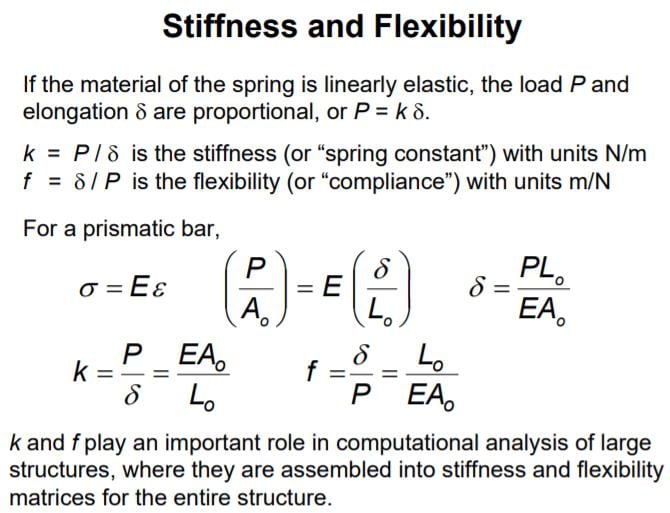
SubscriberYou can create a solid Rail pad, but you will have to calculate the value of Young's Modulus for the material assigned to the Rail pad to get the spring rate of the Rail pad equal to the value of Kp in the table when compressed by the area of the rail across the thickness of the Rail pad.
-
January 15, 2019 at 12:44 pm
NTAKMAT
Subscriberwhich king of formulas to be used?
-
January 15, 2019 at 1:00 pm
peteroznewman
Subscriber
Note that the length in your example is the thickness of the Rail pad, while the area is the contact area of the rail base to the pad, not the entire area of the pad. What advantage do you get from replacing the spring with 3D elements in the Rail pad? How are you going to represent damping?
The diagram I drew above was for the short length of rail supported by a sleeper. But the rail is unsupported between the sleepers, so you need a 3D model where you have this spring system every 30 inches along the length of a rail segment.
-
January 15, 2019 at 1:23 pm
NTAKMAT
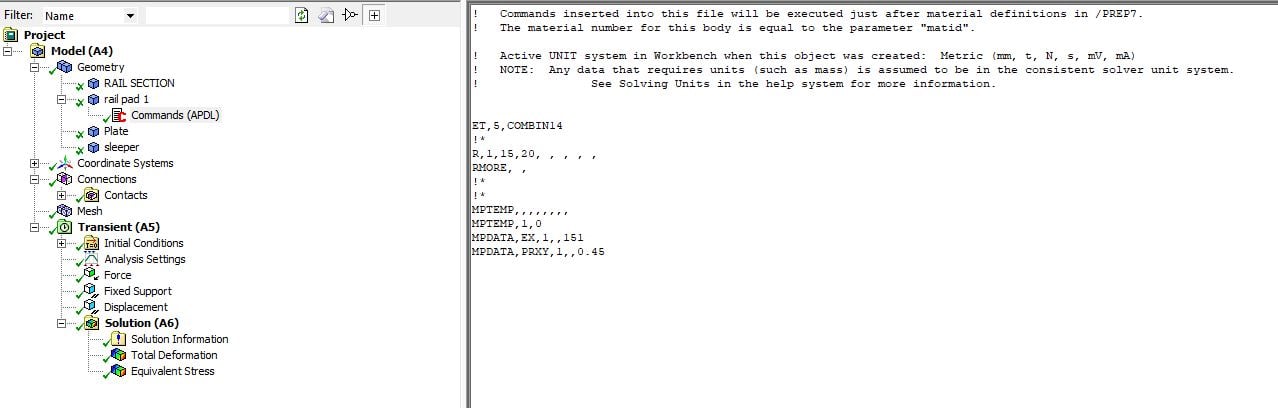
Subscriber1.I am trying to use the command to overlap the properties of railpad in material data sources. surprisingly when i change the material properties no changes for results. I dont know if i used the wrong method or not. any comment on this. Plz refer to the bellow image
Â
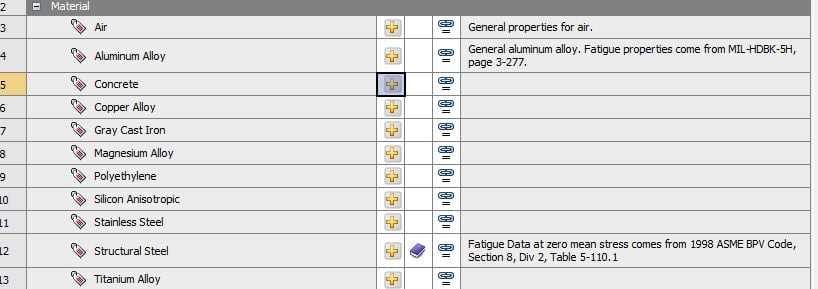
2.among the following materials which one should be selected for rail pad, or i should create new material?
Â
-
January 15, 2019 at 1:34 pm
NTAKMAT
Subscriber1.The advantages that i get in considering railpad as 3d model, the dimension of rail pad will be considered(lateral and longitudinal dimensions) and the contact between sleeper and rail will be considered also. but by considering railpad as spring-damper only the vertical direction is considered, and i believe that this may have impact on reproduction of vertical track dynamics
Â
2.How am i am going to consider damping constant that is the problem that i am facing, anyone who knows how do it, i will appreciate .
-
January 15, 2019 at 2:49 pm
peteroznewman
SubscriberCreate a new material in Engineering Data and set E to get the desired Kp. Don't use a command object under the body, just assign the new material to the body. You would use bonded contact of rail to pad and another bonded contact of pad to sleeper.
You can assign material damping to the material, but I don't know how to make that equal to the damping constant that was given in the table.
I see the advantage of a 3D model. So the sleeper needs to be a 3D body as well, but it could exist with the Behavior = Rigid instead of Flexible so that only the mass is taken into consideration, and you can have a translational joint to ground and a spring to ground to represent the ballast under the sleeper as I was describing above.
-
January 16, 2019 at 7:16 am
NTAKMAT
SubscriberIs there any disadvantages of using command object under body? cause is where u can set the damping constant and stiffness coefficient. The problem is that when i do that and change the damping constant the results dont change
-
January 16, 2019 at 1:58 pm
peteroznewman
SubscriberHere are three disadvantages to using a command object under a body compared with putting the property in Engineering Data.
1) You get the wrong answer if you change units! Command objects don't automatically update when the units change.
2) There is no feedback prior to the solve of a syntax error in your command object. Engineering Data has error checking.
3) There is no reuse of the data outside that one model. Engineering Data can be used in several models and one change updates all models.
When you say "stiffness coefficient" do you mean a number in kN/m? You can't set that on a solid body. That number is relevant to a spring element.
"The problem is that when i do that and change the damping constant the results don't change" What is the "that" that you are doing? Show what you have done in Engineering Data. What result doesn't change? Show all the details about that model.
-
January 17, 2019 at 8:58 am
NTAKMAT
SubscriberAs i have mentioned above i inserted the command under railpad object. I tried to change the values in that command to see if there is any change in the results. but surprisingly there was no change. Bellow is the command i used to overlap the material properties for railpad, so that the stiffness and damping coefficient can be considered in their units.
ET,1,COMBIN14Â Â
!*Â Â
KEYOPT,1,1,0
KEYOPT,1,2,0
KEYOPT,1,3,0
!*Â Â
R,3,100000,15, , , ,10,Â
RMORE, ,
!*Â Â
!*Â Â
MPTEMP,,,,,,,, Â
MPTEMP,1,0Â Â
MPDE,EX,1Â Â
MPDE,PRXY,1Â
MPDATA,EX,1,,100
MPDATA,PRXY,1,,0.49Â
-
January 17, 2019 at 12:30 pm
peteroznewman
SubscriberThis code is setting the element type to a spring, but that is not a valid assignment onto a solid element, that is only valid onto a spring element.
-
January 21, 2019 at 12:12 pm
Ashish Khemka
Forum ModeratorJust a comment - longitudinal spring element will offer resistance along the length only. So as Peter indicated - finding equivalent value for Young's modulus may be helpful.
Â
Regards,
Ashish Khemka
-
- The topic ‘How to make wheel move on rail with a certain speed in workbench’ is closed to new replies.
-
6379
-
1906
-
1457
-
1308
-
1022
© 2026 Copyright ANSYS, Inc. All rights reserved.