-
-
December 18, 2018 at 10:40 am
DanWood93
SubscriberHi,
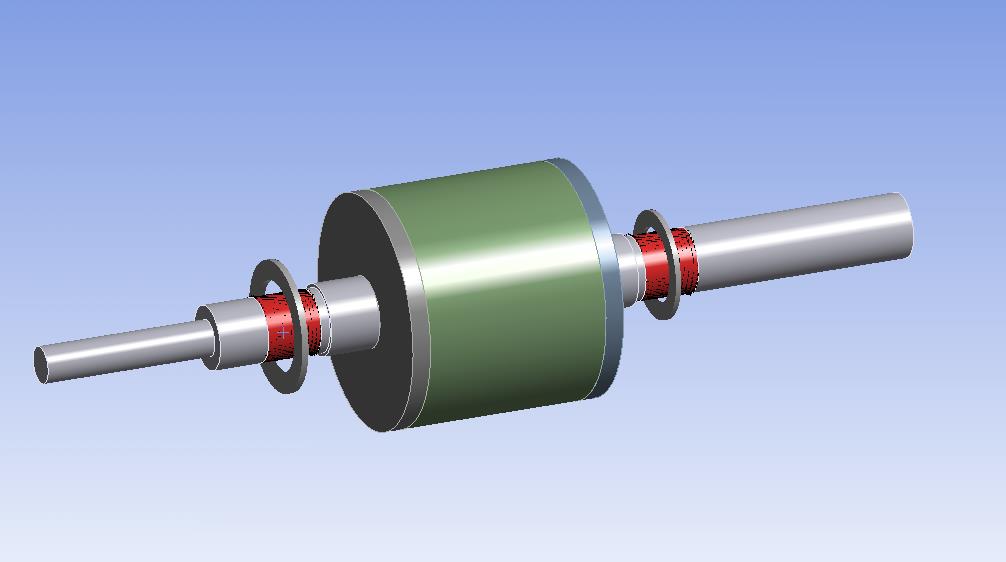
I have set up a simulation of a high-speed machine rotor that I have designed. The rotor rotates about the z-axis and has no lateral movement about that axis.
I am wanting to investigate critical speeds and understand if the rotor will be stable at 100 krpm.
I am wondering if the remote displacements x,y,z components and x,y,z rotation components are set up correctly?
Also, any advice to improve the model would be great.
Kind regards
Dan
-
December 18, 2018 at 5:34 pm
peteroznewman
SubscriberDan,
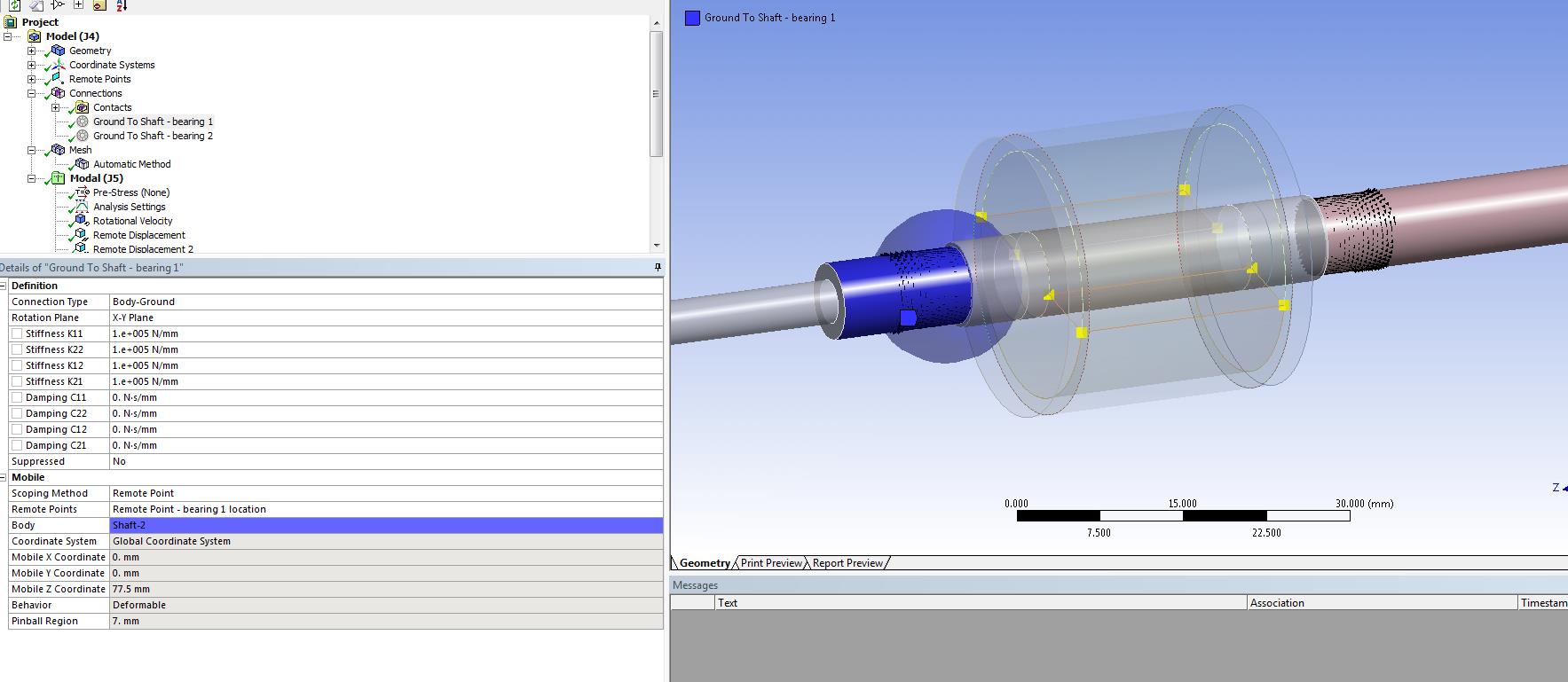
Here is the image from your PDF file.
If the red faces represent where the Bearings are scoped to, that seems like it is much longer than the physical bearing width. If that is true, you should go into the Geometry editor (SC or DM) and split the face so that you have a face width equal to the bearing width, and scope each Bearing to one of those narrower faces.
Regards,
Peter -
December 19, 2018 at 12:46 pm
DanWood93
SubscriberI have used a remote point in the bearing scope however the remote point is scoped to the face but is at a particular z coordinate. Would you recommend I split the shaft at the bearing location (the split width equal to the bearing width) and then use that face as the scope for the remote point? (the z coordinate for the remote point would then be in the centre of that split).
-
December 19, 2018 at 4:51 pm
peteroznewman
SubscriberDan, though the remote point is at a specific coordinate that places it at the center of a bearing, a spiderweb of constraint elements radiate out from that point to the entire face that the point is scoped to. One setting for a Remote Point is Rigid, which would add erroneous stiffness to the shaft if the face is much, much wider than the bearing seat. That is the reason I recommend splitting the face so that the Remote Point is only scoped to a face equal in width to the bearing.
Regards,
Peter
If this answers your question, click the Is Solution link below to show the discussion is Solved, or reply with a follow-up question.
-
January 2, 2019 at 8:39 am
-
January 2, 2019 at 7:24 pm
peteroznewman
SubscriberThat looks much better Dan. Are there any other masses attached to the shaft? Gears? Turbine Blades? All the mass needs to be in the model. Are you going to introduce a small imbalance? If the forces through the bearings become significant, the housing or base of the machine could deform, adding to the flexibility of the system.
-
January 3, 2019 at 8:00 am
DanWood93
SubscriberThe rotor is for a prototype high-speed electrical machine and the testing of the machine will only be done to check the electromagnetic performance so the only mass the bearings are required to suspend is the mass of the rotor itself.
I can try adding a small imbalance however I have never done so before, what are your recommendations to do so?
-
January 3, 2019 at 12:59 pm
peteroznewman
SubscriberYou can add a point mass scoped to one of the circular edges along the rotor. It will snap the point on the axis, but then you can edit the coordinates of the point and move it slightly off axis.
-
January 8, 2020 at 10:24 am
DanWood93
SubscriberHi,
Are you able to recommend a stiffness and damping coefficient for angular contact ball bearings?
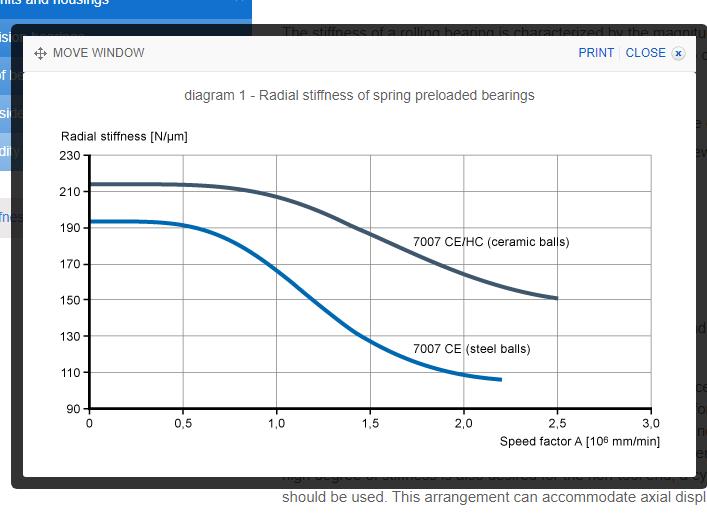
The speed factor for the bearing is (7+19)/2*100,000 = 1.3e6 and from the SKF website they do provide some information on stiffness, i was wondering if you could shed some light on this and damping coefficients
-
January 9, 2020 at 2:40 am
peteroznewman
SubscriberHi Dan,
I don't have any advice other than to get information from the bearing manufacturer, which you are already doing.
Good luck.
Peter
-
- The topic ‘Rotor dynamics of a high speed shaft assembly’ is closed to new replies.
-
5994
-
1906
-
1425
-
1307
-
1021
© 2026 Copyright ANSYS, Inc. All rights reserved.
.pdf---adobe-acrobat-reader-dc.jpg?width=690&upscale=false)