Hello everyone,
I would like to run a Full Transient simulation with a constant damping ratio.
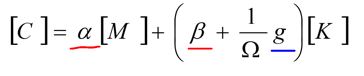
In the analysis settings, only Rayleigh damping is offered in terms of [Betad] and [Alphad] commands, which are computed from two (main) frequencies of the system. This damping declaration is not useful for my study case, as it originates underdamped and overdamped regions.
Structural damping [DMPSTR] (or [DMPS] for multiple materials), as well as the Damping coefficient ratio [DMPR], can also be considered by the solver by specifying the [DMPRFreq] command. However, once again these are depending on the dominant frequency of the system.
Could anyone make the implementation of this constant damping ratio clear to me? I think I am missing something here, I would expect this declaration to be straightforward, such as the case of the Transient Analysis with Modal Superposition, where a constant damping coefficient [DMPRAT] can be chosen directly in the damping controls.
Thank you in advance. I would appreciate any input regarding this matter.
Best,


















 You are navigating away from the AIS Discovery experience