-
-
October 26, 2018 at 5:39 am
jhjang
SubscriberHello everyone,
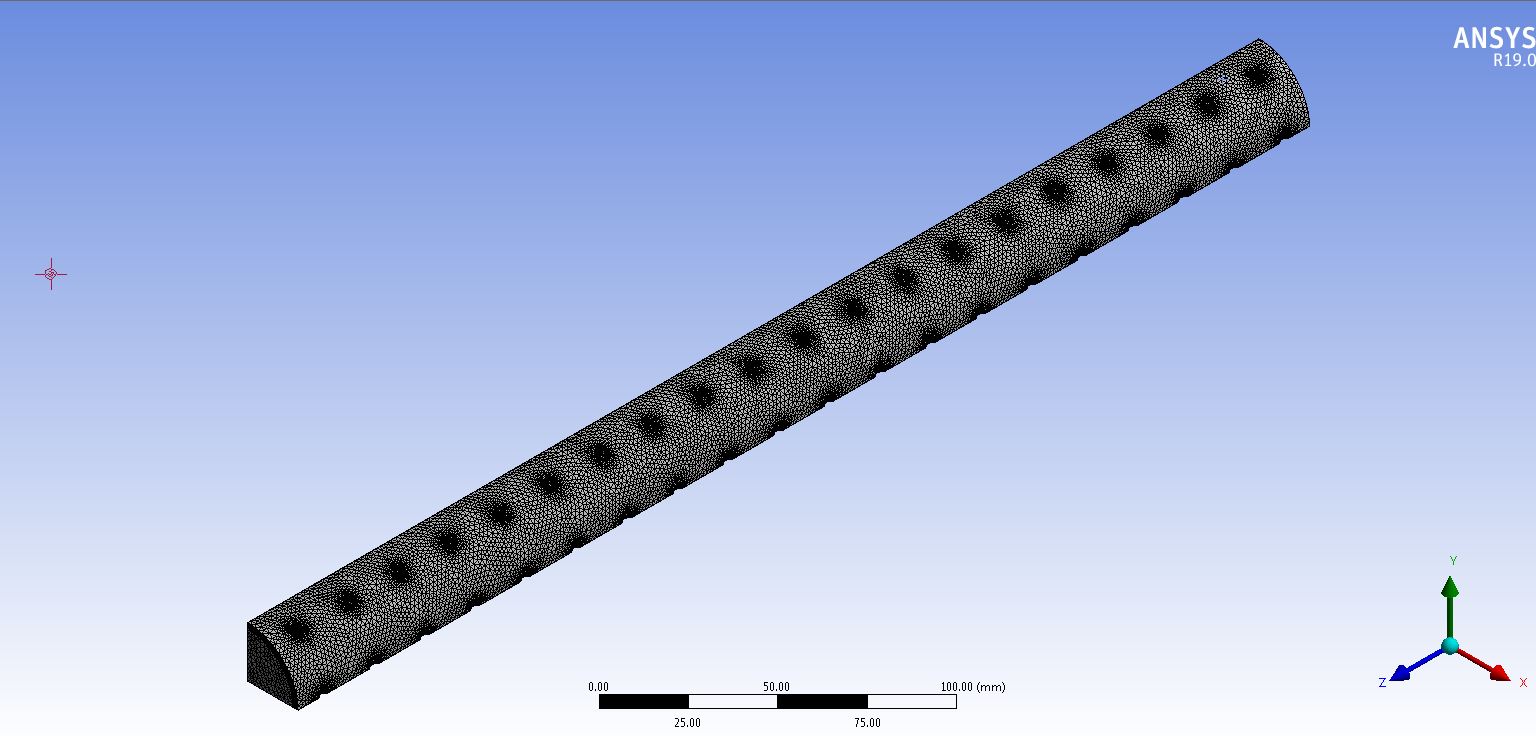
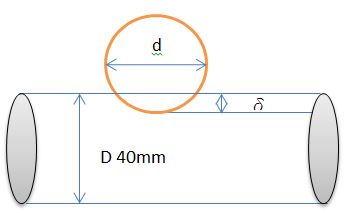
I am trying to simulate 3D laminar developing flow and heat transfer in dimple enhanced pipe. The details are
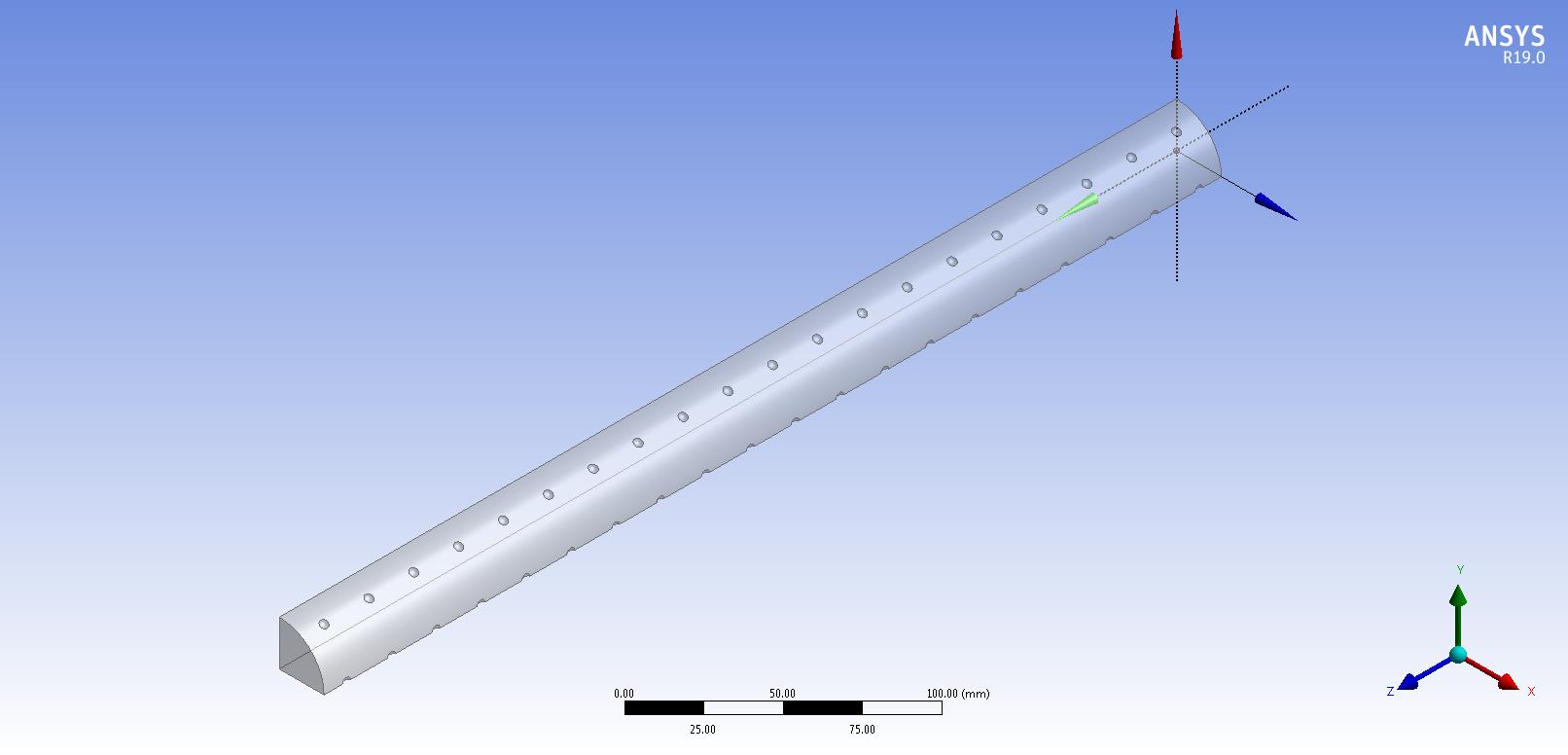


Mesh
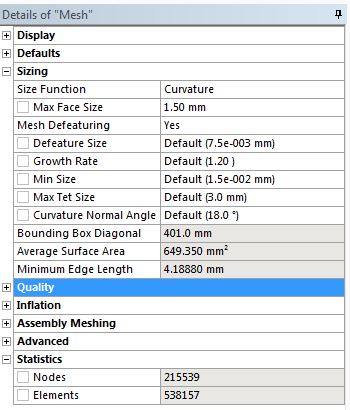
Tetrahedral mesh, 5 inflation layer on the wall
Model: Laminar
Material: Air
Boundary conditions:
Velocity inlet
Pressure outlet
Constant wall heat flux= 50w/m^2
Reference value: length 0.04m
Residual: 10^-4 for all except energy 10^-6
Results
When I calculate Nusselt number in this way…
Surface integral Area-weighted average wall fluxes Nusselt number & Skin friction factor, I feel these results are not in the right pattern...
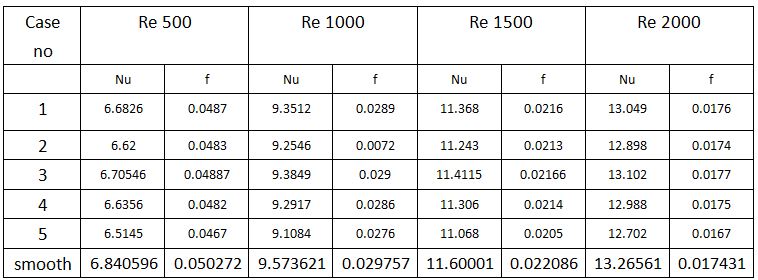
here the trend of results for both Nu and skin friction is in opposite order.
Please help me to calculate local and average Nusselt number and friction factor.

-
October 26, 2018 at 5:53 am
DrAmine
Ansys EmployeeAre you using the skin friction coefficient and Nusselt number from Fluent? Here you need to tune the reference values to match your case.
-
October 26, 2018 at 5:58 am
DrAmine
Ansys EmployeeRegarding the results we can only make an evaluation if you clarify the way you obtained the quantities. But the simple Reynolds Analogy tells that the Stanton number is half of the Friction coefficient.
-
October 26, 2018 at 8:27 am
jhjang
SubscriberThank you, sir,
yes, I am using skin friction factor and Nu number from fluent. Will the reference value change for the enhanced pipe? I use the pipe diameter for both smooth and enhanced pipe as the reference length and inlet area as the reference area during setup.
-
October 26, 2018 at 9:14 am
jhjang
Subscribersir, I am attaching my mesh and case and data file.
case 2 Re 1000 case and data file
https://drive.google.com/open?id=15ryhMiw8z8LkBYDsukVIA9l_htz-ynUX
case 2 mesh file
https://drive.google.com/open?id=1fymWAOxYAgDbEty7M0rk0nVZe_6uk0rr
-
October 26, 2018 at 9:42 am
DrAmine
Ansys EmployeeYes the reference values are use to calculate the dimensionless number like L_ref, v_ref, roh_ref....Just check the manual.
I apologize but as ANSYS Stuff I won't look into the cases you are sharing. Be aware that you are sharing files on an open community.
-
October 26, 2018 at 9:58 am
jhjang
SubscriberIs there any formula for laminar developing flow to calculate HTC, Nu?
Because i see some resources using (h=Q"/area*(tw-tm)), where Tw using maximum temperature at the wall and Tm as mass weighted avg. temperature
"(integration(velocity*temperature*radius)/integration(velocity*radius)) " at axial location z.
Is this formula for HTC be applicable to the laminar developing case?
-
October 26, 2018 at 10:59 am
DrAmine
Ansys EmployeeThe reference temperature to calculate HTC is always case dependent and might also depend on whehter you have exp. data or other cross-references. I generally use a mass-weighted Average of the temperature at the cross-section at position X where I want to get HTC. Others uses the inflow temperature or volume weighted temperature..
-
- The topic ‘HTC Nu and f’ is closed to new replies.
-
6450
-
1906
-
1457
-
1308
-
1022
© 2026 Copyright ANSYS, Inc. All rights reserved.