-
-
October 10, 2018 at 4:42 am
prashant
SubscriberI WANT TO SIMULATE THE FLOW OF LIQUID NITROGEN THROUGH A NOZZLE, I AM FACING DIFFICULTY IN INCORPORATING PHASE CHANGE MECHANICS WHEN LIQUID NITROGEN IS INSIDE THE NOZZLE AS WELL AS WHEN IT IS COMING OUTSIDE.
-
October 10, 2018 at 5:18 am
Amine Ben Hadj Ali
Ansys EmployeeWhich solver are you using? Which models are you deploying?
-
October 10, 2018 at 7:48 am
seeta gunti
Ansys EmployeeHello Prashant,
We have multiple video tutorials on phase change in You tube. I recommend to go through them also very difficult to understand your problem with not much information on problem description. You can add few images describing your geometry and modeling aspects.
-
October 17, 2018 at 5:47 am
prashant
Subscriberthanks for you kind supportÂ
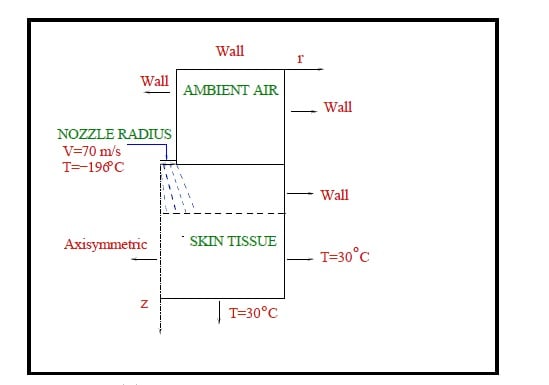
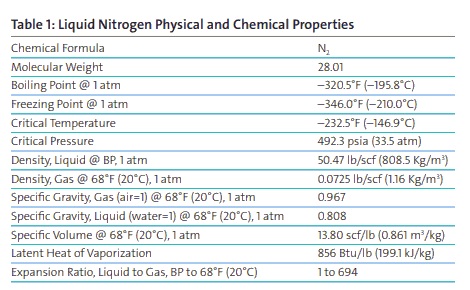
i am attaching the geometry and propertiesÂ
kindly specify how to model this,i have planned to use second order upwind, with pressure correction scheme.k-epsilon turbulence model and energy equation would be solved simultaneously.is their anything else required?nozzle hole is 0.8 mm.


-
October 17, 2018 at 9:10 am
Rob
Forum ModeratorYou're going to need a very fine mesh and small timestep for this as the liquid is going to flash boil. Start with an isothermal VOF jet to understand the mesh requirements and progress from there. As Seeti mentions we have phase change tutorials, and you also want to look at the VOF model: read up on the Fluent documentation too as you need to understand the model limits and requirements.Â
-
October 17, 2018 at 11:56 am
Karthik Remella
AdministratorHi Prashant,
Just to add to rwoolhou's comments, you can use the k-Eps turbulence model to solve your problem. However, I do not think that is going to be the bottleneck. As mentioned by rwoolhou, you will have to check if you are getting reasonable results using VOF. Getting your VOF model up and running will take some effort.
I'd strongly recommend a literature review before jumping into the model. You might get some test problems to play with before attempting to solve your problem - just to get the ball rolling in the right direction.
please let us know if you have any additional questions.
Best Regards,
Karthik

-
December 19, 2018 at 3:12 pm
prashant
SubscriberI am using VOF(3 phases liquid nitrogen, water, air) along with solidification and melting model, keeping k-epsilon for turbulence, but since the velocity at inlet is 70 m/s ,so I have to choose very low time step(0.0000001) in order to satisfy the courant number. Refining mesh increase the computation time. Selecting implicit scheme (in VOF) is not giving the proper result. SUGGEST ANY REMIDY TO DECRESE THE COMPUTATION TIME.
WHY CAN'T WE USE IMPLICIT WITH VOF?
-
- The topic ‘REGARDING TWO PHASE FLOW’ is closed to new replies.
- air flow in and out of computer case
- Varying Bond model parameters to mimic soil particle cohesion/stiction
- Eroded Mass due to Erosion of Soil Particles by Fluids
- I am doing a corona simulation. But particles are not spreading.
- Issue to compile a UDF in ANSYS Fluent
- Guidance needed for Conjugate Heat Transfer Analysis for a 3s3p Li-ion Battery
- JACOBI Convergence Issue in ANSYS AQWA
- affinity not set
- Resuming SAG Mill Simulation with New Particle Batch in Rocky
- Continuing SAG Mill Simulation with New Particle Batch in Rocky
-
4522
-
1494
-
1386
-
1209
-
1021
© 2025 Copyright ANSYS, Inc. All rights reserved.