-
-
August 21, 2018 at 10:55 am
student_18
SubscriberHi,
I want to simulate a transient two-phase flow with VOF in porous media considering capillary action. The porous zone is initially filled with air. I want to model the displacement of air with liquid water due to capillary forces. My main interest is the degree of wetting and the spreading of the wetting front. How to model capillary effects in the porous zone?
Best regards
-
August 21, 2018 at 11:02 am
DrAmine
Ansys EmployeeIn the Eulerian Model the Capillary Pressure and wetting effects are taken into account as an additional source term for the wetting phase momentum equation.
-
August 21, 2018 at 11:30 am
student_18
SubscriberThank you. When using Eulerian Model my calculation diverges after several time steps. Using VOF the calculation has no stability problems. What could be the reason? Might the same mesh be acceptable for VOF but not for Eulerian?
-
August 21, 2018 at 12:19 pm
DrAmine
Ansys EmployeeEulerian Model is more general than the VOF model and requires baby sitting of the closure laws for drag, etc. The Eulerian Model allows for slip by solving additional transport equations
You can still use the VOF model but needs to incorporate what is missing via UDF.Â
-
August 21, 2018 at 1:18 pm
student_18
SubscriberThanks, I would then like to try using UDF with VOF. If I understand that right, I define a momentum source term through DEFINE_SOURCE for the wetting phase. The source term must consider the capillary pressure and permeability both depending on the saturation. But as I am new to UDF, it is not exactly clear to me how to write the UDF. Do you have any tips or good examples?
Best regards Â
-
August 21, 2018 at 2:09 pm
DrAmine
Ansys EmployeeYou can check the Student Resources, customization manual and try to attend a UDF training.
-
August 21, 2018 at 3:10 pm
Karthik Remella
AdministratorHello,Â
Just to add to abenhadj's comments, the Fluent customization manual is extremely extensive. It contains numerous examples. UDFs mainly make use of User Defined Macros. The best way to get used to writing UDFs is to take an existing UDF and modify it. You might have to go through additional debug. You can always reach out to us at the student community if you need additional help about various macros.
Good luck with your modeling.
Best Regards,
Karthik
-
March 1, 2019 at 4:01 am
AstroJZ
Subscriber
Hello,Â
Just to add to abenhadj's comments, the Fluent customization manual is extremely extensive. It contains numerous examples. UDFs mainly make use of User Defined Macros. The best way to get used to writing UDFs is to take an existing UDF and modify it. You might have to go through additional debug. You can always reach out to us at the student community if you need additional help about various macros.
Good luck with your modeling.
Best Regards,
Karthik
Â
Hi Kathik,
Â
I am doing simulation of multiphase flow and I would like to include capillary pressure as source term in liquid phase by UDF. How can I do it?
Â
Thanks,
Â
Astrojz
-
April 25, 2020 at 8:09 pm
Hoss
Subscriber
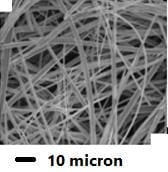
As shown, my media is made of entangled fibers. First, the void space between fibers is filled with water. However, in oil vicinity, oil pushes the water out and is wicked into the microchannels (due to capillary force and lipophilicity of the fibers).
Can I simulate this via porous media? I want to calculate wicking rate of oil.
Thank you!
Eulerian Model is more general than the VOF model and requires baby sitting of the closure laws for drag, etc. The Eulerian Model allows for slip by solving additional transport equations
You can still use the VOF model but needs to incorporate what is missing via UDF.Â
-
October 1, 2020 at 5:08 am
vikash0603
SubscriberI want to simulate a transient two-phase flow with VOF in porous media considering capillary action. The porous zone is initially filled with air. I want to model the displacement of air with liquid water due to capillary forces. My main interest is the degree of wetting and the spreading of the wetting front. How to model capillary effects in the porous zone?n -
October 1, 2020 at 10:49 am
Rob
Forum ModeratorHave a look at the Corey model, otherwise you'll either need to model the structure itself or use a UDF. n -
October 9, 2020 at 1:54 am
vikash0603
SubscriberHinHow to add more than one wetting phase in corey model Ansys fluent? n -
October 13, 2020 at 11:20 pm
vikash0603
SubscriberHinjust let me know how to add more than one wetting or non-wetting phases in that model ? As, I can see we have only one wetting / non wetting phase available in drop down list. In the eulerian model I added three phase(air, water and oil). I want to add air as a primary phase, water and oil as a secondary phase. n -
October 14, 2020 at 9:31 am
Rob
Forum ModeratorYou'll need a UDF for that, the model was added to allow reservoir models to be run but we didn't extend it to cover many phases. n
-
- The topic ‘Fluent: How to model capillary driven flow in porous media model?’ is closed to new replies.

-
6710
-
1906
-
1469
-
1313
-
1022
© 2026 Copyright ANSYS, Inc. All rights reserved.