-
-
June 3, 2023 at 7:51 pm
manuel.pacherres
SubscriberBuenas tardes a todos.
Tengo un problema al hacer la simulación de mi intercambiador de calor con 4 pasos a través de los tubos y uno a través de la carcasa. Para este caso quiero validar algunos datos experimentales. El fluido frÃo que en este caso es agua entra por el lado de los tubos a una temperatura de 22,5°C y con un caudal másico de 0,29 kg/s. Mientras que por el lado de la carcasa entra vapor a una temperatura de 105° con un caudal másico de 0,01898 kg/s. El diámetro interior del tubo de entrada de vapor es de 40,89 mm, mientras que el diámetro interior del tubo de entrada de agua es de 20,93 mm. Lo que sucede es que viendo que el flujo del fluido caliente (vapor) y su mayor diámetro en relación a la entrada de agua; este fluido caliente acaba calentando rápidamente todo el fluido frÃo, que tras el primer paso ya no tiene variación de temperatura y se puede observar que permanece constante. De igual manera calienta hasta la cabeza por donde entra el fluido frÃo (agua), a lo cual no le veo explicación, ya que la coraza se considera adiabática. Estoy obteniendo temperaturas de mas o menos 80°C para ambas temperaturas lo que me parece demasiado si lo comparo con los datos experimentales, que me da una temperatura de salida del agua de 68°C para vapor y 60°C para agua, o al menos resultados cercanos a ellos. Además, veo incoherente que el vapor calienta rápidamente el fluido frÃo en los tubos, sin embargo, como se muestra en la figura, el vapor se enfrÃa a lo largo de su paso por la carcasa y los deflectores de manera coherente, pero su temperatura de salida es de todos modos muy lejos. acercarse al resultado experimental. Estoy activando la gravedad en el eje Y, considerando el modelo de turbulencia KW, que solo estoy considerando como prueba, pero al menos deberÃa darme un resultado cercano. O ¿bajo qué condiciones debo ingresar mis condiciones de contorno?. ¿Debo considerar alguna presión manométrica o debo considerar alguna temperatura de regresión?. Alguien por favor ayúdeme a salir de este problema.
Â
Â
-
June 5, 2023 at 5:53 am
Nikhil N
SubscriberHello,Â
Â
Could you please continue running the simulation for some more iterations? It seems that the residuals are still higher than desired.
Just curious: How are you accounting for latent heat of steam, if it is anticipated to undergo condensation.
-
June 5, 2023 at 7:48 pm
manuel.pacherres
SubscriberThen for this case, the latent heat can be accounted for by means of the following equation:
Q= mh* hfg+ mh ch(Tsat-Toutlet,hot)
Where:
mh: Hot fluid mass flow rate
hfg: Enthalpy of vaporization
ch: specific heat of the hot fluid
Tsat.: saturation temperature
Toutlet,hot: hot fluid outlet temperature
-
June 5, 2023 at 7:49 pm
manuel.pacherres
SubscriberThank you very much, I will run more iterations and give you the feedback.
-
June 6, 2023 at 4:15 am
Nikhil N
SubscriberHow are you incorporating it into the simulation? Are you adjusting the material properties based on temperature, employing any user-defined functions (UDFs), or explicitly modeling condensation?
-
-
June 6, 2023 at 1:39 pm
manuel.pacherres
SubscriberWell, that was also a little bit my doubt, since I am just starting with Ansys.
What I am doing is at the moment of choosing my material in the Ansys library, is practically changing the properties of the steam according to the temperature at which it is entering and in the same way in the boundary conditions I am placing the saturation pressure according to its temperature. Would that be correct?
And I would have to do the same for water entering at 22.5 °C? That is to say, place the properties of the water at that temperature? Emphasizing that I am going to place the water at room temperature.
Thanks in advance. -
June 6, 2023 at 1:45 pm
manuel.pacherres
SubscriberÂ
Regarding condensation also, if I wanted to model it explicitly I would have to leave the material with the standard properties that the Ansys library offers me?
As for the UDF I have been able to see something about it and I think it has to do with a bit of programming language, and it is something I am digging into a bit more now.Â
But for now I'd like to try the more practical means. -
June 19, 2023 at 1:47 pm
manuel.pacherres
SubscriberHello, good morning.
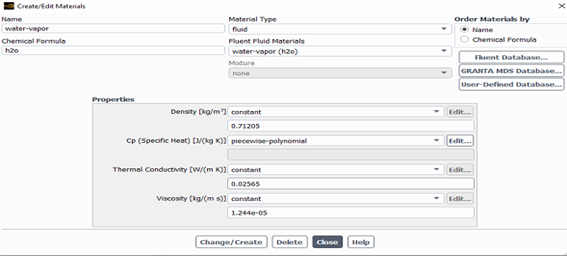
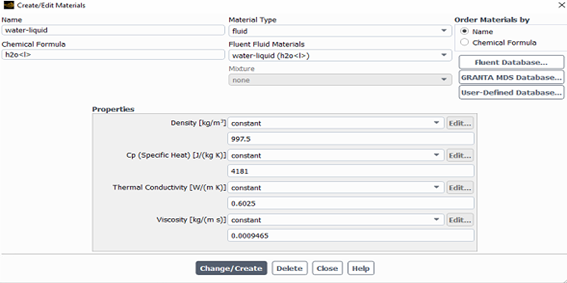
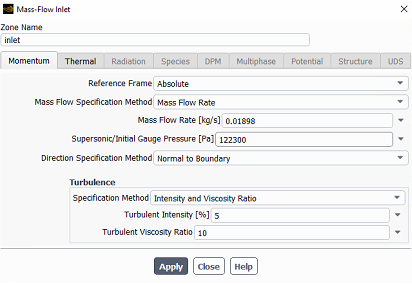
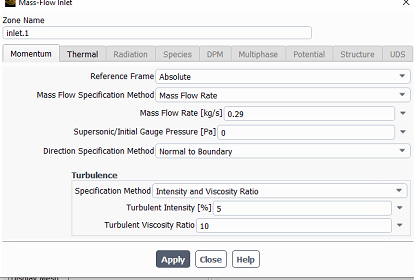
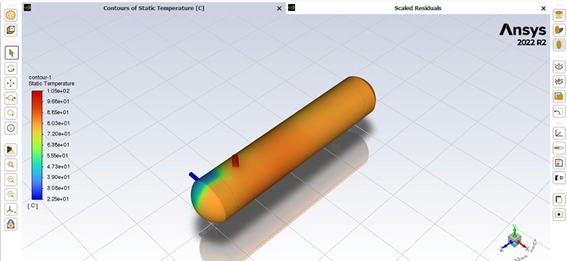
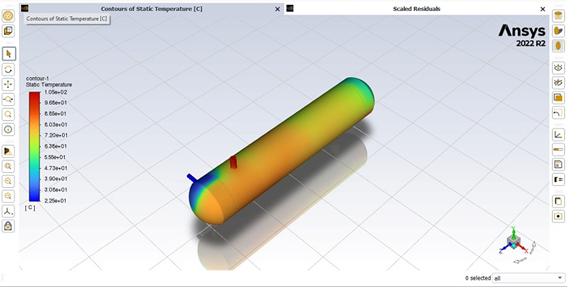
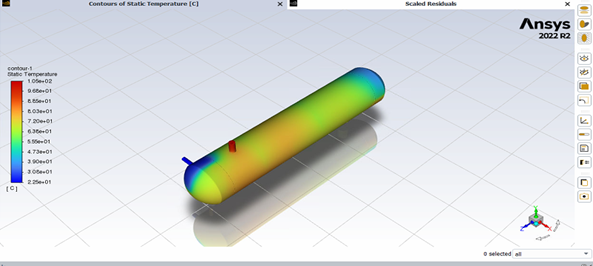
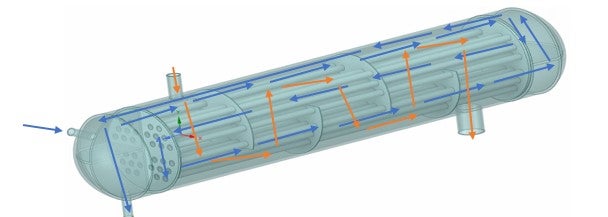
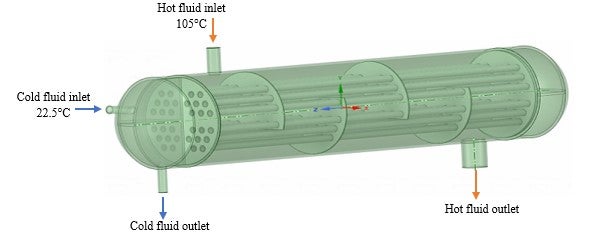
I managed to perform more iterations under the specifications for the materials (according to thermodynamic tables) and the boundary conditions that can be seen in figure 1, figure 2, figure 3 and figure 4 for water and steam.
For water entering at 22.5°C at ambient pressure and steam entering at 105°C with its saturation pressure.ÂWith 300 iterations, the result is a steam outlet temperature of 76°C and water outlet temperature of 80 °C. With 500 iterations a steam outlet temperature at 75°C and water at 80°C.Â
With 700 iterations a steam outlet temperature at 71 °C and water at °C. With 1000 iterations a steam outlet temperature at 64 °C and water at 79 °C.
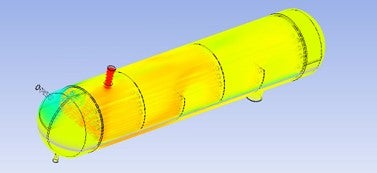
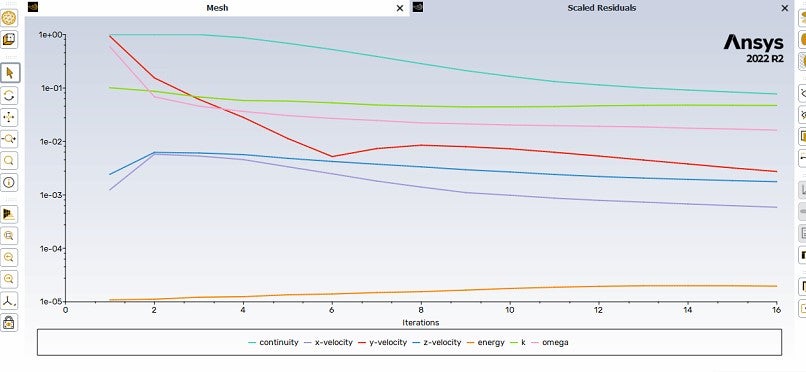
Where it can be seen that already with 1000 iterations my problem does not converge (in figure 5 I attach the image of my residual). It can also be seen that the heat exchanger changes temperatures significantly (figure 6, 7 and 8), but more on the steam side than on the water side. While in the steam temperature I have a variation of 18°C (it varied more or less from 82°C to 64°C); on the water side I have only a variation of 1°C in all iterations (it varied from 80 to 79°C).Â
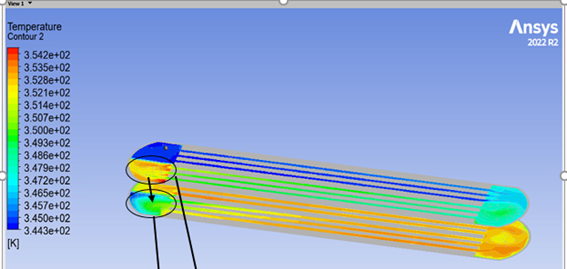
I would like to know if the phenomenon that is occurring in relation to this variation is coherent or not? Anyway I will continue with the iterations, but I don't know how many more iterations I have to do to make the problem converge?Also in Figure 9, which is a view of the heat exchanger in CFD-POST, you can notice that at the end of the second step and to start the third step, the colors of the temperature contour change as can be seen inside the circles, as if it were cooling, for which I made a measurement of both temperatures but the temperatures of both sides are the same. But I would like to know if regardless of the colors that you have in the visualization and also have the same temperatures, that is consistent?
I hope you can help me
ÂFigure 1
Figure 2
Figure 3
Figure 4
Figure 5
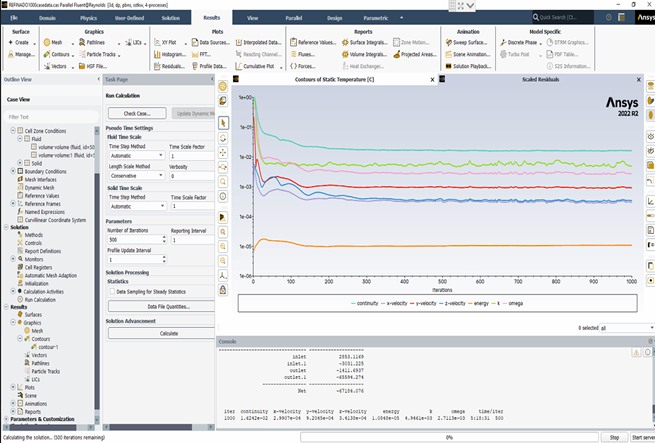
Figure 6Â
Figure 7Â
Figure 8
Figure 9Â
-
June 19, 2023 at 2:39 pm
Nikhil N
SubscriberHello,
Â
1: Please be aware that the specific heat of steam differs (is less) from that of water, and steam's temperature is more sensitive to heat transfer.
2: Regarding the steam side, I would suggest investigating condensation by either explicitly modeling multiphase phenomena or by varying the properties. Based on my understanding of your situation, the steam at the outlet, which is at 76°C, is still in vapor form (with steam properties). This representation may not accurately depict the phenomenon.Â
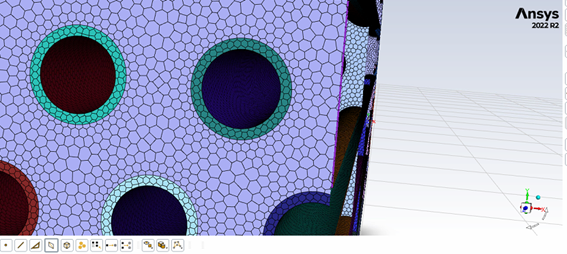
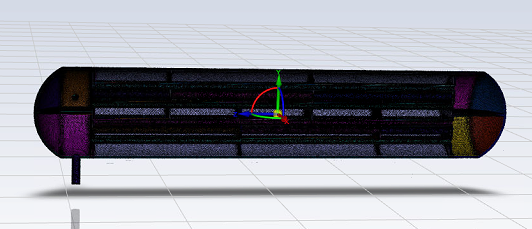
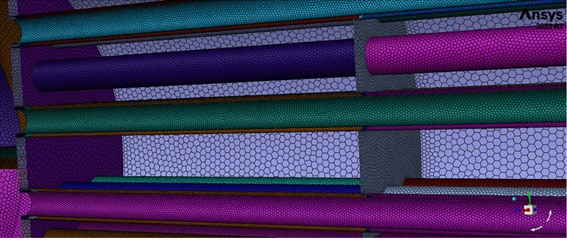
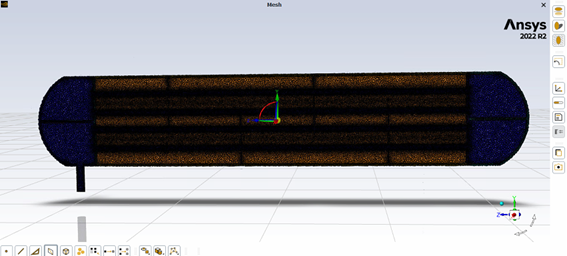
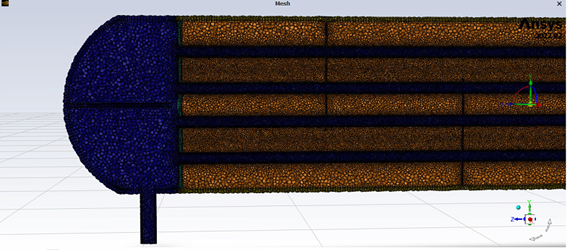
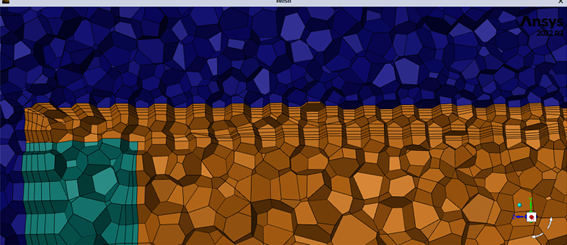
Question: Are you conducting a Conjugate Heat Transfer (CHT) simulation? In other words, have you meshed the pipes to account for their thickness? Can you also share some snippet of the mesh. -
June 19, 2023 at 2:39 pm
Nikhil N
SubscriberRegarding convergence, it depends on multiple factors such as mesh quality, solution methods, and sometimes the actual physics is complex enough to take time to converge. In addition to monitoring residuals, I would recommend also monitoring mass and heat imbalances in the system.
-
June 25, 2023 at 1:52 am
manuel.pacherres
SubscriberGood evening
Thank you very much for the recommendation, I will investigate and try to model a condensation case.
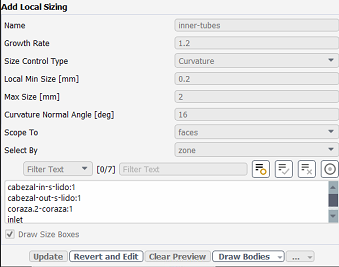
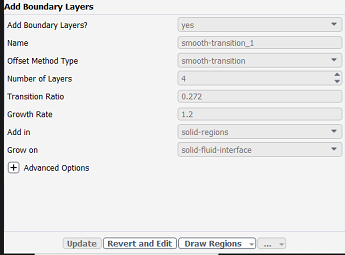
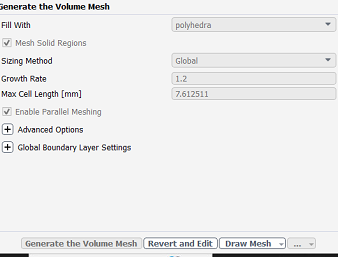
And well regarding point number 3, yes, I am performing a conjugate heat transfer analysis, that is my goal. Regarding the meshing the only thing I did was a local curvature sizing to generate my surface mesh, and to generate my volume mesh I applied to the geometry as a whole, boundary layers with a smooth transition scheme, added to the solid regions, with growth at the solid-fluid interface. Below you can see in the images the above mentioned. Question, what condition should I add to the pipe in this case, to take into account its thickness? And the boundary layer condition to which parts of my geometry should I add it?Â
Â
Â
Â
Â
-
June 25, 2023 at 1:55 am
manuel.pacherres
SubscriberJust to point out that up to the 1000th iteration, the output of my hot fluid (steam) is 64 degrees Celsius.
-
- The topic ‘Heat transfer analysis’ is closed to new replies.
-
6660
-
1906
-
1469
-
1313
-
1022
© 2026 Copyright ANSYS, Inc. All rights reserved.