TAGGED: aqwa
-
-
June 3, 2023 at 8:48 am
Saifeldin Eid
SubscriberHello,Â
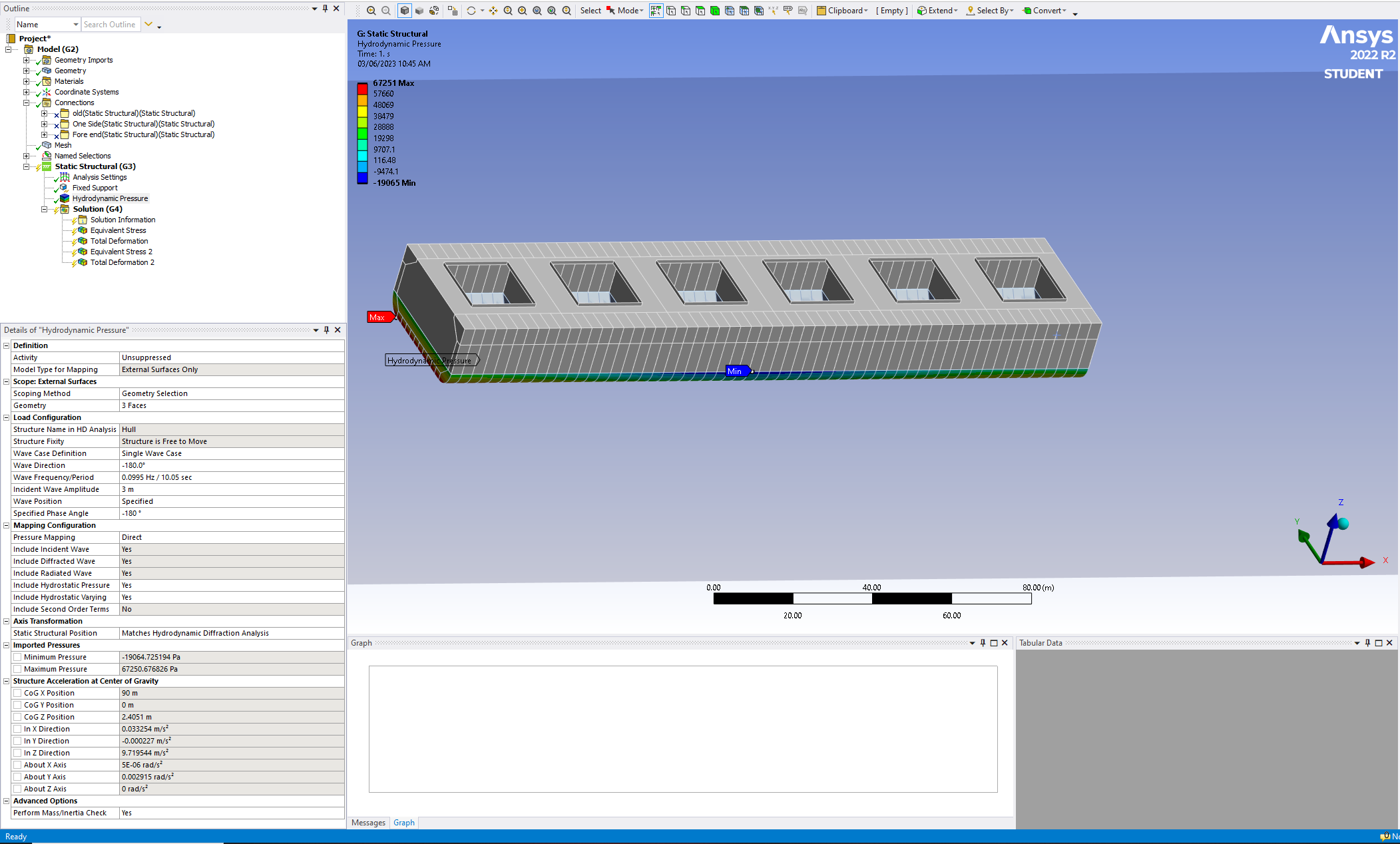
I am doing a simulation on a bulk carrier using AQWA (Hydrodynamic diffraction module) to map the loads in Mechanical. However, when I insert the Hydrodynamic pressure tool and set the frequency corresponding to the ship's length, I get an acceleration (gravity) acting on the center of gravity in the positive Z direction (upwards). If I don't include the hydrostatic pressure loads I don't seem to get this acceleration. My goal is to ultimately have a representation of the hogging and sagging loading conditions on the ship, but currently the acceleration makes it that my structure is moving upwards. Also when I turn off the Perform mass/inertia check I still get the same acceleration. Is there a way to include the hydrostatic pressure and disregard the acceleration caused so that I could represent both load cases mentioned above?
-
June 7, 2023 at 2:02 pm
Mike Pettit
Ansys EmployeeHello,
When hydrostatic pressure is included in the load mapping, it is assumed that the resultant buoyancy force will be balanced by the weight of the vessel. This is why gravitational acceleration is automatically added to the RAO-based acceleration calculated by Aqwa. Otherwise, the vessel weight will be zero, but the buoyancy will be large, causing a resultant acceleration in the positive Z direction.
If your vessel experiences any acceleration in the Static Structural analysis (with or without the hydrostatic term included), this may indicate that the structural mass properties (total mass, COG position, inertia terms) are not consistent between the hydrodynamic and structural models. You should modify the mass definition in one of the systems so that the mass properties are consistent.
Bear in mind that the hydrodynamic pressure mapping always includes some loss of accuracy due to the mapping method, so it is unlikely that you will get an exact force balance in the structural analysis. You should always expect a force reaction at any boundary conditions (fixed support, weak springs etc) but for a freely-floating vessel this should be small compared to the vessel's weight.
I hope this helps.
Mike

-
June 8, 2023 at 7:12 am
Saifeldin Eid
SubscriberHello Mr. Mike,Â
Thank you for your clarification. As you explained, it turns out that the structure's mass is much lower than that computed by aqwa to ensure that the forces are balanced. Adding a point mass in Static Structural equal to the difference between the two masses solved my problem. Thank you again for you assistance.
Best,
Saifeldin Eid,
-
- The topic ‘Hydrodynamic Load Mapping’ is closed to new replies.
-
5869
-
1906
-
1420
-
1306
-
1021
© 2026 Copyright ANSYS, Inc. All rights reserved.