Ansys Assistant will be unavailable on the Learning Forum starting January 30. An upgraded version is coming soon. We apologize for any inconvenience and appreciate your patience. Stay tuned for updates.
Photonics

Photonics

Topics related to Lumerical and more.

Conversion of FDTD far field simulation data into spherical coordinates issues

    • P Nair
      Subscriber

      I have a question related to the conversion of E(ux,uy) data set to spherical coordinates. I have FDTD far-field simulation results E(ux,uy), which is 200x200 matrix data and I need to know how to convert into spherical coordinates r, theta, & phi So that we can extract the data and plot as polar plots in origin. I tried the far-field spherical command line here:https://optics.ansys.com/hc/en-us/articles/360034410194-farfieldspherical-Script-command , but it is not useful for the 200X200 matrix data. As this command line will plot for only one angle, phi=0 for example , at a time. So, it is not possible to generate data for phi= 0 to 360 at a time and convert it into spherical coordinates. Could you please suggest further regarding this?

    • Guilin Sun
      Ansys Employee

      If you pourpose is to visualize the farfield, no need to convert to theta, phi;

      If you want to know the peak location of theta and phi, you can specify phi to get theta plot.


      Please elaborate more of your intention. 

    • P Nair
      Subscriber

      Thank you for the reply.

      We are working with FDTD simulations to plot the far-field from a dipole source inside a thin film structure. However, we are having difficulties with plotting/interpreting the extracted far-field data. Accordingly, we have a few questions regarding this:

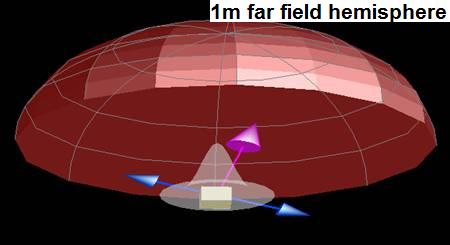
      Primarily, we want to recreate the polar plot of the 3D far-field using that can be seen using the visualizer inside the FDTD software using OriginLab software. For example, this image is taken from the visualizer:
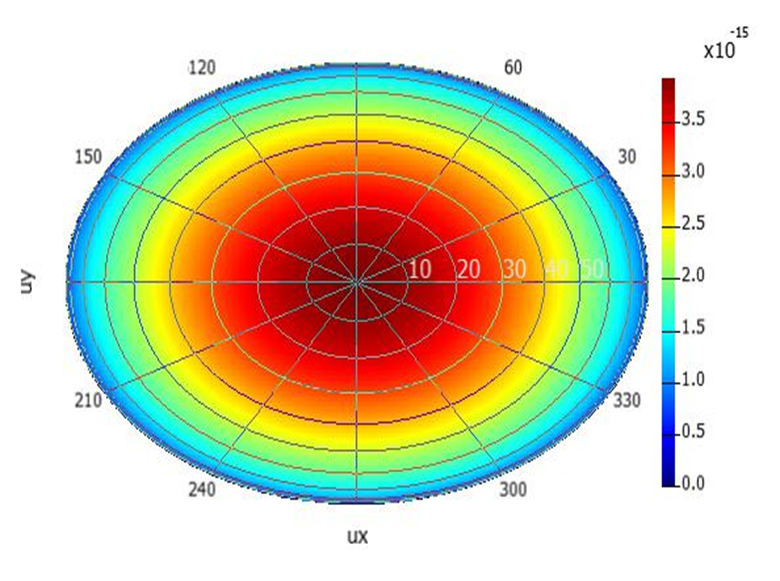
      We have converted the ux and uy data to values of theta and phi using the script at the bottom of this webpage from the Ansys website: https://optics.ansys.com/hc/en-us/articles/360034410194-farfieldspherical-Script-command

      However, we have some confusion about the interpretation of these values.

      1. From the output of this script, the values of theta range of from -90 to 90. As described here: Understanding direction unit vector coordinates in far field projections – Ansys Optics the fields are calculated on a hemispherical surface located 1 meter away from the simulation region, and the range of theta is from 0 to 180 degrees (0 to pi radians). Why then does script give values from -90 to 90 for theta and what is the physical location of the values from -90 to 0 on the hemisphere/polar plot?
      2. In general, what is the proper way to extract this data and plot in a polar plot in an external software like OriginLab?

      Thank you!”
    • Guilin Sun
      Ansys Employee

      A1: The theta is from -90 to 90 or 0 to 180  in theory. However, for the semi-sphere it is 0-90.  -90 to 0 is the other half.

      A2: I do not know OriginLab. But you have ux,uy, and uz, as well as theeta and phi that you can import to any 3rd party script.

    • P Nair
      Subscriber

      Thnk you for the reply. Could you please explain what is that other half represent? For sphere in theory it from 0 to 180. Then,  for hemisphere it should be from 0 to 90. What does it represent for -90 to 0?

    • Guilin Sun
      Ansys Employee

      Please check this article:https://optics.ansys.com/hc/en-us/articles/360034394294-Understanding-direction-unit-vector-coordinates-in-far-field-projections

      This graph shows 0-90deg

      usr_far_field_use_case_4.jpg


      this is toward the propagation direction.

      The other half is toward the 180 deg direction.  A sphere is cut in halves so one is for 0-90 deg and the other is for 0 ~-90 deg.

      As for it is 0~180 or -90 to 90, it is just a choice of definition. any way it is only the hemisphere.

Viewing 5 reply threads
  • The topic ‘Conversion of FDTD far field simulation data into spherical coordinates issues’ is closed to new replies.
[bingo_chatbox]