Ansys Assistant will be unavailable on the Learning Forum starting January 30. An upgraded version is coming soon. We apologize for any inconvenience and appreciate your patience. Stay tuned for updates.
LS Dyna

LS Dyna

Topics related to LS-DYNA, Autodyn, Explicit STR and more.

Application of base acceleration to a spring-mass system

    • Tonmoy
      Subscriber
    • Andreas Koutras
      Ansys Employee

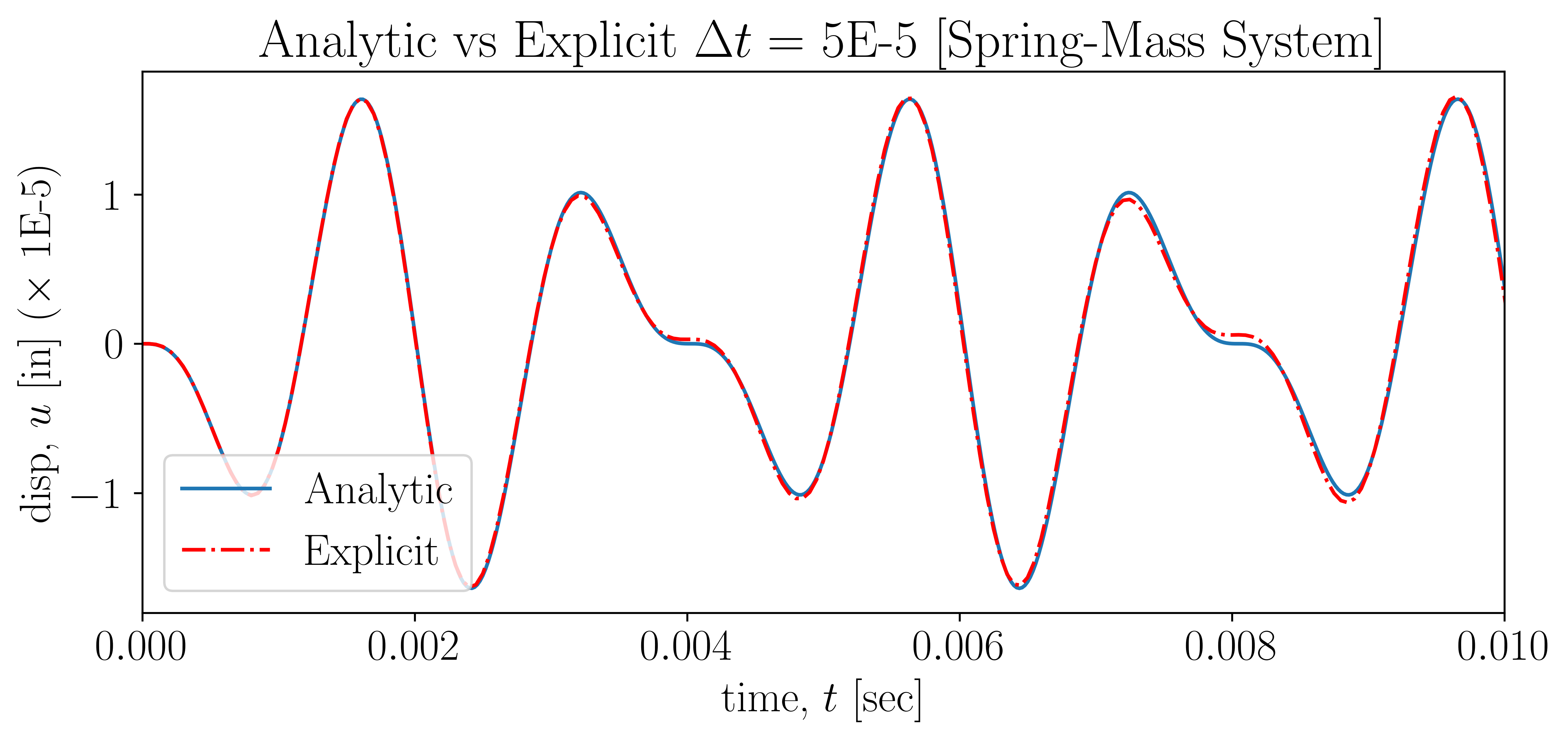
      Hello, since with reducing the explicit time step the model converged to analytical solution, I don't think there is an issue.

      For implicit analysis see:

      https://www.dynasupport.com/howtos/implicit/implicit-checklist

      ABSTOL =1e-20 is recommended to prevent premature convergence. 

      • Tonmoy
        Subscriber


        Thank you for your reply Dr. Koutras. I will work to fix the implicit then.

        I have two more questions about the problem:


        • the analysis did not “perfectly” overlapped even using 1/20*T. Should I also consider that as “okay”?


        • When should I use the keyword deck *BOUNDARY_PRESCRIBED_MOTION rather than *LOAD_BODY_X? As in my small experience, I have seen that using the former deck (setting VAD=1) the whole system moves away from the initial coordinates, so I get a response which increases as the time increases.
    • Andreas Koutras
      Ansys Employee

      Hello,

      Please try also with beam elements of ELFORM 1 and 3.

      *BOUNDARY_PRESCRIBED_MOTION with VAD=1 will prescribe the acceleration at the node. You will need to prescribe the acceleration only at the node of the base (node 1). The total result at node 2 will be (motion at the base) + (motion at node 2 relative to the base).

      LOAD_BODY applies the inertia force due to the base acceleration. In this case, node 1 should be fixed. The response at node 2 will be the motion relative to the base. To simulate the response due to base acceleration, we usually use this approach.

      • Tonmoy
        Subscriber


        Dear Dr. Koutras,

        I really appreciate your insightful comments.

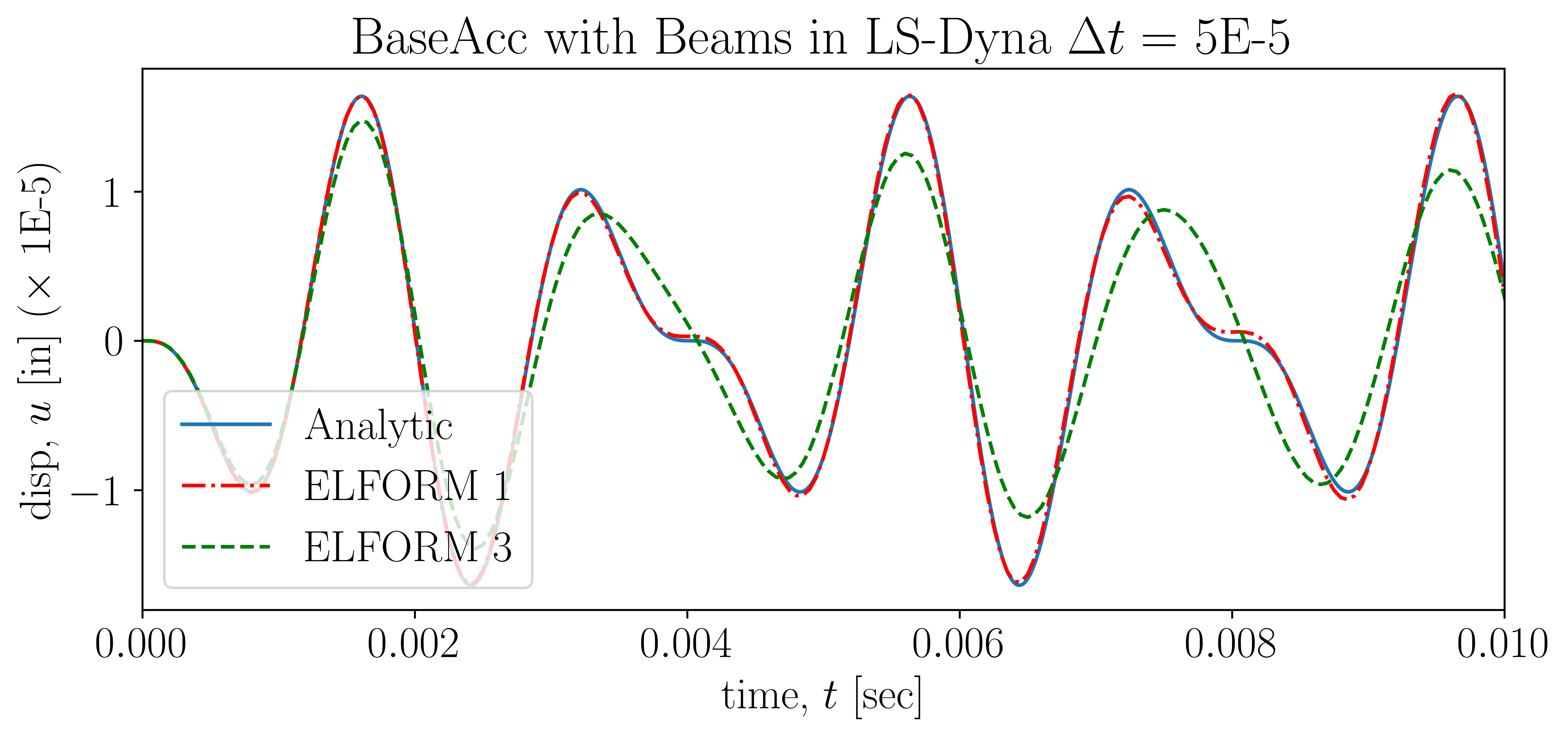
        I tried the keyword deck *ELEMENT_BEAM and *SECTION_BEAM (setting ELFORM 1 and 3) before. For both of them, the results are presented below:

        (as we can see, there are still small difference, like before, between the Hughes-Liu and the analytical solution, whereas the story is very much different for the truss element)!!!

        At that time, it confused our team a lot, especially because the CFL limit was not satisfied and the output from LS-Dyna was very jagged compared to the analytical solution (you can see my conversation about troubleshooting it with Dr. Basu here: /forum/forums/topic/applying-base-acceleration-in-ls-dyna/).


    • Andreas Koutras
      Ansys Employee

      I believe the truss element has damping added by default in the code which cannot be deactivated. Anyway, the result of ELFORM=1 and the spring element seems acceptable. Reducing the time step size further may lead to a better match. Thank you. 

      • Tonmoy
        Subscriber

        Dr. Koutras,

        Thanks a lot for helping me understand the problem better.

Viewing 3 reply threads
  • The topic ‘Application of base acceleration to a spring-mass system’ is closed to new replies.

[bingo_chatbox]