Ansys Assistant will be unavailable on the Learning Forum starting January 30. An upgraded version is coming soon. We apologize for any inconvenience and appreciate your patience. Stay tuned for updates.
LS Dyna

LS Dyna

Topics related to LS-DYNA, Autodyn, Explicit STR and more.

Total Contact Force and Contact Pressure

    • Luisa Hornung
      Subscriber

      Dear all,

      I am currently examine the impact of a ball (steel) with the human hand (I use the hand of the THUMS model). I want to investigate what contact forces and pressures occure when the ball is impacting the human hand. Now I am a little bit confused how to interpret the output of the simulation. The human hand consists of multiple layers: spon bone (solid), cortical bone (shell), tissue (shell), flesh (solid) and skin (shell). All layers have different material properties. I also defined AUTOMATIC_SURFCAE_TO_SURFACE contacts between some of the layers as well as between ball and skin. The goal is to investigate what effect an impact of an object with the back of the human hand has on contact pressure und contact force. 

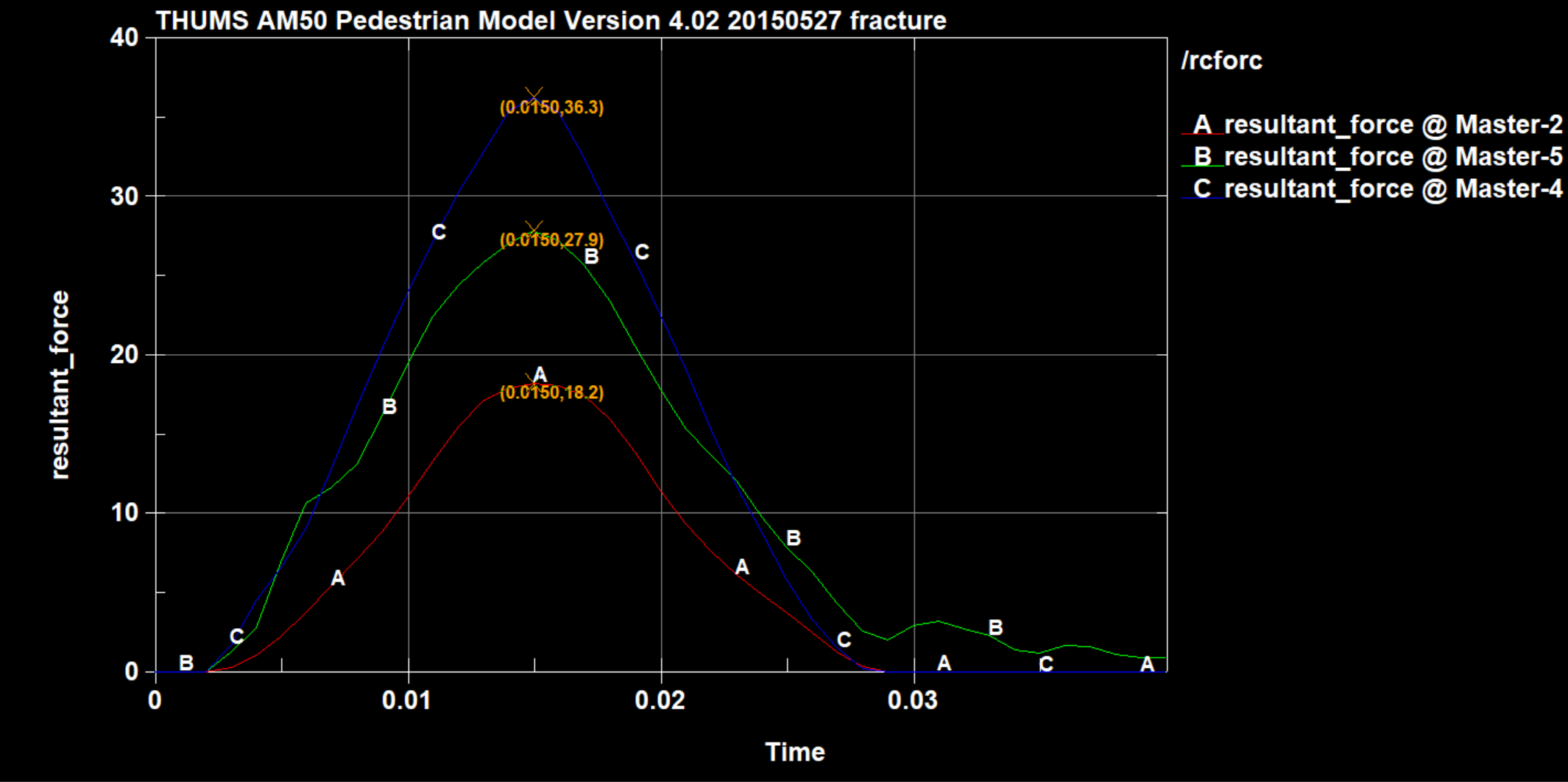
      1. Reading the Ouput RCFORC: do I have to add all forces at a particular time step to get the overall contact force?
      2. Reading the Ouput INTFOR: the same as 1 - do I have to add the pressures given by FriComp or is it just the maximum of all contact surfaces? I am also not really sure what pressure output I have to take, segment or nodal? is the pressure over the segment calculated as the average of the elements and the nodals is the peak pressure at the particular node?
      3. What is the difference between RCFORC and the "resultant interface force" (nodal or segment) in INTFOR?
      4. In order to get the correct results, should I define contact between all layers? Currently contact is defined only between the solids and the shells, but not between two shells

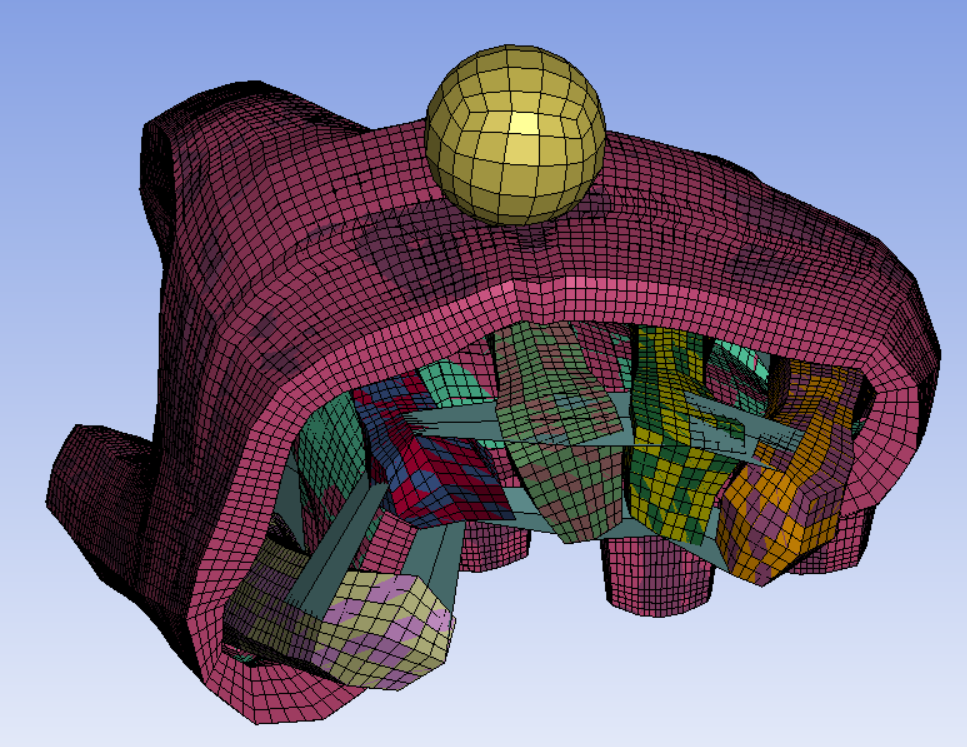
      At the beginning, I just examined the ball skin contact, but I quickly realized that this is not sufficient. Here is a picture of the simulation (I refined the mesh):

      Thanks in advance

    • Andreas Koutras
      Ansys Employee

      Hello,

      RCFORC outputs the overall contact forces across the whole surface of the corresponding *CONTACT definition. The rcforc value at a certain step correspods to the sum of the nodal contact forces across all nodes of the contact surface at that time step. The two opposing contact surfaces are the ones defined by the SURFA and SURF on the *CONTACT card 1. If there are more than one *CONTACT definitions that overlap across a surface, the total contact force on this surface will be the sum of the forces contributed from each of the *CONTACT definitions.

      The binary database INTFOR fringes the contact forces and stresses per contact segment. A segment is the face a one element on the contact surface.

      Since this model has various parts coming into contact, you could include all parts in a single *CONTACT_AUTOMATIC_SINGLE_SURFACE to avoid using multiple surface-to-surface contacts. The contact force between pairs of parts or pairs of part sets can be obtained in RCFORC by defining a *CONTACT_FORCE_TRANSDUCER_PENALTY between each pair. *CONTACT_FORCE_TRANSDUCER_PENALTY measures contact force only, it is not an actual contact. 

      I hope this helps.

Viewing 1 reply thread
  • The topic ‘Total Contact Force and Contact Pressure’ is closed to new replies.
[bingo_chatbox]