TAGGED: 1-way-fsi, cfd-icfluent, dynamic-mesh, one-way-coupling, six-dof-solver
-
-
February 3, 2023 at 6:26 pm
Milne Ando
SubscriberG'day,
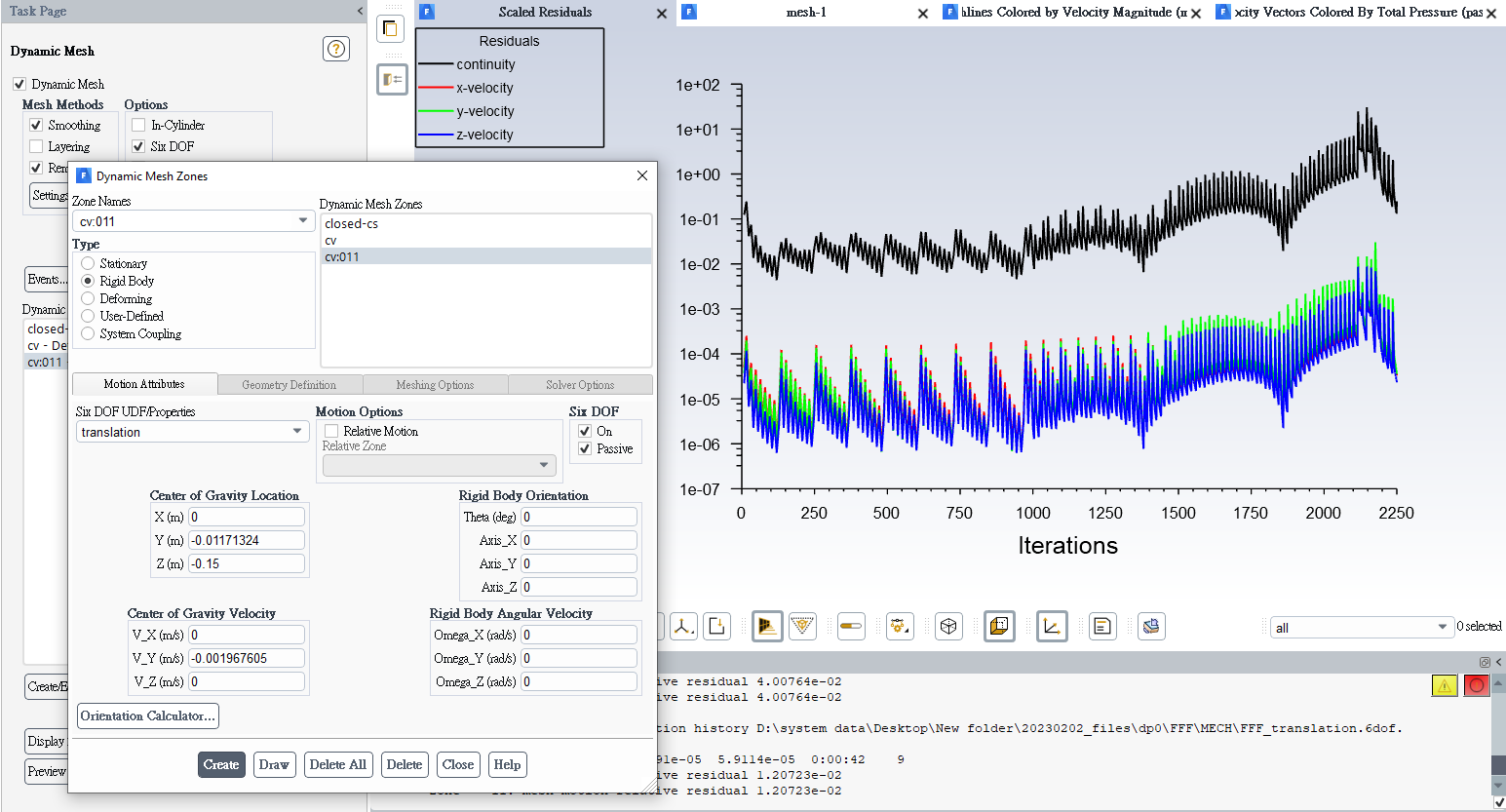
I'm working on the simulation of vortex-induced vibration, and I followed the hint given in the user guide: to preserve the prism layer cell zone (inflation) which surrounds the movable rigid body, one should separate it from the fluid domain and assign "rigid body" to it in Dynamic Mesh Zones. The inflation part (CV:011 as the pic shows) needs a six DOF UDF to make it move with the rigid body, so I assigned the UDF of the rigid body to it. But I'm not sure...is this correct? The UDF has properties of the rigid body (mass, inertia,...etc.), so the inflation will have the same mass and inertia? This seems unreasonable.
-
February 6, 2023 at 2:25 pm
Federico
Ansys EmployeeHello Milne,
this approach is correct as long as CV:011 is the fluid cell zone adjacent to moving body and you set the 6DOF to passive (as I can see in your screenshot).
I hope this helps!
-
February 6, 2023 at 6:42 pm
Milne Ando
SubscriberHello sir,
I read the explanation about “passive” in the user guide, it says
“Note that the Passive option in the Six DOF group box is used when you do not want the forces and moments on the zone to be taken into consideration.”
This statement isn’t clear enough. Are the stress forces acting on the inflation (CV:011) from CV ignored? Or there is no force (gravity, stress forces) existing within the inflation (CV:011)?
Hmm I just want to check the underlying principle of “passive” option and how it works.
Thanks for your reply!
-
-
February 6, 2023 at 7:01 pm
Federico
Ansys EmployeeRight, what it means is that the motion on a passive zone in 6DOF will not be based on forces/moments calculations on THAT zone, but will be coupled to the motion assigned to the zone (in your case "translation").
In other words, you want 6DOF model to compute forces and moments on the moving boundary zone to set its motion and you want the adjacent inflation layer cell zone to follow this motion, while ignoring any forces/moments acting on this cell zone.
I hope this clears it up!
-
February 7, 2023 at 5:49 am
Milne Ando
SubscriberThank you, understood. Since there is no any video or article about simulating 3D vortex-induced vibration in detail, I've spent around 3 months figuring out all the needed settings. But there is still a problem in that negative cell volume sometimes occurs, especially while the amplitude is increasing. I know it's relevant to time step size. Is there any empirical formula for calculating time step size?
-
-
February 7, 2023 at 1:39 pm
Federico
Ansys EmployeeThe idea is to have the moving boundary zone never displace by more than 1 cell length. Hence as a rule of thumb, the time step should be less than the smallest cell length divided by largest speed of moving boundary.
You should also set the fluid cell zone, in which the moving boundary zone is moving into, to deforming with the appropriate remeshing settings.
You can find a tutorial on 6-DOF in our Fluent Help page Chapter 13: Using Overset and Dynamic Meshes (ansys.com). Obviously this is not the same case as you (ignore Overset Meshing section) but best practices are described therein, including initializing the flow with a steady-state simulation prior to setting dynamic mesh setup to facilitate convergence.
-
- The topic ‘How to make the cell zone (inflation) surrounding the rigid body move with it?’ is closed to new replies.

-
6625
-
1906
-
1469
-
1311
-
1022
© 2026 Copyright ANSYS, Inc. All rights reserved.