Hello,
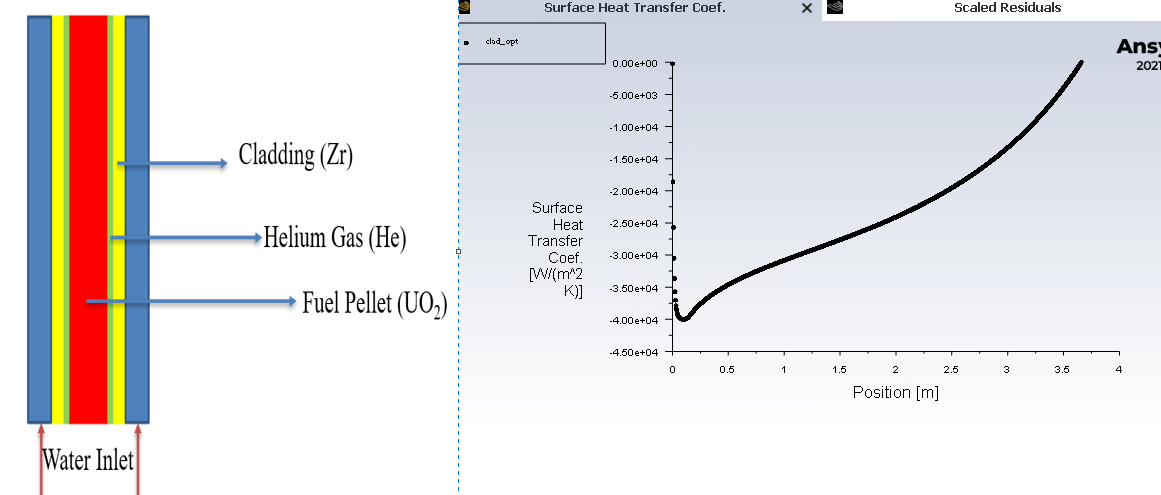
I am simulating conjugate heat transfer in a nuclear fuel pin. Heat is generated in the fuel pellet and transferred to the liquid. I got the converged result. Now I want to calculate the heat transfer coefficient and heat flux at the cladding outside surface which is in contact with liquid. While I tried to get the surface heat transfer coefficient, I see the heat transfer coefficient was negative. I set the reference temperature of 566.25K where the inlet temperature is also 566.25K. The bulk temperature of the liquid increased to 612.25K at the outlet.
HTC is dependent on the reference value. So, what should be the reference for this reference temp?
What may be the reason for getting the negative value of HTC and total heat flux even though the surface temperature is always greater than the bulk/inlet temperature?
Is there any other way to get heat transfer and HTC? I am using a k-epsilon model with a wall function for turbulence modeling.
Regards,
Anadi


















 You are navigating away from the AIS Discovery experience