-
-
November 18, 2022 at 6:11 pm
javat33489
SubscriberHi all. I'm solving pipe buckling problems. My model is a 10m pipe made by the midsurface and an outer pipe made by rigid. A force of 10 tons (100000N) acts on the inner tube. I need to determine the buckling point.
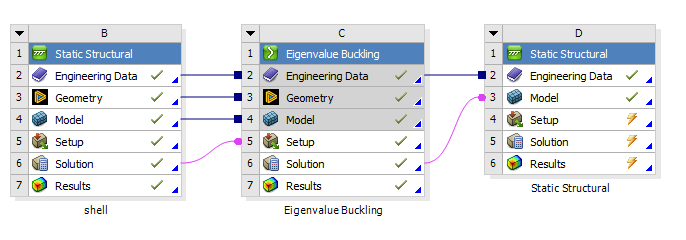
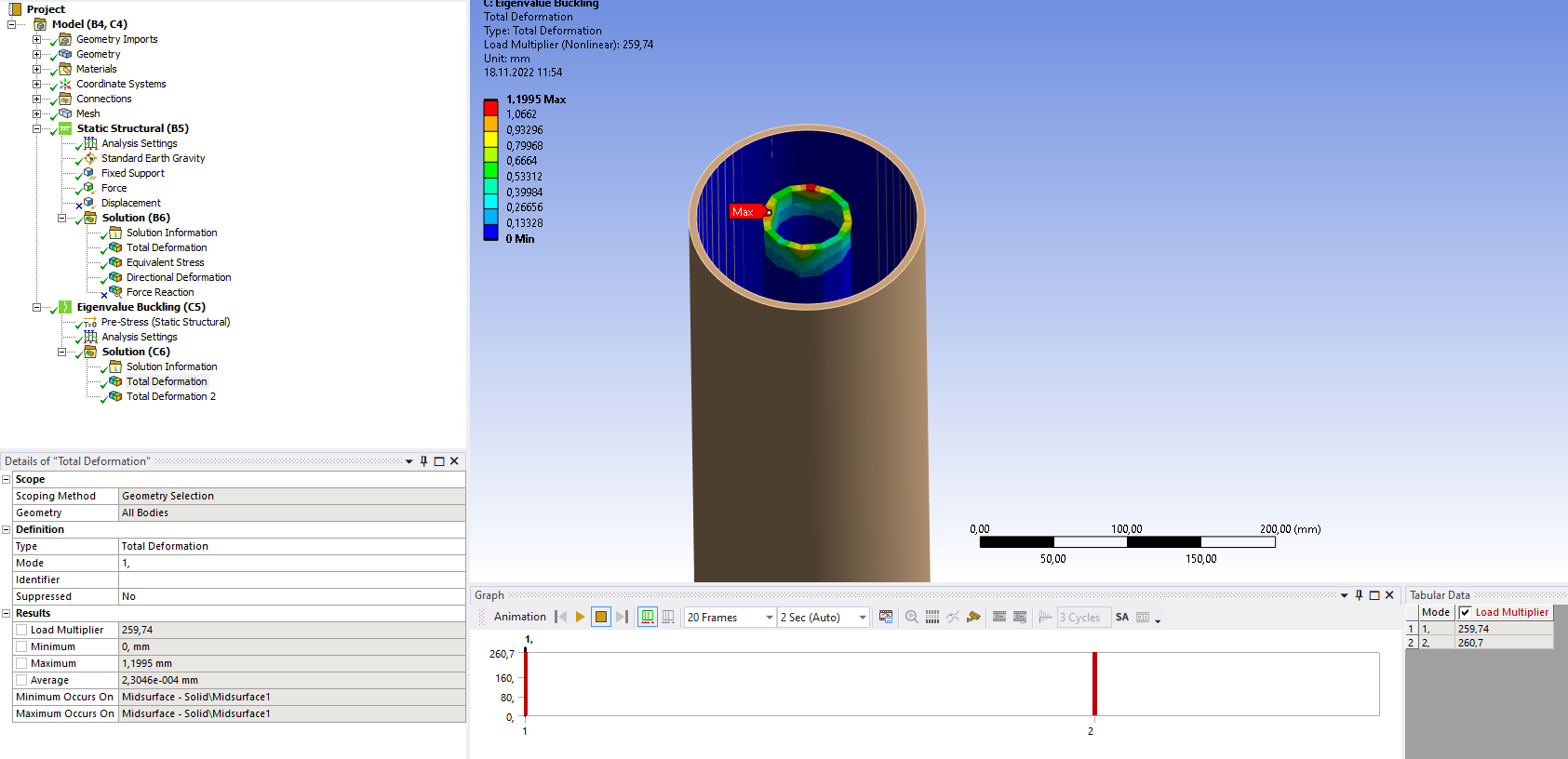
1.First, I do a linear calculation, get the margin multiplier for the first two modes. These are 259.74 and 260. Now I understand that the loss of stability will occur at F*k=259.74*100000N=25974000N. This is a lot, but the pipe is ideally straight and all effects are linear in the calculation.
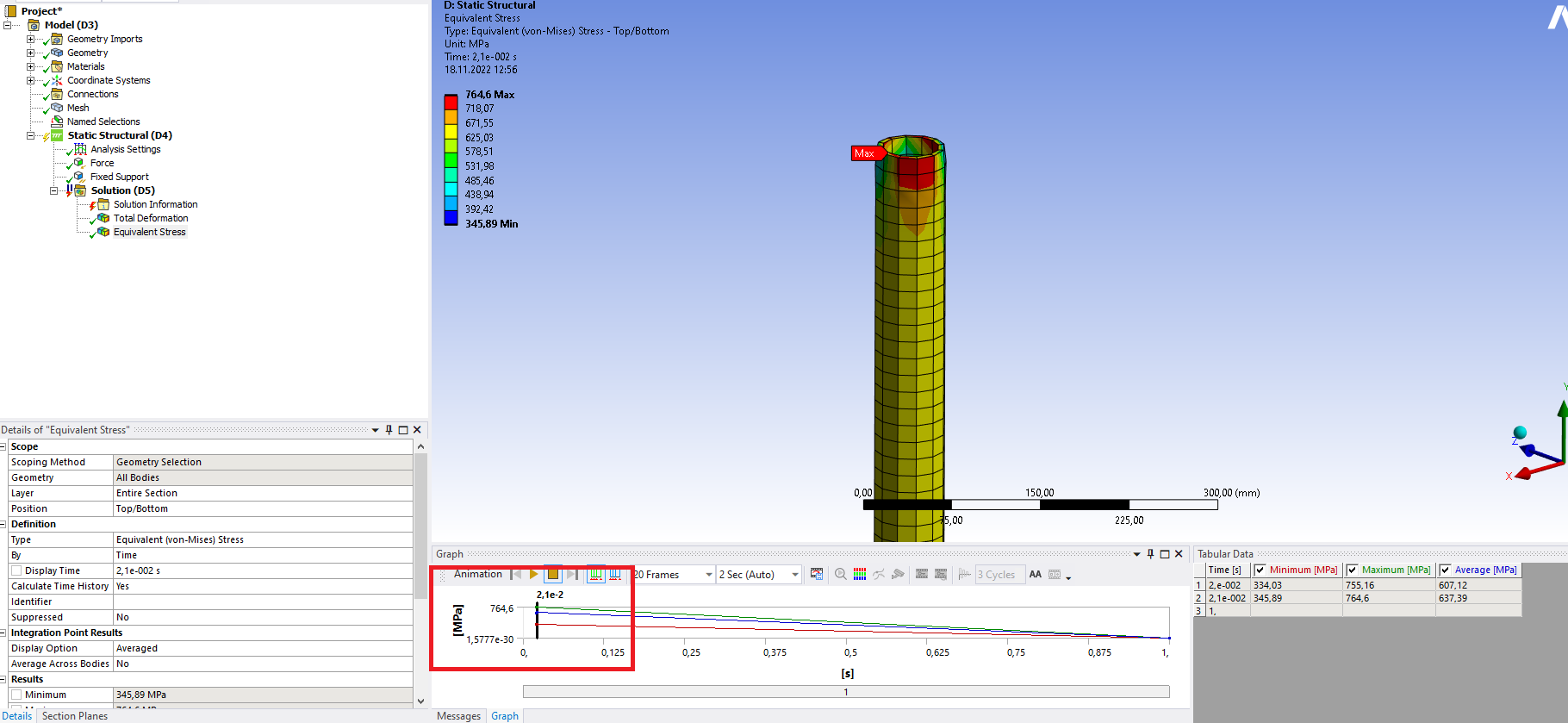
2.I'm doing a check through a non-linear calculation. I take a new static analysis, the input for it is the solution from the Buckling module. The deformed pipe is transferred. I set all the same loads, only the force is now 25974000N. Now the calculation almost immediately crashes with an error. Shouldn't he be completely determined? At least 80 percent before the onset of buckling?
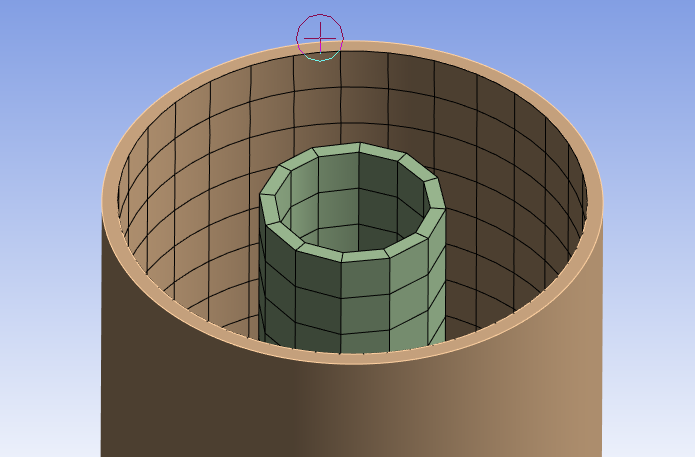
Mesh
-
November 19, 2022 at 11:40 am
peteroznewman
SubscriberI don't understand your question. I expect you want to know why the solution gave an error.
Please reply with details about the error. Copy some of the text from the Solution Output (solve.out) where the error is reported and paste it into your reply.
-
November 19, 2022 at 1:20 pm
javat33489
SubscriberDistorted error because 259.74 load is too high. And the question is why is it too large, if in a linear analysis it showed that 259.74 is the limit?
-
-
November 22, 2022 at 1:15 pm
javat33489
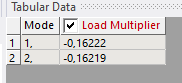
SubscriberI thought it might be the Scale Factor in the second buckling calculation. I set the Scale Factor to 0.2. I made a finer grid on the pipe and made a calculation. I got negative parameters for the first two modes:
If you read the documentation, then this means that there will be a crush. I checked with a non-linear calculation, and multiplied my load by nga, the resulting multiplier F * k. It turned out 100000N * 0.16222 \u003d 16222N. This means that the pipe will lose stability at 1.6 tons. I made such a load. But the pipe survived, and the stress was only 30 MPa.
-
November 22, 2022 at 1:16 pm
javat33489
SubscriberMaybe we don't understand each other.
I attached an old archive where I did not change the Scale Factor
-
November 23, 2022 at 12:35 pm
peteroznewman
SubscriberI took a closer look at the original model and noticed that you have a Frictional Contact with some friction between the inner and outer tubes and you have used Adjust to Touch. Was that intentional? I hope you understand that means the contact elements that cover the surface of the small pipe are offset from the pipe surface until they touch the inner diameter of the large tube, therefore the small pipe is already supported by the large tube before any load is applied.
Read the ANSYS Help on Eigenvalue Buckling. Eigenvalue Buckling Analysis (ansys.com)
Since you have a nonlinear item in your Static Structural model, the Eigenvalue Buckling is using the Linear Perturbation Analysis procedure.
I also notice that there are two loads on the static structural model: the force and gravity.
The load multiplier is for both loads, not just the force. You would have to replace Standard Earth Gravity with Acceleration so you can apply the multiplier to the acceleration of 9.81 m/s as well as the force.
Eigenvalue Buckling is a linear analysis and so is Modal analysis. In Modal analysis, an automatic conversion of nonlinear contact to linear contact is performed, so a Frictional contact that is closed (as yours is due to Adjust to Touch) would be converted into Bonded contact. I don't know how Eigenvalue Buckling treats frictional contact. Perhaps someone who knows can answer.

-
November 23, 2022 at 6:59 pm
javat33489
Subscriber>>I took a closer look at the original model and noticed that you have a Frictional Contact with some friction between the inner and outer tubes and you have used Adjust to Touch. Was that intentional? I hope you understand that means the contact elements that cover the surface of the small pipe are offset from the pipe surface until they touch the inner diameter of the large tube, therefore the small pipe is already supported by the large tube before any load is applied.
Yes, so I removed the outer tube and any contacts. To count only one inner pipe. I also made the mesh smaller for this pipe.Â
I got two values on forms but they are very small:
>>Since you have a nonlinear item in your Static Structural model, the Eigenvalue Buckling is using the Linear Perturbation Analysis procedure.
What is this about? Is it about the material? Maybe remove the bilinear kinematic hardening in the first calculation?
>>Read the ANSYS Help on Eigenvalue Buckling. Eigenvalue Buckling Analysis (ansys.com)
Yes, I read. I did not find answers to my questions.
-
-
November 23, 2022 at 9:33 pm
peteroznewman
SubscriberIf you have no plasticity, no contact, no outer pipe, and no gravity, you can have a linear solution in Static Structural with just the Force of 1e5N
Then in Eigenvalue Buckling, you will get a small Load Multiplier of 1.7008e-2. That means the critical buckling load is 1,700.8 N.
-
November 24, 2022 at 2:25 pm
javat33489
SubscriberYes, that is right!
Isn't that enough?
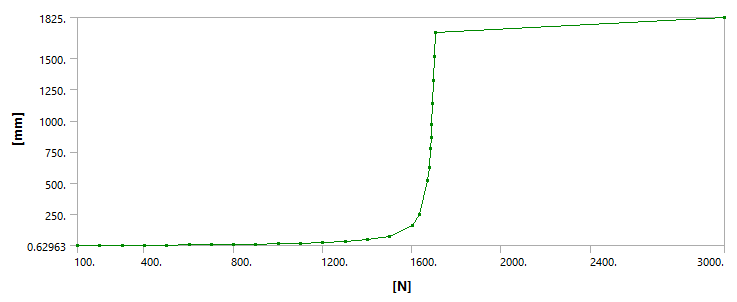
Then such a question. After Eigenvalue Buckling, I do a dashed non-linear calculation using the solution from Eigenvalue Buckling. I set the load force*multiplier, i.e. 1,700.8 N. In this case, the structure used is already deformed from the previous solution. But when tested, it does not lose stability. Why?
-
-
November 25, 2022 at 12:32 pm
peteroznewman
Subscriber-
November 25, 2022 at 1:28 pm
javat33489
SubscriberYes, you have everything set up correctly! Can you upload the archive of the project? I think I will find my mistake there.
-
-
November 25, 2022 at 4:09 pm
-
November 25, 2022 at 8:09 pm
javat33489
SubscriberThanks a lot. I will look and write to you
-
November 28, 2022 at 4:50 pm
javat33489
SubscriberYes, everything is fine. I have a similar result! Thank you!
-
-
- The topic ‘Problem in solving pipe buckling’ is closed to new replies.
-
6379
-
1906
-
1457
-
1308
-
1022
© 2026 Copyright ANSYS, Inc. All rights reserved.