-
-
September 28, 2022 at 8:12 am
alejandro.fernandez
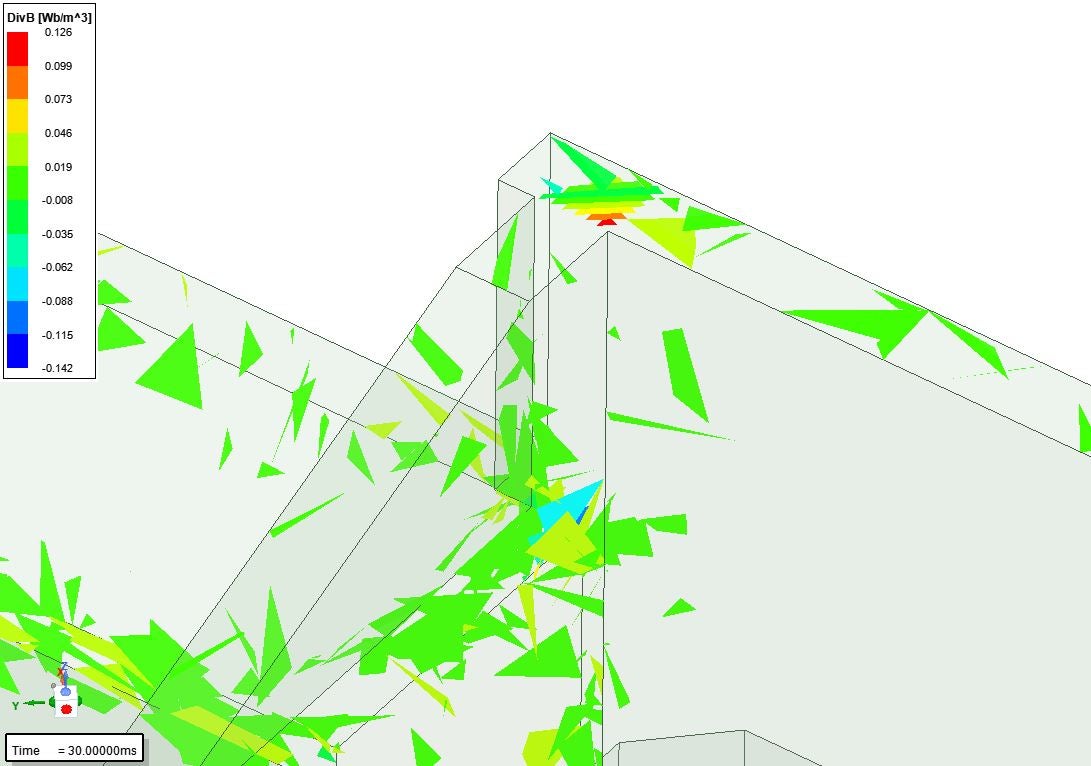
SubscriberI am studying the singularities that appear in inner sharp corners in Maxwell 3D transient simulations, where the the condition of Divergence of B = 0 is not satisfied. To understand how the errors are produced I would like to find information about the implementation of the T-Omega formulation used for 3D transient simulations in ANSYS Maxwell. I have search in the documentation (User´s guide Maxwell 3D and Maxwell Help) but there is not information about the details of the implementation of the T-Omega formulation. For example, among the information I am looking for, I would like to know what is the gauge used in the formulation. Anyone knows where to find this information? Or, anyone knows about a publication explaining the T-Omega formulation used in Maxwell 3D? In addition, do you know if there is any information, internal documents or publications, related to these local errors?
Attached a figure where you can see this local error in a corner:
Thank you all and best regards,
Alejandro
-
September 28, 2022 at 9:46 pm
HDLI
Ansys EmployeeHello Alejandro,
   Please review this link in Maxwell -> Maxwell 2D Technical Notes -> Transient Simulation. https://ansyshelp.ansys.com/Views/Secured/Electronics/v221/en/home.htm#../Subsystems/Maxwell/Content/TimeDependentMagneticFieldSimulation.htm?TocPath=Maxwell%257CMaxwell%2520Help%257CMaxwell%25202D%2520Technical%2520Notes%257CTransient%2520Simulation%257CTime-Dependent%2520Magnetic%2520Field%2520Simulation%257C_____0
HDLI
Â
Â
-
October 4, 2022 at 12:24 pm
alejandro.fernandez
SubscriberHello HDLI,
Thank you for the answer, however the provided link does not show the information we are looking for. It just show the Maxwell equation, not how it is implemented in ANSYS Maxwell, and does not tell what is the gauge used.
A second question is the following: Are aware of these local errors in corners due to the formulation used? Do you have any information, internal documents or publications, related to them?
These errors for the T-Omega formulation are described in this publication:
https://ieeexplore.ieee.org/document/877575
Thank you and best regards,
Alejandro
-
October 11, 2022 at 6:06 pm
Paul Larsen
Ansys EmployeeHi Alejandro,Â
There are several levels to discuss this question. The high-level response is that these local errors are part of the numerical noise, and will get better both on a local and global scale during adaptive mesh refinement.
The more technical explanation can be found in the publications here:
- https://ieeexplore.ieee.org/document/4527037
- https://ieeexplore.ieee.org/document/996146
 The T-omega FEA implementation of Maxwell causes a "strongly-imposed" curl calculation, and a "weakly-imposed" divergence calculation. The zero-divergence should improve both locally and globally as the elements adapt, but local convergence may depend on singularities, or near-singularities (near corners). Notice that the "energy error" quantity in the Maxwell solvers is related directly to this weakly-imposed zero-divergence, and is a global calculation of the convergence of this numerical error residual.
-
October 24, 2022 at 1:02 pm
alejandro.fernandez
SubscriberHi Paul,
Thank you very much for the answer.
The thing is that we have observed that the local error increases when refining the mesh. There are singularities in inner sharp corners, in which the result does not converge when refining the mesh. We think that this is the same case as the singularities explained in this paper: https://ieeexplore.ieee.org/document/877575Â
You said that there is a "weakly-imposed" divergence calculation. This seems equivalent to the case explained in the mentioned paper, where they use the Coulomb gauge (rho*Div T=0) in a weakly-imposed way, leading to non-zero divergence in inner corners of the geometry. Do you agree that this is the cause of our local errors? Do you use this Coulomb gauge as well in your formulation?
I performed several simulations to show how this error increases when refining the mesh: For a 25 mm max. element size in the whole geometry I get a 0.001471% energy error, while this error increases up to 0.001538% when applying local refinements in the regions with high variation of eddy currents.
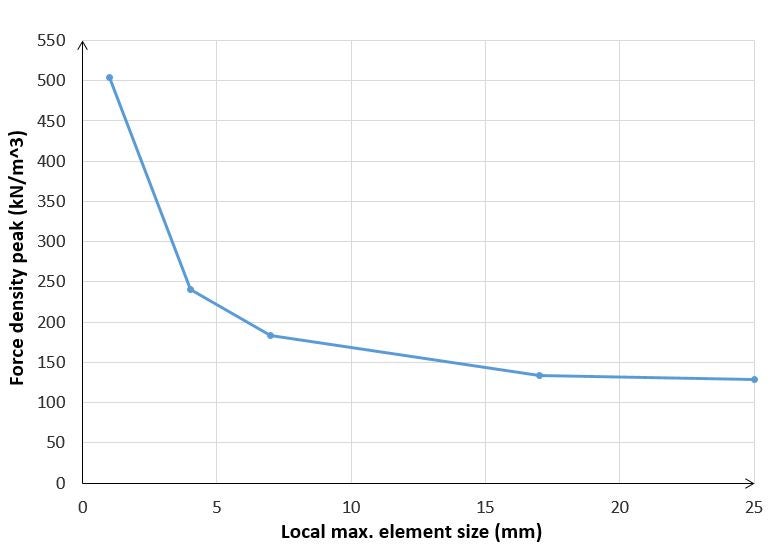
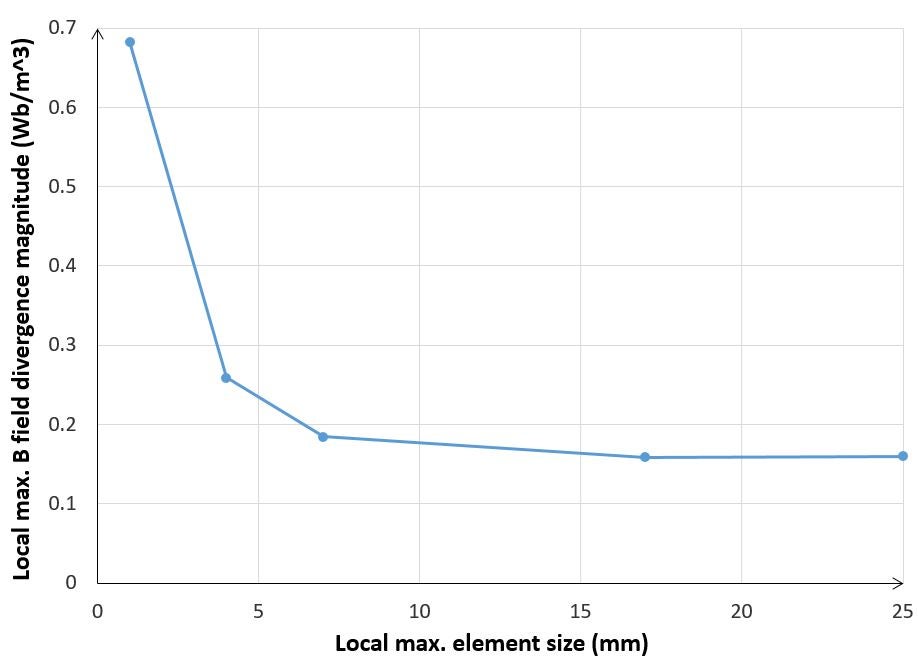
On the other hand, for a specific corner with high variation of eddy currents I applied further local mesh refinements to study the evolution of the peak electromagnetic force when refining the mesh and its relation with the divergence of B.
The peak volumetric force increases without convergence when refining the local mesh:
The trend is the same of the divergence of B in the same zone. When refining the mesh, the error increases:
-
- The topic ‘Maxwell error: divergence of magnetic field (B) different from cero at corners’ is closed to new replies.
-
4683
-
1565
-
1386
-
1242
-
1021
© 2025 Copyright ANSYS, Inc. All rights reserved.