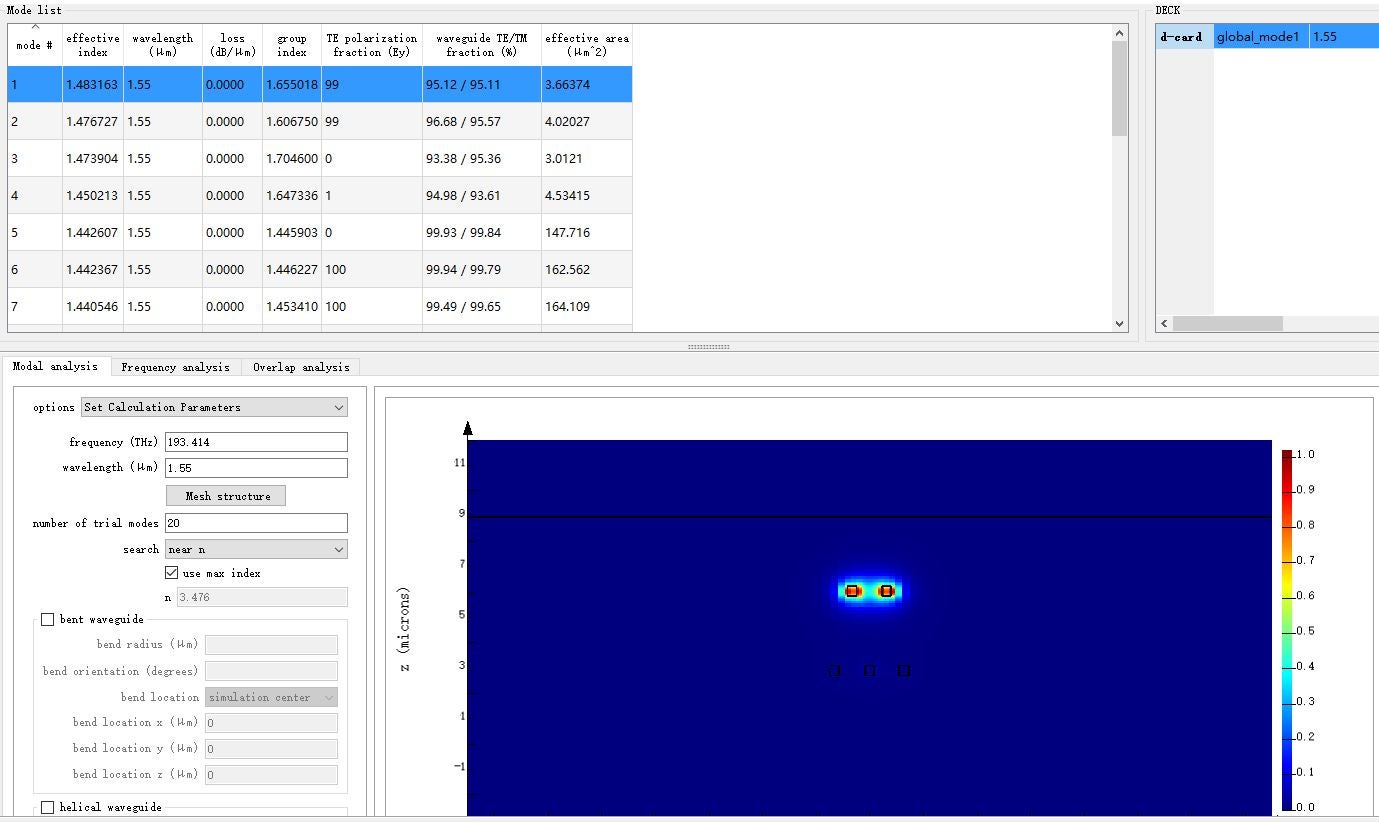
When high index material appears in FDE, usually it begins from the largest refractive index. If you know the effective index roughly, you can deselect the "use max index", and select "near n" close to the effective index. If more silicon is exposed to FDE, this might not work well. disabling the Si is an option, or only expose a small part of it. You may also need to use PML BCs instead of Metal BCs. However you may need to increase the number of trial modes. This is because the solver will give both the propagation modes and the PML modes and the latter are disposed, eg, not shown in the mode list.
As for " how to identify the TE/TM mode? " if you use Lumerical definition of TE/TM, please check the "TE polarization fraction", if it is more than 50%, it would mainly the TE polarization. However in case of symmetry and degeneracy, TE and TM may be mixed up. You can use symmetry BCs to isolate them.https://optics.ansys.com/hc/en-us/articles/360034382694-Symmetric-and-anti-symmetric-BCs-in-FDTD-and-MODE
Please try.

















 You are navigating away from the AIS Discovery experience