Hello.
I am currently simulating a high speed turbulent flow, with the main focus on investigating the particle deposition on the walls. I have done a convergence check and determined that the total number of cells had to be around 2.5 millions. The total mass flow rate is 0.0355 kg/s, and I am injecting 1000 particles from the surface inlet at steady state. I would like to compare the particle deposition for three different particle sizes, 100, 10 and 1 nm. I have successfully simulated for the 100 nm particles with the Max. number of steps set to the default value of 50000 and a step length factor of 5 as shown in the figure below. For the numerics I have used the trapezoidal tracking scheme.
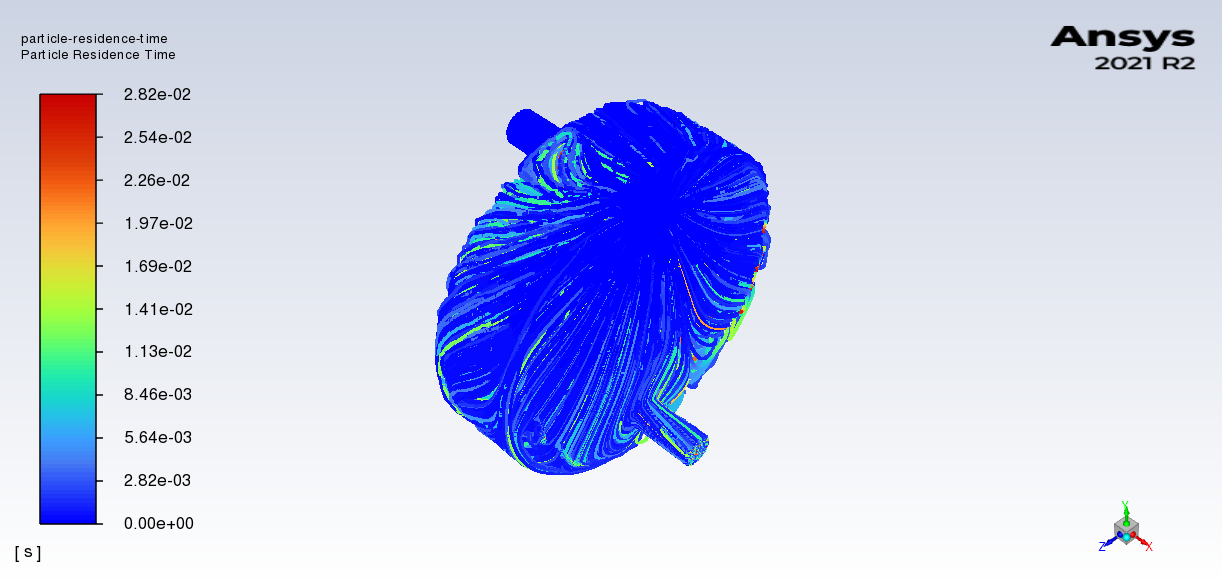
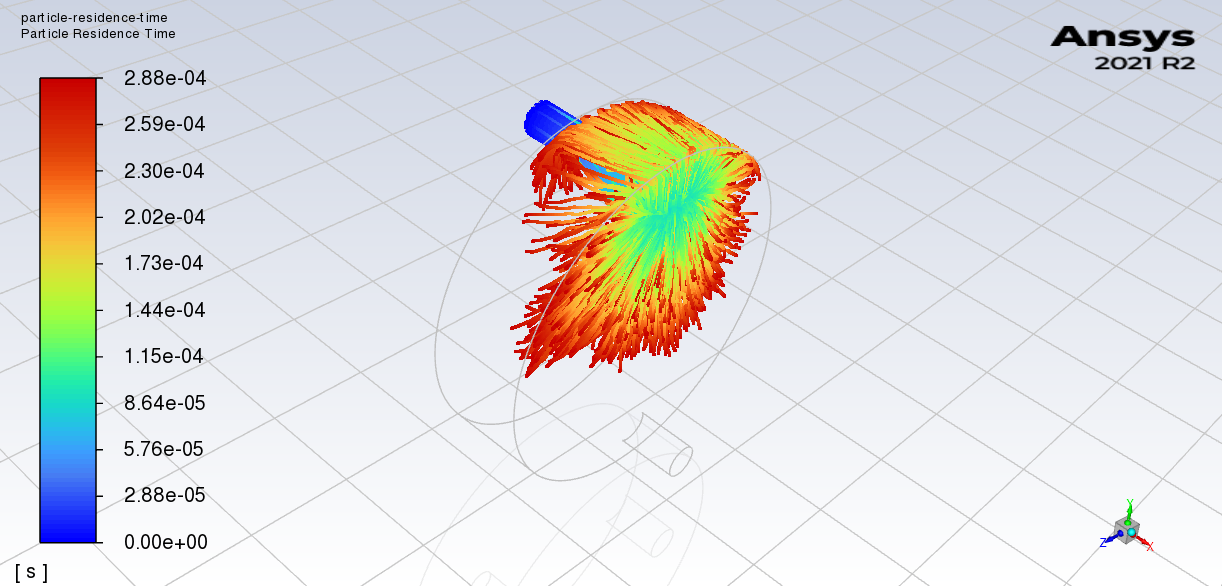
However, when I change the particle size to 10 nm, all of the injected particles are set to incomplete possible due to the max number of time steps being too small. I tried to increase the Max. number of steps to 100 000 as well, but this was not sufficient either. As you can see from the particle residence time it is of a magnitude of 10^-2 lower than for the 100 nm particles. What is the reason of this phenomena? And do you have any recommendations to what I can do to simulate for the smaller particles without encountering an enormous computational time.
50 000 number of steps:
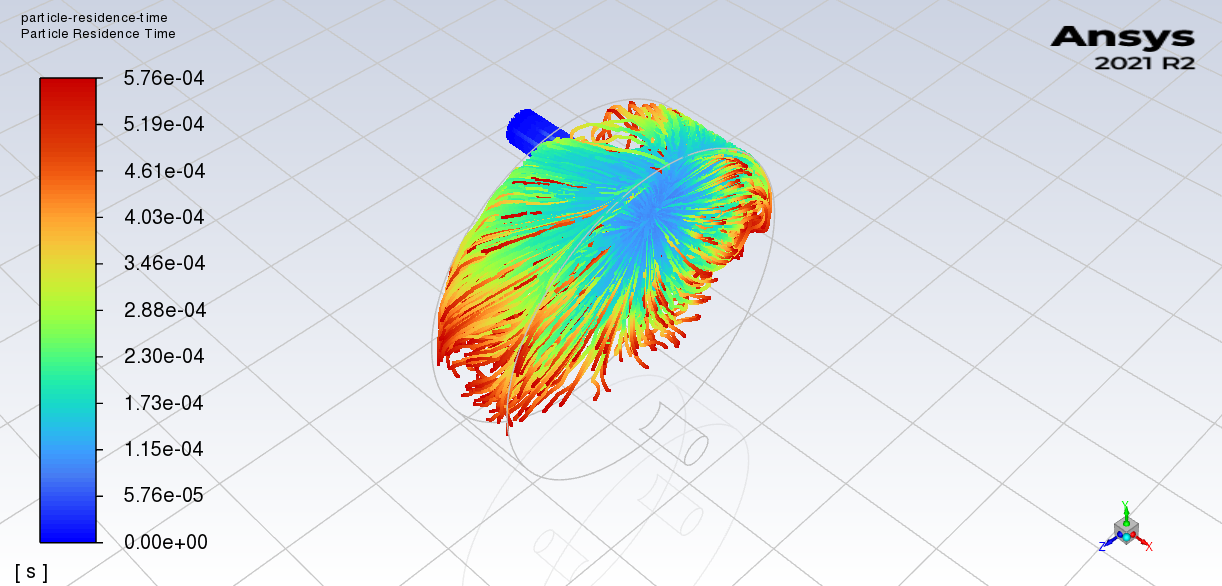
100 000 number of steps
I am also trying to investigate the deposition of particles, and I have read on this forum that the accretion rate would be an useful measurement, but I am not able to understand what it is a measurement of. In the theory guide it is defined as:
Sum of the number of particles (mdot_p)/A_face
But what does this mdot_p represents? Is that the mass of the particle or is it the total mass flow rate of the particle injected, i.e. 0.0355 kg/s which is equal to the fluid flow rate?
I also tried to post-process for the accretion rate, to compare the deposition rate with the fluid flow rate. To calculate this I integrated over the wall area, resulting in a Accretion integral of 1617.61 kg/s. However, this is several magnitudes larger than the total fluid flow rate of 0.0355 kg/s, so what does actually this entity tell me?
Thanks


















 You are navigating away from the AIS Discovery experience