

-
-
May 6, 2022 at 6:41 am
umad
SubscriberHello everyone.
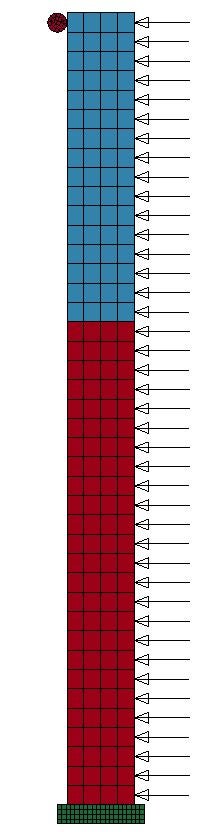
I am doing simulation of Rigid body analysis of masonry wall in LS DYNA and needs help on how to improve the numerical simulation.
Wall dimensions: Height of the wall is 4.1m, Length is 1.15m, thickness is 0.35m. During the experiment, the crack height from the base of the wall is 2.501 m. i.e height of bottom wall is 2.501 m and height of top wall is 1.599
Contact Automatic Surface to Surface was used in a between the two walls interface and between the floor and bottom wall interface. Friction coefficient of 0.7 was used.
Contact Automatic Surface to Surface was used in a between the top wall and top support. Zero friction was used here.
Uniformly distributed load was assigned on the wall face.
Material model: Top support and Floor (MAT_001) and assigned to Young modulus Elasticity of 40000 MPa
Two block walls (MAT_020) and assigned to masonry Young modulus of 4758 MPa
Numerical result is not matching with the hand calculation (Rigid body Analysis)
May 10, 2022 at 10:54 ampeteroznewman
SubscriberDid your hand calculation include inertia forces or was it a statics analysis?
May 10, 2022 at 8:48 pmSubscriberMy hand calculation did not include inertia forces. It was only a static analysis.
May 10, 2022 at 11:30 pmSubscriberAs the velocity of the wall increases, less force is needed to increase the displacement.
Can you update your hand calculation to include the effect of the velocity?
Viewing 3 reply threads- The topic ‘RIGID ROCKING WALL SIMULATION: HOW TO IMPROVE RESULT’ is closed to new replies.
Innovation Space Trending discussions
 Top Contributors
-
peteroznewman
 6625
6625 -
scabo
 1906
1906 -
Dennis Chen
 1469
1469 -
javat33489
 1311
1311 -
Shyam Prasad V Atri
1022
Top Rated Tags
© 2026 Copyright ANSYS, Inc. All rights reserved.
Ansys does not support the usage of unauthorized Ansys software. Please visit www.ansys.com to obtain an official distribution.
-
Ansys Assistant will be unavailable on the Learning Forum starting January 30. An upgraded version is coming soon. We apologize for any inconvenience and appreciate your patience. Stay tuned for updates.


 You are navigating away from the AIS Discovery experience