

TAGGED: fluent
-
-
February 23, 2022 at 11:18 pm
mjh0619
SubscriberFebruary 24, 2022 at 1:03 pmMurari Iyengar
Ansys EmployeeHi mjh0619
Can you provide more information about your simulation? On which surface are you monitoring Mass Flow Rate?
February 24, 2022 at 1:55 pmSubscriberHey
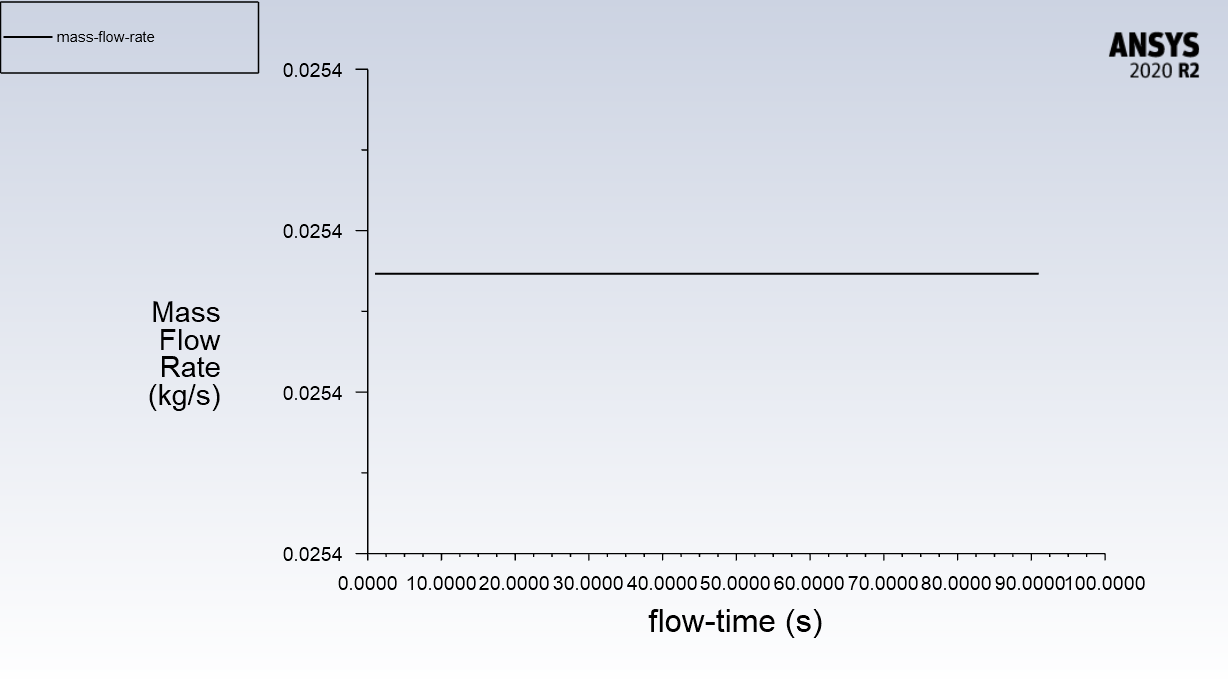
I am monitoring from the INLET surface. I am running a transient analysis for a heat transfer problem with a small internal fan (pressure jump) inside. I am using an inlet velocity of 0.1 m/s with a pressure outlet to ambient. Please let me know what other information I can provide.
February 24, 2022 at 3:10 pmRob
Forum ModeratorIf you're monitoring the inlet mass flow, and the inlet velocity is 0.1m/s what should the mass flow be?
February 24, 2022 at 4:07 pmSubscriberWell, assuming I have a cross sectional area of 0.4 x 0.4 = 0.16 m^2. I have an air density of 1.225 kg/m^3. And a velocity of 0.1 m/s. I would expect it to be about 0.0196 kg/s. I am hoping this answers your question?
February 24, 2022 at 4:08 pmSubscriberI have never ran a simulation where the mass flow was so straight before! Maybe I am overthinking it?February 24, 2022 at 4:24 pmForum ModeratorIf you're monitoring a fixed flow boundary the results tend to be fairly constant. Check the inlet area in Fluent too.
Viewing 6 reply threads- The topic ‘Help with ANSYS Fluent – Mass Flow Rate Issue’ is closed to new replies.
Innovation Space Trending discussions
 Top Contributors
-
peteroznewman
 5879
5879 -
scabo
 1906
1906 -
Dennis Chen
 1420
1420 -
javat33489
 1306
1306 -
Shyam Prasad V Atri
1021
Top Rated Tags
© 2026 Copyright ANSYS, Inc. All rights reserved.
Ansys does not support the usage of unauthorized Ansys software. Please visit www.ansys.com to obtain an official distribution.
-


The Ansys Learning Forum is a public forum. You are prohibited from providing (i) information that is confidential to You, your employer, or any third party, (ii) Personal Data or individually identifiable health information, (iii) any information that is U.S. Government Classified, Controlled Unclassified Information, International Traffic in Arms Regulators (ITAR) or Export Administration Regulators (EAR) controlled or otherwise have been determined by the United States Government or by a foreign government to require protection against unauthorized disclosure for reasons of national security, or (iv) topics or information restricted by the People's Republic of China data protection and privacy laws.

 You are navigating away from the AIS Discovery experience