

TAGGED: ansys-workbench, topology-optimization
-
-
January 26, 2022 at 1:15 pm
anurag.ce
SubscriberWhat is the maximum value of the response constraint to be considered in the topology optimization problem when the objective function is considered as minimise mass and the global or local von-mises stress is considered as a constraint? Is this value be the yield strength of the material or the maximum equivalent von-mises stress when the static structural analysis is performed prior to topology optimization?
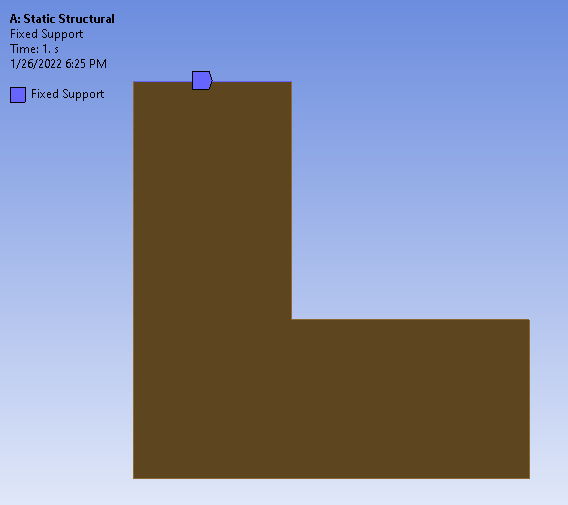
I am doing the stress constraint topology optimization of the L-shaped beam structure with the material is considered as aluminum alloy and the fixed constraint is applied at the top and point load of 1500 N is applied at its tip. The model is modeled as surface and the analysis is kept 2D(plane stress). The length is 200 mm and width is 80 mm. The point load is applied as nodal force and distributed to some nodes so as to avoid the stress concentration and the 4 noded quad elements are used. It as shown as:
January 27, 2022 at 4:20 pmAshish Khemka
Forum Moderator
Please see if the following post helps you:
Global von -Misses stress constraint in Topology optimization ÔÇö Ansys Learning Forum
Regards Ashish Khemka
January 31, 2022 at 1:44 pmSubscriber
Thanks for sharing information regarding global as well as local von-mises stress constraint. When I am doing stress constraint topology optimization for the problem statement defined above using local von-mises stress constraint with the maximum value of constraint set as yield strength of material (which is 350 MPa in this case), I am getting this type of final topologically optimized design.
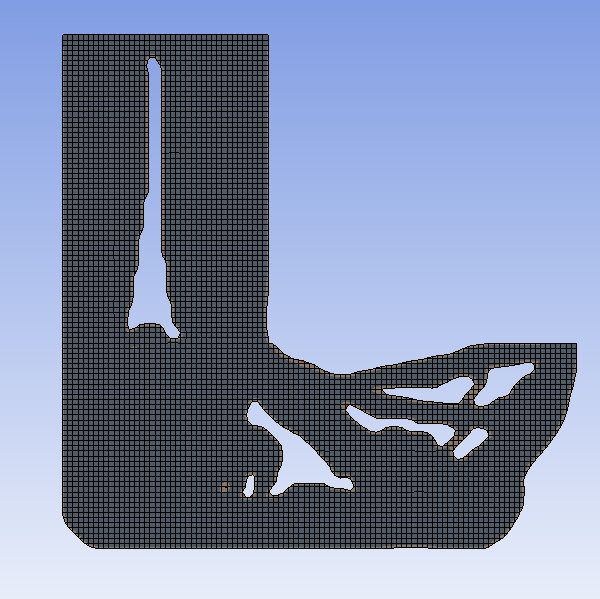 In this final optimized design, there is not so much reduction in material. The stress contour for the unoptimized geometry is :
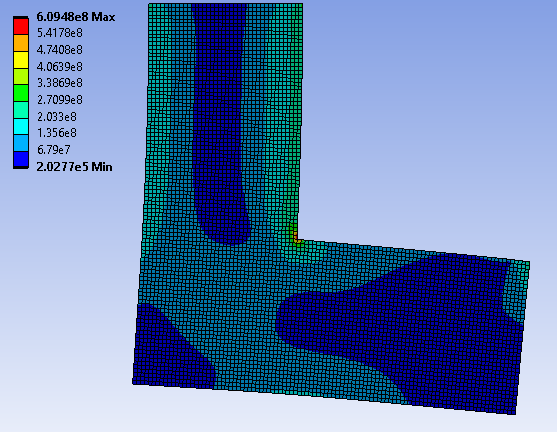
The same type of topology I am getting with the global stress constraint also (i.e not so much material reduction).. I am mentioning again that my problem statement is to minimize mass with global/local stress constraints for the 2D geometry (plane stress; dimensions, loading and boundary conditions are previously already mentioned). Any idea in this matter why there is not so much material reduction?
February 2, 2022 at 2:24 pmJohn Doyle
Ansys EmployeeThe theoretical peak stress at a perfectly sharp corner is infinity. Would it help to put a small radius at this corner and scope your local stress response constraint in the topology optimization run to all the elements at this radius? That might make the problem a little more forgiving in terms of try to chase down an optimal distribution of the mass.
February 7, 2022 at 11:52 amSubscriber
Yes, the stress is infinite at the sharp corner point due to the singularity phenomenon. Actually, I want that when I am doing topology optimization with stress constraint, the radius at the corner point is automatically built up in the optimized geometry, and there is no need for post-processing. As far as I know, when we incorporate stress constraints in the topology optimization formulation, stress concentration regions are automatically smoothened with the optimal mass distribution. The importance of stress constraints in topology optimization is that they can handle stress concentration regions so effectively that there is no need for post-processing. I hope I have made it clear to you.
Viewing 4 reply threads- The topic ‘Stress constraint Topology Optimization’ is closed to new replies.
Innovation Space Trending discussions
 Top Contributors
-
peteroznewman
 6465
6465 -
scabo
 1906
1906 -
Dennis Chen
 1458
1458 -
javat33489
 1308
1308 -
Shyam Prasad V Atri
1022
Top Rated Tags
© 2026 Copyright ANSYS, Inc. All rights reserved.
Ansys does not support the usage of unauthorized Ansys software. Please visit www.ansys.com to obtain an official distribution.
-


 You are navigating away from the AIS Discovery experience