

-
-
January 20, 2022 at 9:29 am
denischebakov
SubscriberGood time of day,
I have a problem setting the surface-to-ambient radiation boundary conditions for the thermal analysis of a 2D model. It seems that I have misunderstandings in fundamental theory. In my world, the surface-to-ambient radiation satisfies the Stefan-Boltzmann law: q = σε(T^4-Ta^4), where T and Ta are nodal and ambient temperatures in Kelvin, respectively. Thus, it must be the same as setting the convection q = α(T)*(T-Ta), where α(T) = σε(T^2+Ta^2)(T+Ta), following the difference of squares formula.
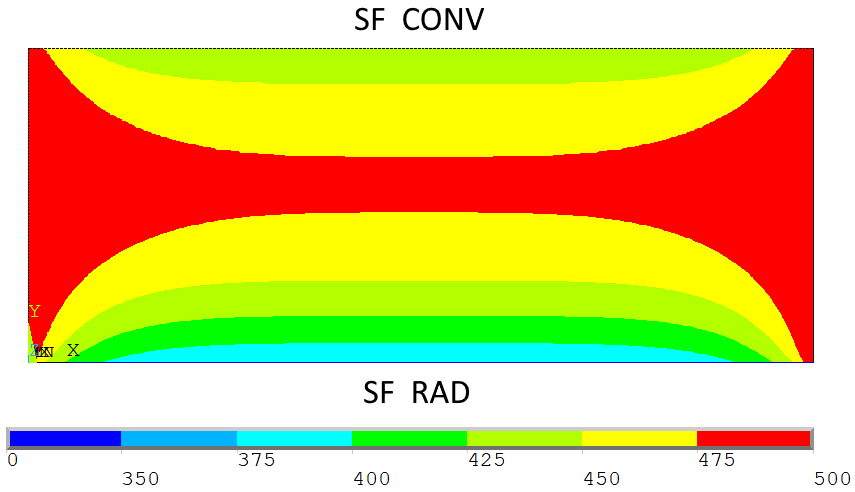
I tried to check it with a simple APDL model (the script is attached). I created a rectangle and set the constant temperatures of 500 °C for the left and right borders, radiation for the bottom, and convection with α(T) table for the top. I computed all in °C, so I used the temperature offset of 273 for radiation and calculated α(T) as σε((T+273)^2+(Ta+273)^2)(T+Ta+2*273). The RAD keyword does not seem to work in my case, so I used RDSF with a space node with the ambient temperature of 20 °C for setting the radiation to ambient.
The results are presented in the following image, and they are different for the top and the bottom, and I do not understand why. I tried to compute all in Kelvin and change the position of a space node, but nothing changed.
January 25, 2022 at 4:07 pmAshish Khemka
Forum Moderator
Please see if the following example helps you:
5.7. Example of a 2-D Radiation Analysis Using the Radiosity Method (Command Method) (ansys.com)
6.4. Radiosity Solution Method (ansys.com)
Regards Ashish Khemka
Viewing 1 reply thread- The topic ‘Radiation to ambient and convection with heat transfer coefficient of temperature do not match’ is closed to new replies.
Innovation Space Trending discussions
 Top Contributors
-
peteroznewman
 5849
5849 -
scabo
 1906
1906 -
Dennis Chen
 1420
1420 -
javat33489
 1305
1305 -
Shyam Prasad V Atri
1021
Top Rated Tags
© 2026 Copyright ANSYS, Inc. All rights reserved.
Ansys does not support the usage of unauthorized Ansys software. Please visit www.ansys.com to obtain an official distribution.
-
Ansys Assistant will be unavailable on the Learning Forum starting January 30. An upgraded version is coming soon. We apologize for any inconvenience and appreciate your patience. Stay tuned for updates.


 You are navigating away from the AIS Discovery experience