-
-
October 31, 2021 at 8:15 pm
janetj
SubscriberHello all,
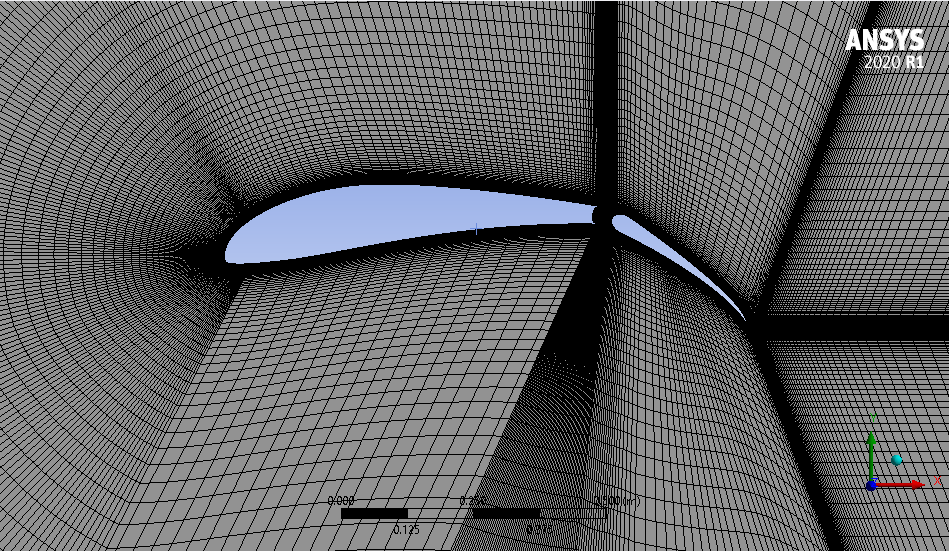
I am working on an airfoil with a trailing edge flap at 25 degree. I have done quad structured meshing. I have some questions regarding that.
Total number of elements are 61,760 and total nodes are 62,524. 32 Elements have the Skewness of 0.886, whereas 309 elements have 0.121 Orthogonal quality. According to Ansys meshing guide, Skewness of 32 elements is under "Acceptable" level, whereas 309 of the elements with 0.121 Orthogonal quality are in "Bad" quality level. Despite struggling with the orthogonal and skewness improvement, I was unable to do that. So I tried Mesh Adaption in Ansys Fluent to bring both Skewness and Orthogonal in the levels ranging from 0.50-0.80 and 0.20 - 0.69 respectively. In this situation, is it okay to use Mesh Adaption in Ansys Fluent while I am unable to fix the skewness and orthogonal quality in Ansys meshing?
Secondly, my Y-plus value is 7. I am using Spalart Allmaras model with Reynolds number of 200,000. (Density 1.225 kg/m3, Chord Length 1m, Viscosity 1.7894e-5, Velocity 2.92 m/s). Looking at the mesh and model, is my Y-plus value of 7 okay for S-A turbulence model? What should be the the minimum or maximum Y-plus value?
November 2, 2021 at 12:52 pmKarthik Remella
AdministratorHello The SA model in Fluent has a y+ insensitive wall treatment, which means that it is capable of resolving both viscous sub-layer as well as log layer near the wall depending on the y+ values (which depends on the mesh resolution). If your final goal is to estimate drag and compare it with experiments or values from the literature, I'd urge you to reduce your first layer thickness.
Also, I'm curious why you wish to use SA? Why not the default SST k-omega model?
Karthik
November 3, 2021 at 9:55 pmjanetj
SubscriberDear Kremella I have used default SST k-omega model. But I am not able to reduce the drag. At 0 degree alpha, the Cd is 0.12 whereas Cl is 1.8. I don't understand what I am missing. I am attaching the pic of the Mesh. If you can check. I have spent quite a lot of time getting a lower Cd but to no avail. Sometimes when I changed the Mesh, I am unable to get convergence with Density based solver, however with Pressure-based I am getting a converged solution quite easily. I am using Mapped meshing, and my bias setting for the split lines are 80 division and 2500 bias. I have also reduced the bias and brought it down to simple 150, but again, I am not getting a lower Cd. The idea is, with the flap, you should get a higher Cl and lower Cd when compared with the experimental/validated results of single element airfoi. But this is not happening in my case. What am I missing?

November 11, 2021 at 1:53 pmKarthik Remella
AdministratorHello Your mesh looks beautiful. I have just one comment though. Your flow is likely to separate, especially in the downstream area. You will need to capture this flow separation as well as the wake regions properly. It seems to me that you do not have sufficient resolution to capture this wake and your pressure drag may be off. This might be the reason why your Cd Cl values may not be matching the experimental data.
Also, please double-check if you are using the same reference values as those done by the experiments. This is extremely important for drag and lift coefficient calculations.
Karthik
November 11, 2021 at 8:13 pmjanetj
SubscriberDear Karthik Thank you for your suggestion. I think you are right. I am going to improve the mesh for the downstream area. This I believe will require further splits in the main geometry.
Viewing 4 reply threads- The topic ‘Issues with Skewness and Orthogonal Quality and Y-plus value’ is closed to new replies.
Innovation SpaceTrending discussionsTop Contributors-
5849
-
1906
-
1420
-
1305
-
1021
Top Rated Tags© 2026 Copyright ANSYS, Inc. All rights reserved.
Ansys does not support the usage of unauthorized Ansys software. Please visit www.ansys.com to obtain an official distribution.
-
Ansys Assistant will be unavailable on the Learning Forum starting January 30. An upgraded version is coming soon. We apologize for any inconvenience and appreciate your patience. Stay tuned for updates.