
TAGGED: co2, real-gas, under-relaxation-factors
-
-
September 17, 2021 at 11:02 am
mlanahan3
SubscriberI have come across some odd behavior in converging certain fluid simulations (using ANSYS Fluent) and I was hoping to gain some insight and/or recommendations on how to interpret these results. I will briefly explain what I am attempting to do, and then ask my question below.
Simulations:
The simulation is that of an impingement jet, with mass flow (3-8 g/s) and temperature (20-400 ⁰C) specified at the inlet, and the outlet pressure specified (of around 10 MPa). The model is turbulent, for which I am using the k-epsilon turbulence model to model. The surface that the jet impinges on has an imposed heat flux on the other side, which heats up the fluid.
Simulations have been conducted using Helium as the working fluid, approximating the properties of helium as purely functions of temperature. I have recently been attempting to simulate the impinging jet using CO2 as the working fluid, and due to the strong dependence of CO2 properties on temperature I have to be fairly creative with my solution procedure to achieve convergence. Additionally, due to the strong dependence of the properties of CO2 on pressure at the critical point, I am using a function to approximate the properties as a function of both temperature and pressure.
My question stems from the plots attached in the variables_solution_iteration_comparison.png and residual_solution_iteration_comparison.png, which show the values of monitored variables and residuals vs. iteration number respectively. The legend in both plots corresponds to the following solution strategies:
Legend Label
Simulation summary
CO2 Real Gas, End Relaxation = 1
Fluid properties are simulated as functions of both temperature and pressure, and the relaxation coefficient on density and temperature is changed to 1
CO2 Real Gas, End Relaxation = 0.8
Same as above except the end relaxation is 0.8
Isobaric CO2 End Relaxation = 1
Fluid is approximated as a function of temperature and the relaxation at the end of the solution is 1
Isobaric He, End Relaxation = 1
Same as above except using Helium
Isobaric He, End Relaxation = 0.8
Same as above except the end relaxation is 0.8
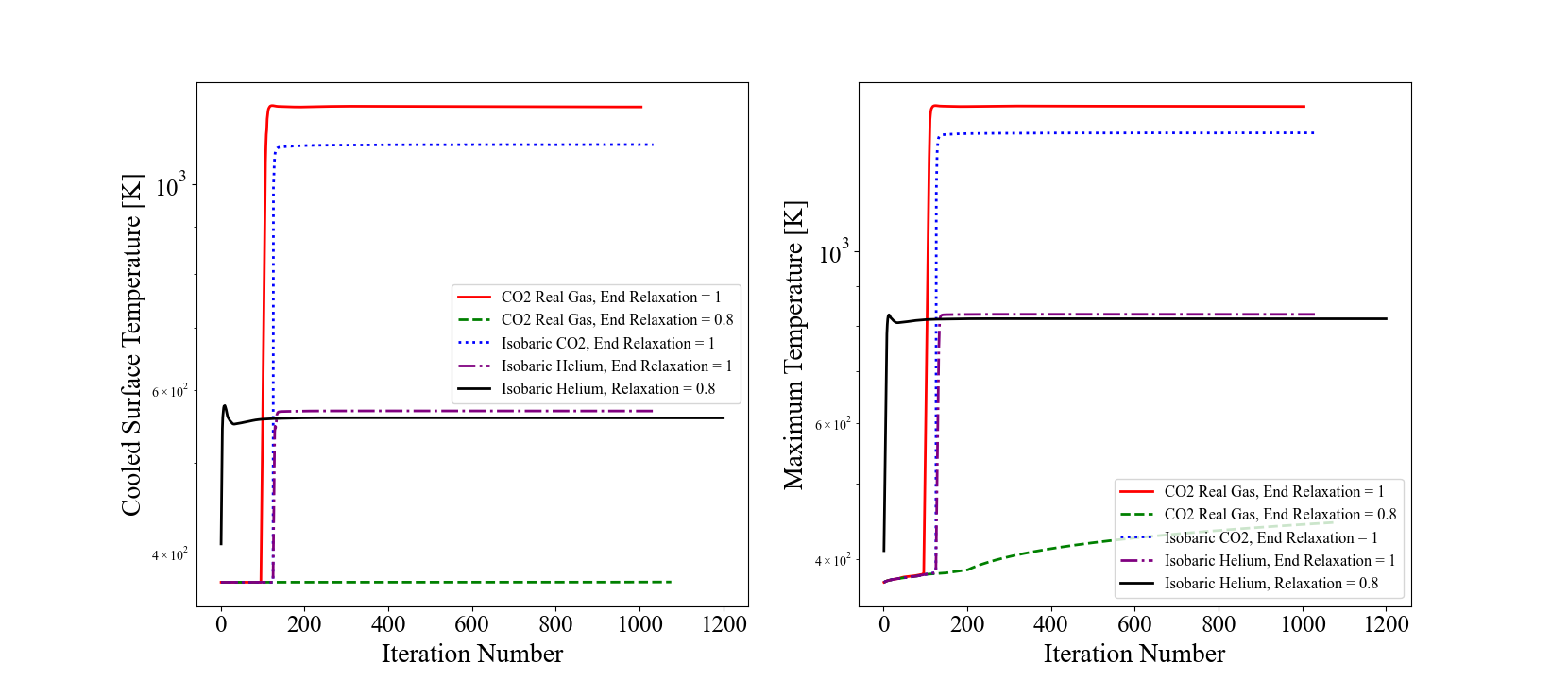
variables_solution_iteration_comparison.png shows the averaged temperature on the impinged surface in the left plot, and the maximum temperature on the impinged surface in the right plot. My concern stems from the spike in the value of the simulation, originally noticed in CO2 Real Gas, End Relaxation = 1. At this spike I change the relaxation coefficient on the temperature and density from 0.5 to 1.0, as I have deemed that the solution is now stable enough to do so.
Comparing, CO2 Real Gas, End Relaxation = 1 and Isobaric CO2 End Relaxation = 1, it is clear that the different property approximations yield significantly different results for CO2, as expected. Comparing CO2 Real Gas, End Relaxation = 1 and CO2 Real Gas, End Relaxation = 0.8 we can see that leaving the relaxation coefficient untouched significantly alters the results, while comparing Isobaric He, End Relaxation = 1 and Isobaric He, End Relaxation = 0.8 we see that the same change does not significantly alter the solution value for the isobaric Helium properties.
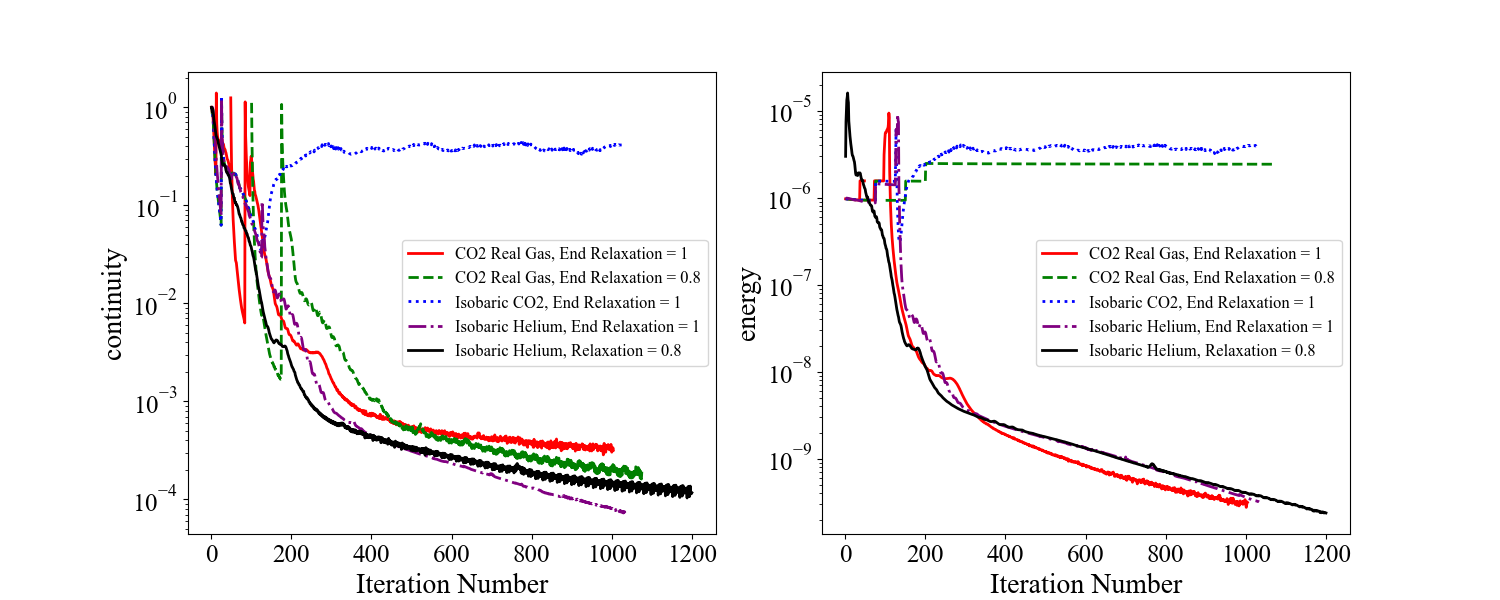
Examining the residuals of the continuity and energy equations in residual_solution_iteration_comparison.png it is evident that increasing the relaxation coefficients on density and temperature leads to “better” convergence in the sense that the residual on energy reaches smaller values, while the residual on continuity is not unduly affected.
based on the definition of the relaxation coefficient in the ANSYS Theory Manual, I would not expect this sort of dependence on the solution controls. The mesh is extremely fine, with around 6e6 elements, so I do not expect that further refinement will help this issue, though I am open to trying it.
My question is:
Changing the relaxation coefficient to 1 (vs. 0.8) while simulating CO2 significantly alters temperature simulation results, are these results more correct?
I am extremely grateful for whatever sort of guidance you could give me on this issue
September 17, 2021 at 1:05 pmKarthik Remella
AdministratorHello Ansys employees cannot open attachments on the forum. Please embed your screenshots directly into the post.
Regarding your question related to under-relaxation factors, please check your mass and energy balance between the cases you are comparing. If I were to guess, the solutions are not converged to the same extent and the net energy balance would show the difference.
Karthik
September 22, 2021 at 11:37 amMichael Lanahan
SubscriberHI Kremella, Thanks for getting back to me so quickly. I will do as you say, I have attached the images as directed.
September 22, 2021 at 1:17 pmAdministratorHello Thank you! Please check the overall mass and energy and make sure that the models converge to the same level. I'm thinking this might be the reason for the different results.
Karthik
September 22, 2021 at 6:06 pmSubscriberI did as you said, and you are correct, for the situation in which I see the spike the in surface temperature (when I set the relaxation coefficient on density and temperature to 1 at this point) the energy balance is correct. Why is this the case? Why is the solution unable to converge if I do not set the relaxation coefficients to 1? I would expect slow convergence not no convergence.
Michael
September 23, 2021 at 12:29 pmAdministratorHello It is very tricky to isolate the reasons for this behavior. How far is the overall energy balance between the two URFs? Also, what does your residual plot look like?
Karthik
September 23, 2021 at 4:00 pmSubscriberI have attached the residual plots for the various test cases I have run for continuity and energy. I have tried a number of things:
(1) I thought it might be an issue with instability and ran the transient solver with the same convergence strategy - but found this did not satisfy the energy balance even remotely.
(2) I tried a different turbulence model (k-omega) to see if this would alleviated the issue (it did not)
(3) I tried a lower reynolds number flow (about 1/10 of the original) and ran the viscous solver, and produced the same effect, before crashing the simulation due to numerical instability
(4) I tried a higher reynolds number flow (about x10 the original) to see if the flow was not turbulent enough, but experienced the same effect - less pronounced because of the significantly higher mass flow rate
(5) I tried a first order discretization on the kinetic energy and dissipation equations to see if this would help the issue - the same effect was found
(6) I tried gradually increasing the relaxation coefficient from 0.5 to 1.0 in increments of 0.05 every 25 iterations to see if the convergence would be more gradual, but the effect is not seen until the relaxation coefficient is exactly one.
After performing some simulations using the CO2 real gas model on a much simpler mesh where I can afford to discretize the geometry very finely, I am beginning to suspect that the mesh convergence performed on the original geometry that was conducted for helium is not valid for the real gas model.
September 24, 2021 at 1:24 pmAdministratorHello May I ask you a question - why are you looking at the impact of under relaxation factors on the convergence? Most people would gladly take the solution that converges deep. Just curious about your end goal of this study? Are the results not mimicking the experiments?
Karthik
Viewing 7 reply threads- The topic ‘Interpreting Convergence Behavior’ is closed to new replies.
Innovation Space Trending discussions
 Top Contributors
-
peteroznewman
 5824
5824 -
scabo
 1906
1906 -
Dennis Chen
 1420
1420 -
javat33489
 1305
1305 -
Shyam Prasad V Atri
1021
Top Rated Tags
© 2026 Copyright ANSYS, Inc. All rights reserved.
Ansys does not support the usage of unauthorized Ansys software. Please visit www.ansys.com to obtain an official distribution.
-


 You are navigating away from the AIS Discovery experience