

TAGGED: polyflow-blow-molding
-
-
August 21, 2021 at 1:51 pm
zwq
Subscriberhow to import the data of parison thickness(which I've got from another project simulating extrusion) into the initial thickness of parison in polyflow blow molding setup ,thx for your help!!!
August 24, 2021 at 5:01 pmydai
Ansys EmployeeIt looks like you are using shell geometry element, or if simply state, shell element method for modeling the current blow molding on the parison sheet. If the simulation starts from a non-uniform parision thickness distribution, the thickness distribution can be save in the text CSV file which can be applied as the initial thickness distribution for the simulation. The CSV file will look like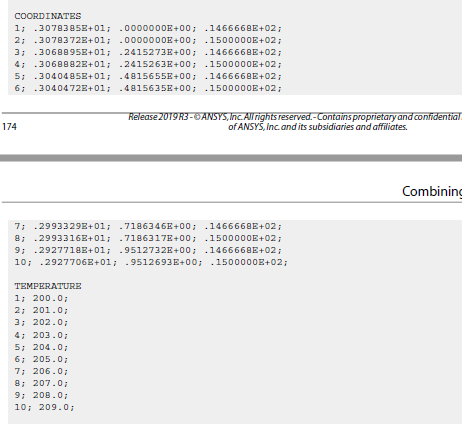 The example is for the one when the field name TEMPERATURE. The field name must match with the known name in polyflow. Other typical field names are VELOCITIES, PRESSURE, THICKNESS. For further details, please refer to user's guide: https://ansyshelp.ansys.com/account/secured?returnurl=/Views/Secured/corp/v212/en/poly_pf/pf_ug_sec_mesh_csv_initialize.html
When the parison in a blow molding simulation is a 3D volume like from the extrusion simulation, the 3D parison fluid shape geometry can be exported from the extrusion simulation to the ansys spaceclaim/Mesher for creating the 3D element mesh, and then import into polyflow for the simulation.
Hope this answers your question.
Thanks
Yi
August 26, 2021 at 12:12 pmSubscriberAppreciate for your detailed answer !!
I'm follwing the exanmples of blow molding in ansys Tutorial Guide,
I have another quedstion now.My current project demands me to set up a viscoelastic flow for blow molding, then I select KBKZ model and derive relevant parameters through curve fitting experiment data,which is the subsititute of the previous material data of parison,however ,this change make the solving step rather slowly,later the listing viewer showes that divergence occured for field thickness(which is maintained constant in setup), I get no idea about this problem, relevant exanmples about the setup of viscoelastic flow are not available either in Guide or website, could you please give me some advice on my question, really need your help!!
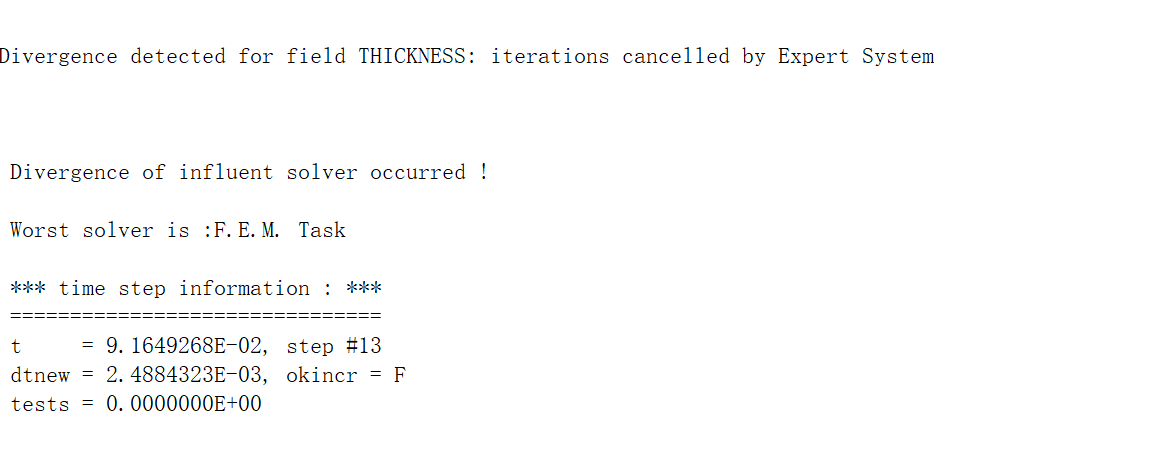
August 26, 2021 at 5:49 pmAnsys EmployeeApplying the integral viscoelastic model, KBKZ model is numerically more challenging. But I am wondering if you have confirmed whether this issue may be caused by anything related with nonuniform initial film thickness in CSV file? Have you tested if KBKZ model works with constant film thickness without using CSV file?
Thanks
Yi
August 27, 2021 at 1:32 amSubscriberTHX for your reply again!!
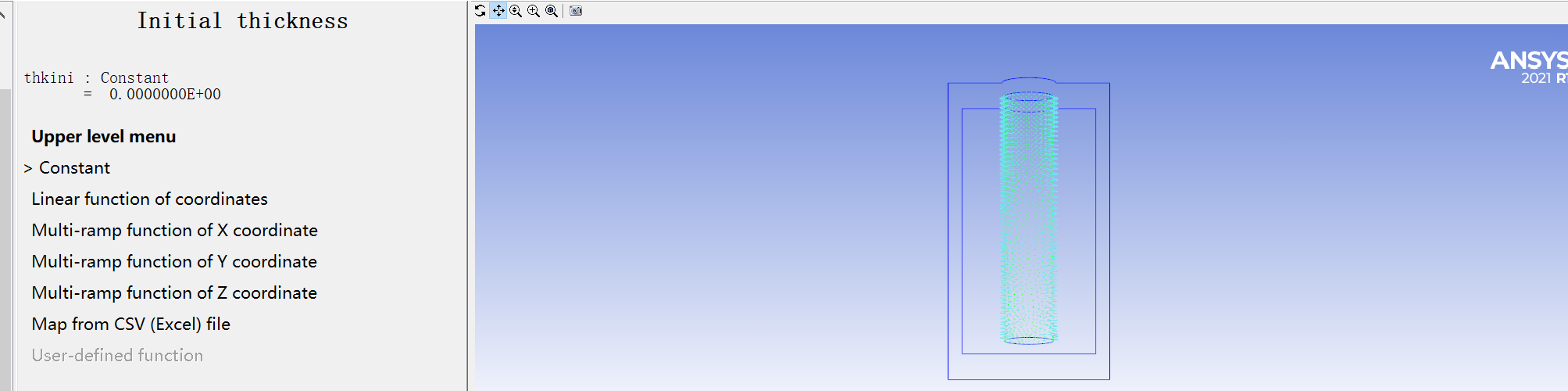
To avoid the first isuue you mentioned,I have tried to test with constant film thickness, the picture I uploaded was the corresponding result. I guess if here is something different(besides material data of parison) in the setup cell, like trasient iterative parameters or other settings, should be changed as well, since I can successfully simulate the generalized newton flow as Tutorial Guide shows.
Viewing 4 reply threads- The topic ‘set up initial thickness of blow molding in ansys polyflow’ is closed to new replies.
Innovation Space Trending discussions
 Top Contributors
-
peteroznewman
 6485
6485 -
scabo
 1906
1906 -
Dennis Chen
 1458
1458 -
javat33489
 1308
1308 -
Shyam Prasad V Atri
1022
Top Rated Tags
© 2026 Copyright ANSYS, Inc. All rights reserved.
Ansys does not support the usage of unauthorized Ansys software. Please visit www.ansys.com to obtain an official distribution.
-


The Ansys Learning Forum is a public forum. You are prohibited from providing (i) information that is confidential to You, your employer, or any third party, (ii) Personal Data or individually identifiable health information, (iii) any information that is U.S. Government Classified, Controlled Unclassified Information, International Traffic in Arms Regulators (ITAR) or Export Administration Regulators (EAR) controlled or otherwise have been determined by the United States Government or by a foreign government to require protection against unauthorized disclosure for reasons of national security, or (iv) topics or information restricted by the People's Republic of China data protection and privacy laws.

 You are navigating away from the AIS Discovery experience