

TAGGED: acceleration, remote-points, transient-structural, vibration
-
-
July 14, 2021 at 5:58 am
ayush_3
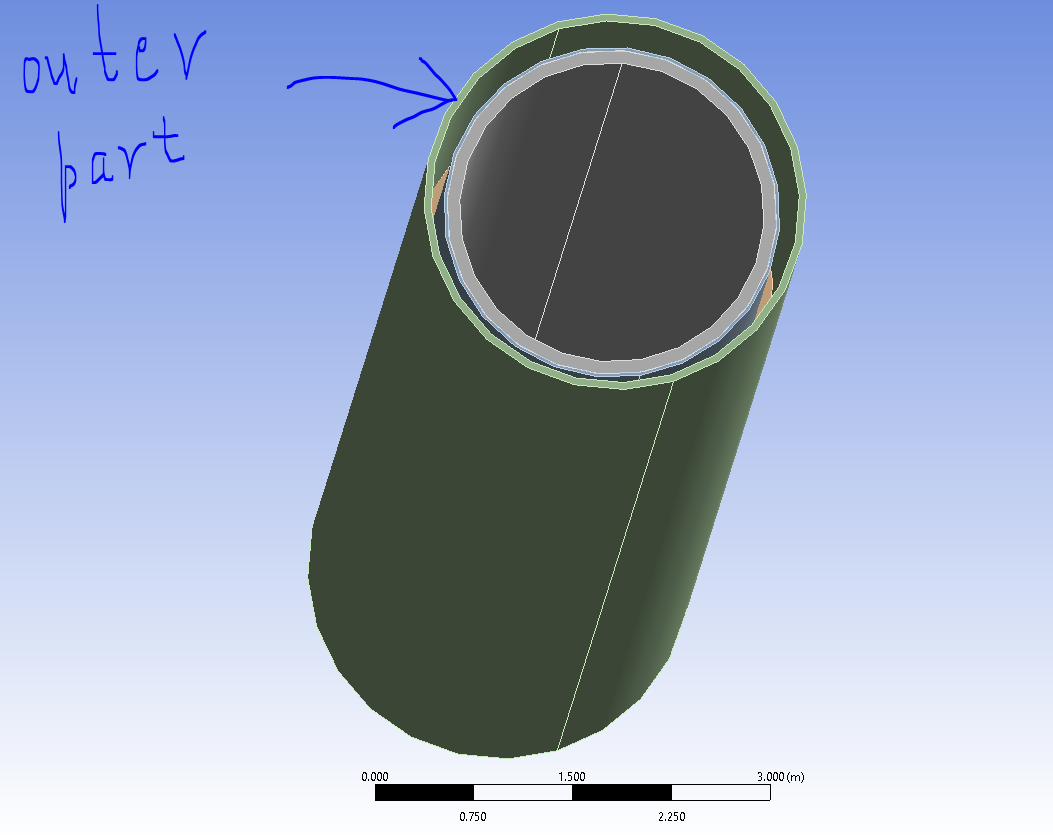
SubscriberI was performing the transient analysis and want to apply external triangular excitation to the outer part of the geometry. When I insert acceleration from the option, it can only be applied to the entire geometry and cannot be scoped to the outer part. There is no option for the Remote Acceleration in the Transient Analysis. What do I do to have the acceleration to only the outer part of my geometry? See figure below.
July 14, 2021 at 8:20 amErKo
Ansys Employee
Can you try to explain what you are doing, and what you want to analyse (how would you apply acceleration to one part in reality if it is bonded to some other parts).
Why not apply a force (can be applied to a single body)? Since as you correctly said the acceleration is for all bodies as shown in your image.
Thank you
Erik
July 14, 2021 at 8:43 amSubscriber
I want that outer body to shake and see the deformation and acceleration of the inner article, which has been padded with hyperelastic material from the outer covering. How do I achieve this?
I was thinking of applying the shocks in the form of acceleration to the body's outer covering and seeing the inner article response. But you are saying this isn't possible.
Should I fix the inner article's inner surface in the direction in which shocks (acceleration) have been applied? Will that do what I want to achieve?
One more doubt: What does it mean when Ansys apply acceleration to all bodies, there must be some point/surface onto which acceleration has been applied, so what is that point/surface?
July 14, 2021 at 8:59 amAnsys Employee
That is much clearer now.
See the reference and help manual for accelerations in a transient analysis (acceleration is a global load and is applied to the entire model).
So in general, you need to model and capture the physics of this part as it is in its physical environment, hence apply the closest boundary conditions and loads that represent the real physical situation.
E.g., one could use a force (which will cause movement of the outer part) scoped to the outer part (say an outer face) and see how much is transmitted to the inner part, just as one can do when looking at transmission and vibration isolators.
All the best
Erik
July 20, 2021 at 1:36 pmSubscriber
Someone on Youtube says we can apply acceleration to components and individual bodies using APDL commands, and I have no idea about this. Can you please confirm?
Thanks
July 20, 2021 at 1:38 pmAnsys EmployeeHi
Please ask that person (on youtube), to clarify how it was done.
Thank you
Erik
October 6, 2023 at 7:59 amShirsa Nandy
SubscriberHi. Could you kindly provide the link to that youtube video and could you resolve your issue? I am also facing the same problem
Viewing 6 reply threads- The topic ‘How to apply acceleration at one part (not entire body)?’ is closed to new replies.
Innovation Space Trending discussions
 Top Contributors
-
peteroznewman
 6495
6495 -
scabo
 1906
1906 -
Dennis Chen
 1458
1458 -
javat33489
 1308
1308 -
Shyam Prasad V Atri
1022
Top Rated Tags
© 2026 Copyright ANSYS, Inc. All rights reserved.
Ansys does not support the usage of unauthorized Ansys software. Please visit www.ansys.com to obtain an official distribution.
-


The Ansys Learning Forum is a public forum. You are prohibited from providing (i) information that is confidential to You, your employer, or any third party, (ii) Personal Data or individually identifiable health information, (iii) any information that is U.S. Government Classified, Controlled Unclassified Information, International Traffic in Arms Regulators (ITAR) or Export Administration Regulators (EAR) controlled or otherwise have been determined by the United States Government or by a foreign government to require protection against unauthorized disclosure for reasons of national security, or (iv) topics or information restricted by the People's Republic of China data protection and privacy laws.

 You are navigating away from the AIS Discovery experience