TAGGED: fluent, steady-state, transient-simulation
-
-
June 12, 2021 at 8:35 am
Darnok
SubscriberHi,
I have a question about steady-state and transient simulation.
I am simulating a heat problem with natural convection in a closed domain with the aim on the stationary solution.
Since my temperature differences are high (between 850°C in the inside of the simulated ofen, and 20°C on the outside of the closed domain with simulated free stream convection), so I can not use bousinessq. The Ansys-Fluent user guide says, I have to use transient simulation, to simulate the right mass inside the closed domain.
Fluent user's guide:
When you model natural convection inside a closed domain, the solution will depend on the mass inside the domain. Since this mass will not be known unless the density is known, you must model the flow in one of the following ways:
Perform a transient calculation. In this approach, the initial density will be computed from the initial pressure and temperature, so the initial mass is known. As the solution progresses over time, this mass will be properly conserved. If the temperature differences in your domain are large, you must follow this approach.
The thing is, in reality the closed domain is not air-tight. So the mass and density don't have to be conserved. In fact, it would be wrong.
So the thing is, I tried both transient and steady-state simulation and obviously get different solutions. I have learned from almost all the discussions, it is up to the person in front of the simulation to decide, whether it is a good solution or not.
But I just don't know, which is the right choice.
Help is very much appreciated and thanks in advance

June 12, 2021 at 8:49 amDarnok
Subscriber
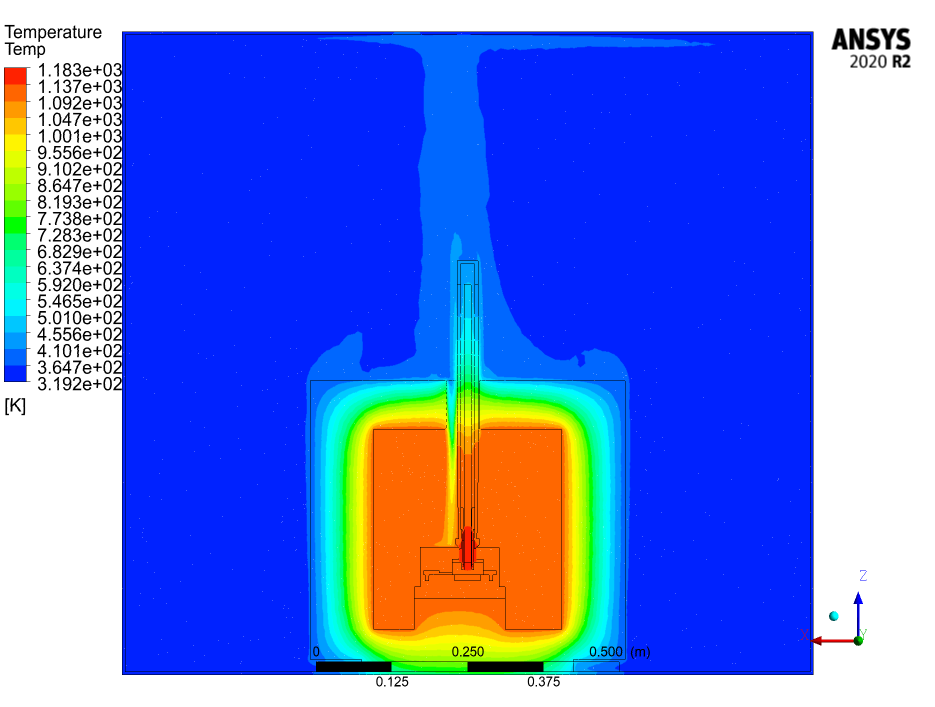
the first picture is a transient simulation
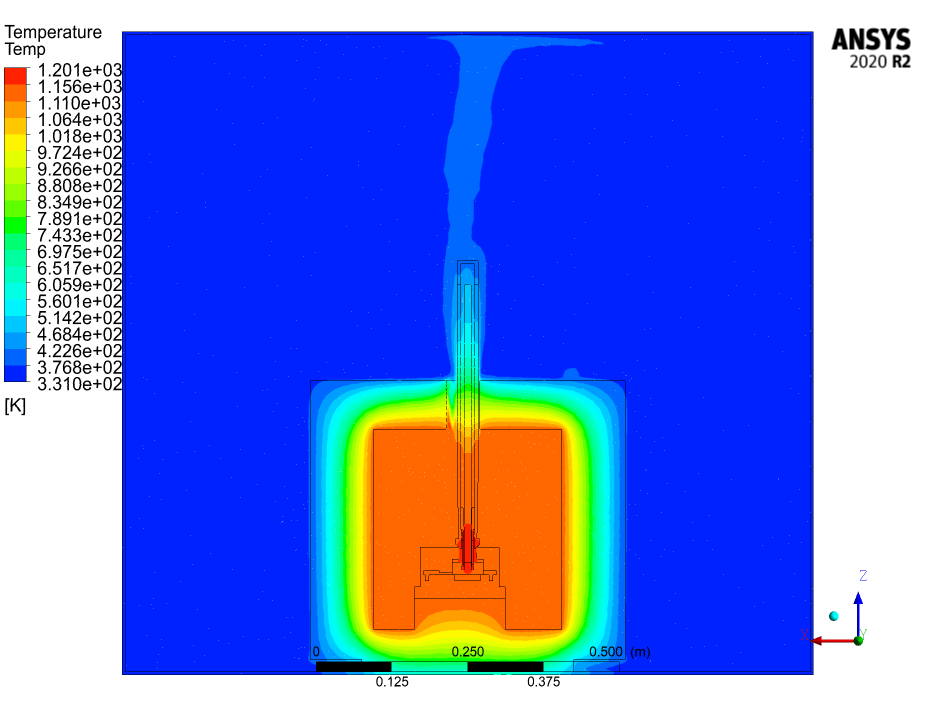
the second one is a steady-state simulation.
You can see the ofen in a closed domain of air (and a barrier of plexiglas on the outside). The inner wall of the ofen is a heated wall, inside the ofen is a ceramic housing and this rod coming from above. Inside this ceramic is another heat source as you can see with the red color.
It is simulated with laminar flow, since the air speed is low 0,6-0,7 m/s, and thermal radiation (S2S). The outside of the closed domain has free stream convection, as I mentioned above.
June 14, 2021 at 10:26 amRob
Forum ModeratorTransient will show the evolution of flow over time, steady won't. Other than that for transient if it's a sealed volume you need to vary density of fluids with temperature and pressure. For an open system you probably only need to vary with temperature in this case.
Which bits are fluid and which bits are conducting solids?
June 14, 2021 at 10:50 amDarnok
SubscriberThank you very much Rob, for the fast answer.
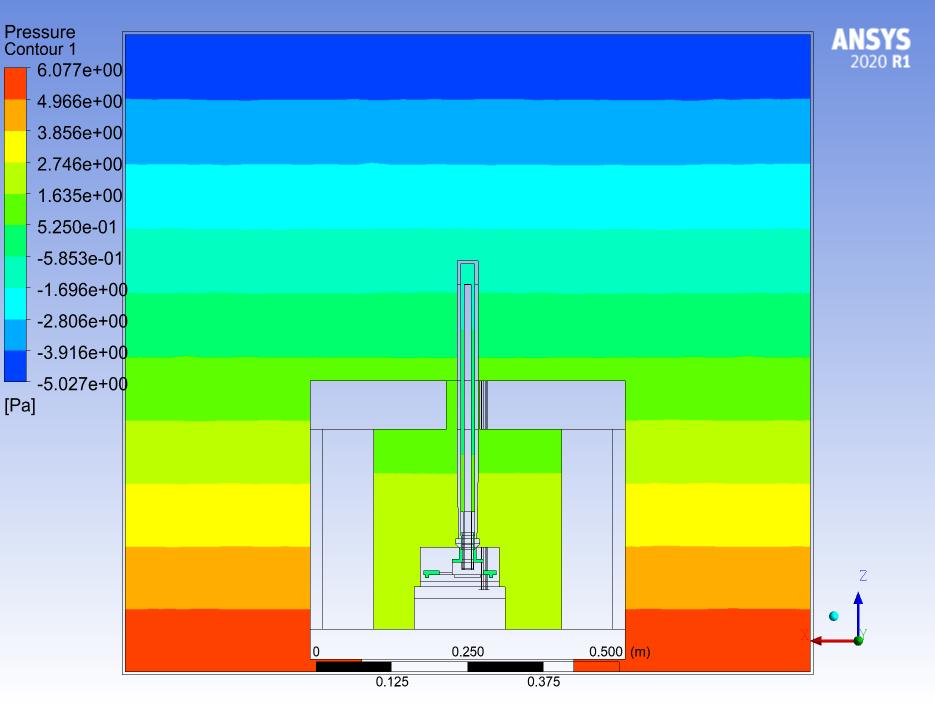
The grey parts are solids, the colored part is air.
Since I do not care about the evolution of flow over time, and the influence of pressure on the density is also not important, you think I could simulate with the steady-state solver.
I think steady-state is the right choice for my simulation. I just wanted to know, if there is another influence on the simulation by the transient solver, but the mass conservation (as stated in the user's guide on natural convection)
June 14, 2021 at 12:58 pmRob
Forum ModeratorAssuming all of the fluid regions are connected I agree. The flow is very likely unsteady (transient) as there won't be a continuous, constant, buoyant plume. The steady solver will work fine, but convergence may not be as good as in many cases. Read up on, and use, monitors to see what's going on.
How does gas enter and leave the outer casing?
June 14, 2021 at 2:09 pmDarnok
Subscriber>>Assuming all of the fluid regions are connected I agree.
The air inside the casing inside the inner casing (above the 0.250 of the scale) is connected with the air in the pipe. But this inner air region is not connected to the overall fluid region.
>>Read up on, and use, monitors to see what's going on.
The energy-residual is down to 3.95E-06 after 200 Iterations, I think that is okay.
>>How does gas enter and leave the outer casing?
In my fluent-simulation, it does not. It is closed, there are two heat sources inside the inner casing, and convection as BC on the outside of the outer casing.
In reality, it is not air tight, and gas can leave the outer casing.
June 14, 2021 at 3:14 pmRob
Forum ModeratorIf any zones are closed you MUST use either bousinesq or ideal gas. It can still be steady state, but the density model needs to be correctly set up.
June 15, 2021 at 6:02 amDarnok
SubscriberI use ideal gas.
Based on our discussion, I assume that the steady-state simulation can be used in my case. If I get it wrong and only hear what I want to hear, please let me know.
Otherwise, I'll go ahead and mark the question as answered.
Thanks a lot
June 15, 2021 at 1:42 pmRob
Forum ModeratorSteady is fine, just note my comments earlier in the thread.
Viewing 8 reply threads- The topic ‘Question about steady-state and transient simulation’ is closed to new replies.
Innovation SpaceTrending discussionsTop Contributors-
5894
-
1906
-
1420
-
1306
-
1021
Top Rated Tags© 2026 Copyright ANSYS, Inc. All rights reserved.
Ansys does not support the usage of unauthorized Ansys software. Please visit www.ansys.com to obtain an official distribution.
-