

TAGGED: adhesion, contact, contact-debonding, convergence
-
-
May 5, 2021 at 2:44 am
Ben
SubscriberI'm using CZM model to simulate the contact debonding between Silicon and a metal contact (Ag, Cu, etc).
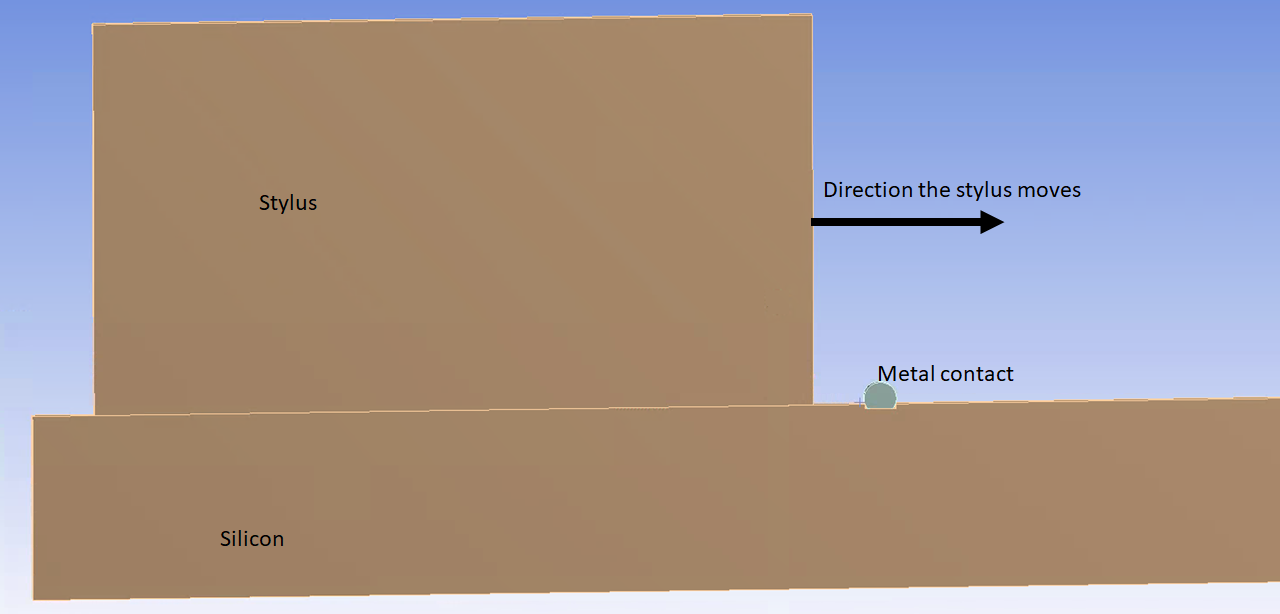
I'm using mode 2 separation-distance based debonding as the forces are mostly tangential. The simulation is made to match an experimental process where a stylus bumps against the metal contact and debonds it of the surface.
This is the geometry of the model, very simple as it only has 3 components.
May 25, 2021 at 1:07 pm1shan
Ansys EmployeeHello @Ben You might want to try a couple more things. Firstly, try increasing the artificial damping coefficient value under the CZM material property(10^-3). Debonding is generally accompanied by convergence difficulties in the Newton-Raphson solution. Artificial damping is used to stabilize the numerical solution. Secondly, you may also want to see if switching to Mode 1 debonding gets the solution to converge. Also, it looks like the metal contact will pivot against one edge of the indentation and would rotate about it. You way want to include a remote displacement at this edge with all dofs fixed except rotation about 1 axis (parallel to edge).
Regards Ishan.
Viewing 1 reply thread- The topic ‘Contact debonding between textured surfaces’ is closed to new replies.
Innovation Space Trending discussions
 Top Contributors
-
peteroznewman
 5844
5844 -
scabo
 1906
1906 -
Dennis Chen
 1420
1420 -
javat33489
 1305
1305 -
Shyam Prasad V Atri
1021
Top Rated Tags
© 2026 Copyright ANSYS, Inc. All rights reserved.
Ansys does not support the usage of unauthorized Ansys software. Please visit www.ansys.com to obtain an official distribution.
-


The Ansys Learning Forum is a public forum. You are prohibited from providing (i) information that is confidential to You, your employer, or any third party, (ii) Personal Data or individually identifiable health information, (iii) any information that is U.S. Government Classified, Controlled Unclassified Information, International Traffic in Arms Regulators (ITAR) or Export Administration Regulators (EAR) controlled or otherwise have been determined by the United States Government or by a foreign government to require protection against unauthorized disclosure for reasons of national security, or (iv) topics or information restricted by the People's Republic of China data protection and privacy laws.

 You are navigating away from the AIS Discovery experience