

-
-
May 3, 2021 at 12:45 pm
oumaimalahmar.ol
SubscriberHello,
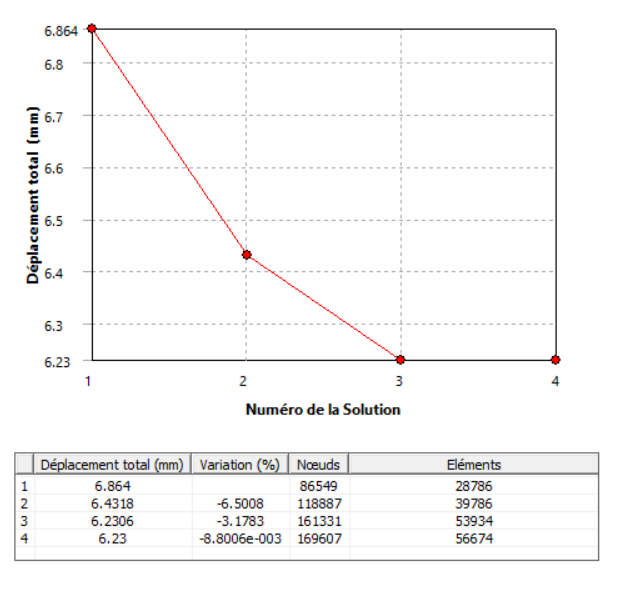
Can you help me I'm working on a tank, I did the mesh convergence to get my results, for example with a bottom thickness of 5mm and a mesh convergence I find that my membrane stress is equal to 209MPa and as soon as I increase the thickness to 6mm with the convergence I find a stress of 250MPa which is not logical at all the stress should normally decrease I don't know what the problem is.
May 3, 2021 at 1:19 pmpeteroznewman
SubscriberThere is not enough information in your post to understand the tank geometry and supports.
You show a Displacement convergence graph. Displacement converges faster than stress. How do you know the stress converged?
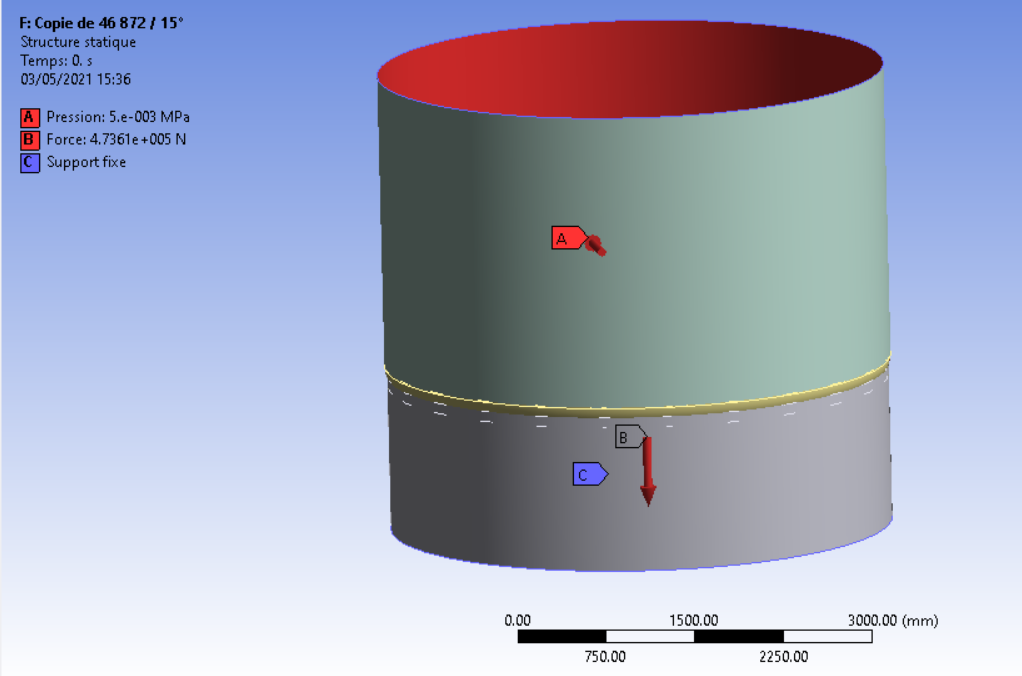
May 3, 2021 at 1:55 pmSubscriberthere is my complete model,
I applied a fixed support at the top and bottom of the tank, a pressure inside the tank of 0.005MPa and a force of 4.73e+5 MPa on the bottom of the tank.
it is not better to do my convergence study on the constraints which are elementary results contrary to the displacements which are "exact" nodal results, that is why I did the convergence on the displacement and I look at the constraints.
I work on the same model when I increase the thickness of the bottom the stress also increases when I do the convergence and without convergence the stress decreases something I did not understand
May 3, 2021 at 3:40 pmSubscriberThe Fixed Supports are introducing an artificial stress concentration into the model that is not present in the real world.
In reality, what supports the top and bottom of the tank?
There are methods of creating constraints to allow Static Structural to solve without introducing artificial stress concentrations.
For example, a Remote Displacement, Behavior = Flexible, could be used on the bottom circle. All six DOF should be set to zero.
Why do you need a Fixed Support on the top of the tank? Try solving with that suppressed.
Displacement will converge in a model that includes a Stress Singularity. Stress will not converge in such a model. If you are interested in stress, you must do the mesh refinement study on stress.
You could create a 2D Axisymmetric model and have elements through the thickness of the walls to see detailed stress concentrations if the geometry is axisymmetric.
May 4, 2021 at 1:22 pmSubscriberHello, i understand you, i use a fixed support on the top of the tank to take into account the effect of the cover.
it is better not to do my convergence study on the constraints which are elementary results contrary to the displacements which are "exact" nodal results that's why. you find the complete geometry of my model.
Thank you
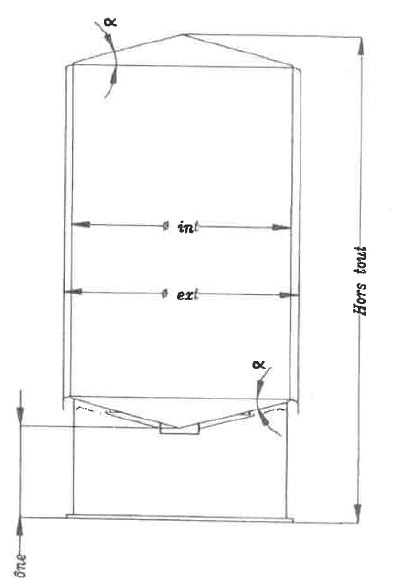
May 4, 2021 at 9:07 pmSubscriberYour model should include the cylindrical support barrel below the bottom of the tank. The fixed support can be on the bottom of that cylinder and you can ignore the stress around the fixed support.
Your model should include the cover. The cover is flexible while a fixed support is not, so the fixed support does not give a good result for the stress at the top of the tank.
May 5, 2021 at 6:27 amSubscriber
I did not understand what you mean bythe cylindrical support barrel, instead of applying the fixed support on the edge of the skirti apply a remote displacement and i took the cover, but always the same problem,
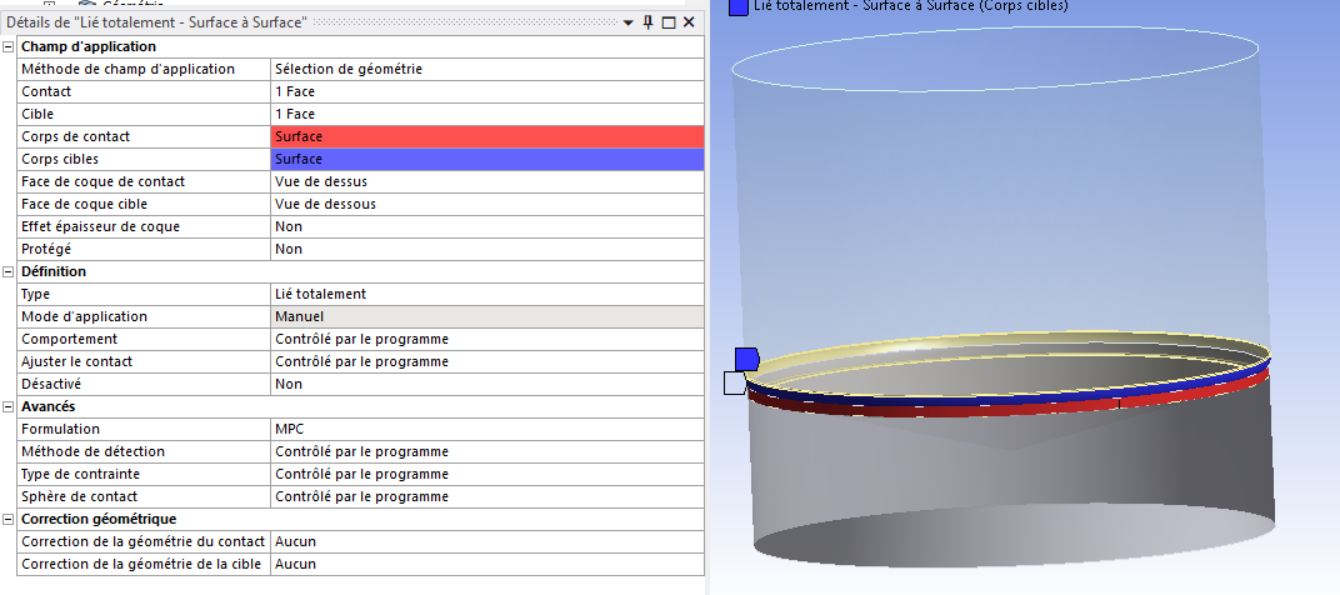
May 5, 2021 at 6:58 amSubscriberwhat I noticed that the singularity of the constraints is caused by the contact
when i don't create the contact on workbench and I use the parter option on spaceclaim my model converges but it's correct what i do i dont take into account of the contact knowing that i have a totally linked contactin my model.
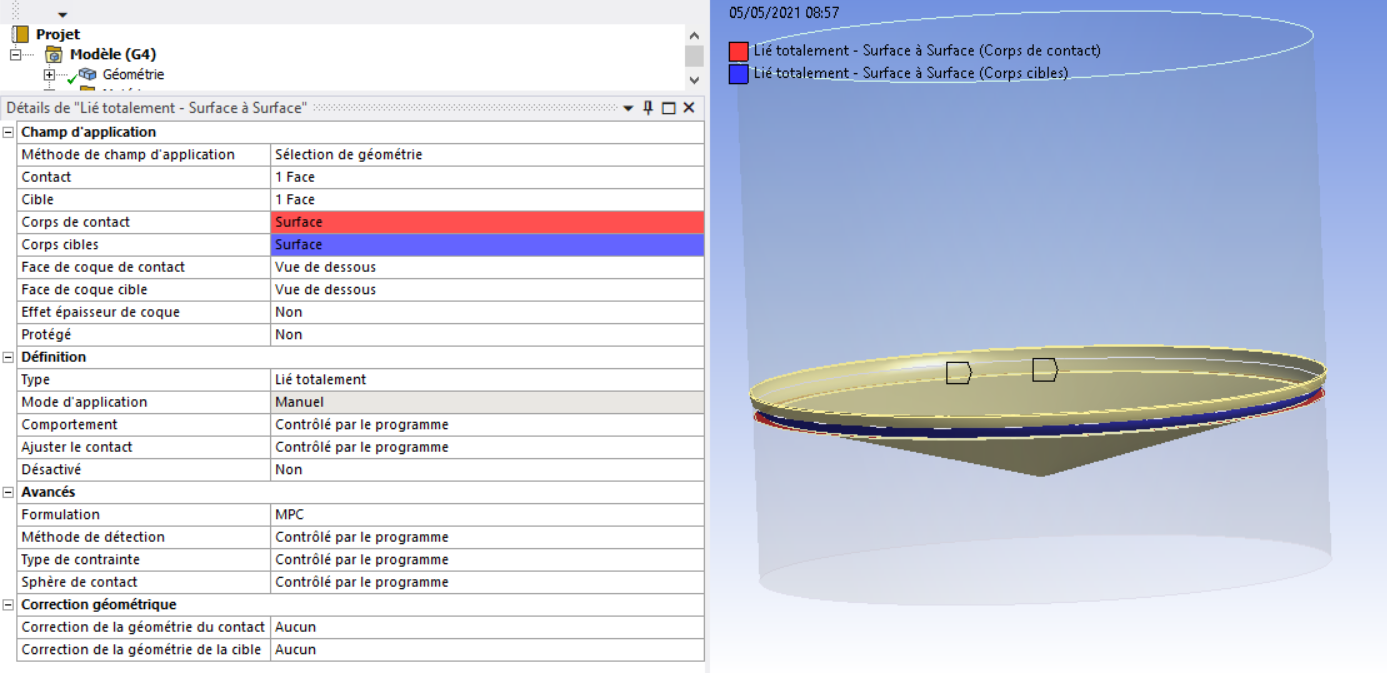
May 5, 2021 at 11:18 amSubscriberThe last image helped me to understand that your model does include the cylindrical support barrel.
If the bottom of the tank is welded to the support barrel, then using Shared Topology in SpaceClaim and having no contact is an accurate model.
If the bottom of the tank is sitting on the support barrel, then frictional contact is appropriate. If you are getting stress concentrations, you might need more detailed geometry to more accurately represent the stress.
You could create a 2D Axisymmetric model and have elements through the thickness of the walls to see detailed stress concentrations if the geometry is axisymmetric.
May 5, 2021 at 11:33 amSubscribernormally the bottom is welded to the support barrel,
my manager wants me to work with the complete model dont use the axisymmetric.
thank you for your response i want just know the way ANSYS treats parts with shared topology is like a bounded contact.
May 6, 2021 at 11:53 amSubscriberShared topology is the best option to cleanly connect two parts that have a continuous, full-penetration weld joining them.
Bonded contact is less desirable because there may be more or less nodes connected depending on the pinball radius and the varying location of nodes on each part.
May 7, 2021 at 8:56 amSubscriberThank you so much
Viewing 11 reply threads- The topic ‘Problem in membrane stress’ is closed to new replies.
Innovation Space Trending discussions
 Top Contributors
-
peteroznewman
 6379
6379 -
scabo
 1906
1906 -
Dennis Chen
 1457
1457 -
javat33489
 1308
1308 -
Shyam Prasad V Atri
1022
Top Rated Tags
© 2026 Copyright ANSYS, Inc. All rights reserved.
Ansys does not support the usage of unauthorized Ansys software. Please visit www.ansys.com to obtain an official distribution.
-


The Ansys Learning Forum is a public forum. You are prohibited from providing (i) information that is confidential to You, your employer, or any third party, (ii) Personal Data or individually identifiable health information, (iii) any information that is U.S. Government Classified, Controlled Unclassified Information, International Traffic in Arms Regulators (ITAR) or Export Administration Regulators (EAR) controlled or otherwise have been determined by the United States Government or by a foreign government to require protection against unauthorized disclosure for reasons of national security, or (iv) topics or information restricted by the People's Republic of China data protection and privacy laws.

 You are navigating away from the AIS Discovery experience