

-
-
May 2, 2021 at 9:53 pm
SteveSmith
SubscriberHallo,
I am investigating the influence of different roots of the cantilever beam. Unfortunatly, i cann´t validate any of my results becaurse of singularities in the coners of the fixed support. Is there any workaround to get finite results despite the singularity?
May 2, 2021 at 10:00 pmpeteroznewman
SubscriberThe way to study a cantilever beam is to have a large blend radius at the base of the beam where it intersects a larger plate or solid block volume. Put the Fixed Support on the side faces of the solid block so that those faces are separate from the face of the block where the beam base intersects the block with the large blend radii.
Also, don't apply the force to the edge of the tip of the beam, apply it to the whole end face.
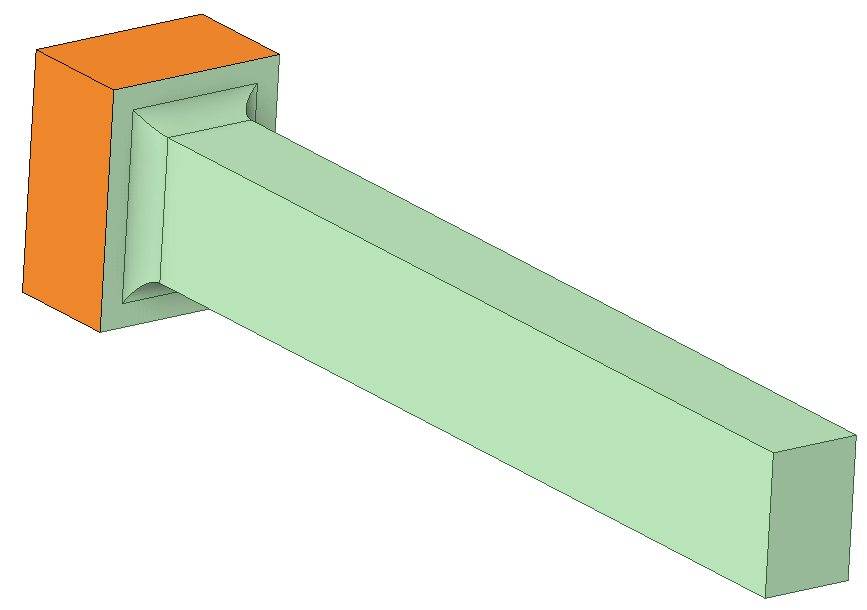
May 2, 2021 at 10:22 pmSubscriberDid you mean some thing like this?
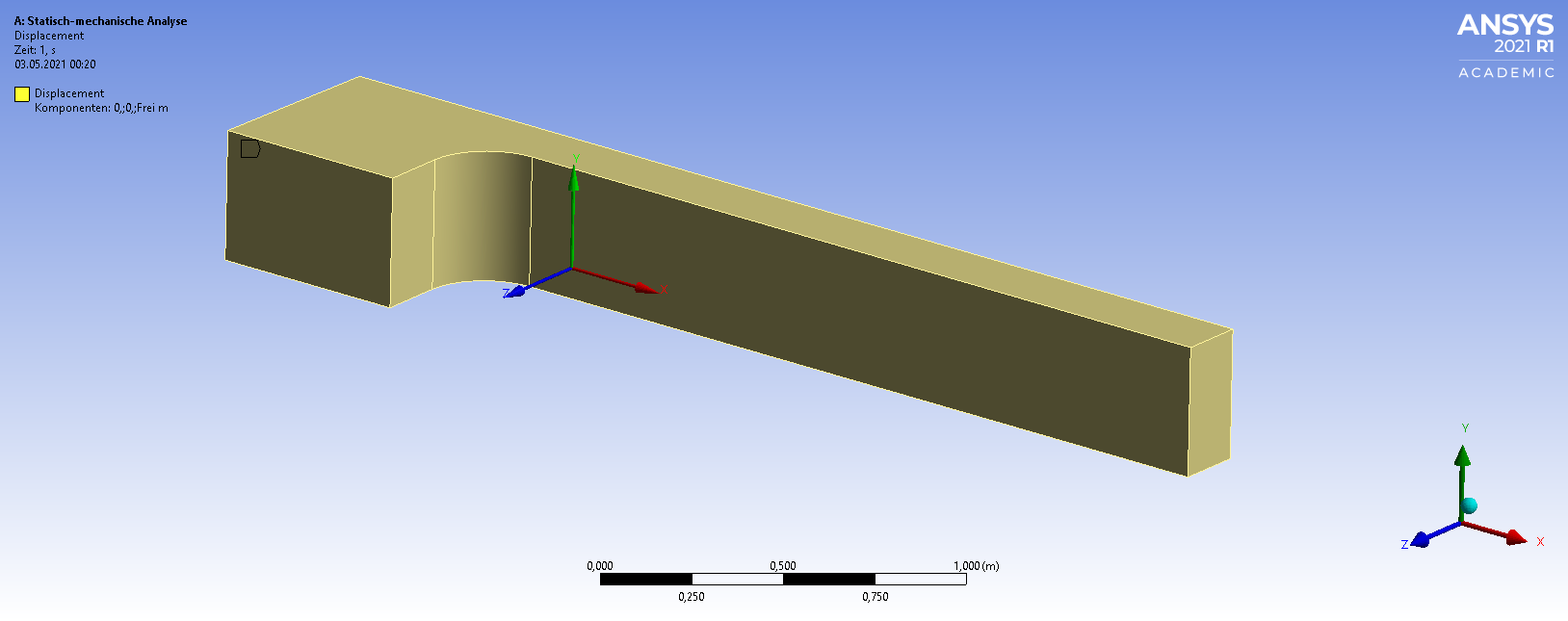
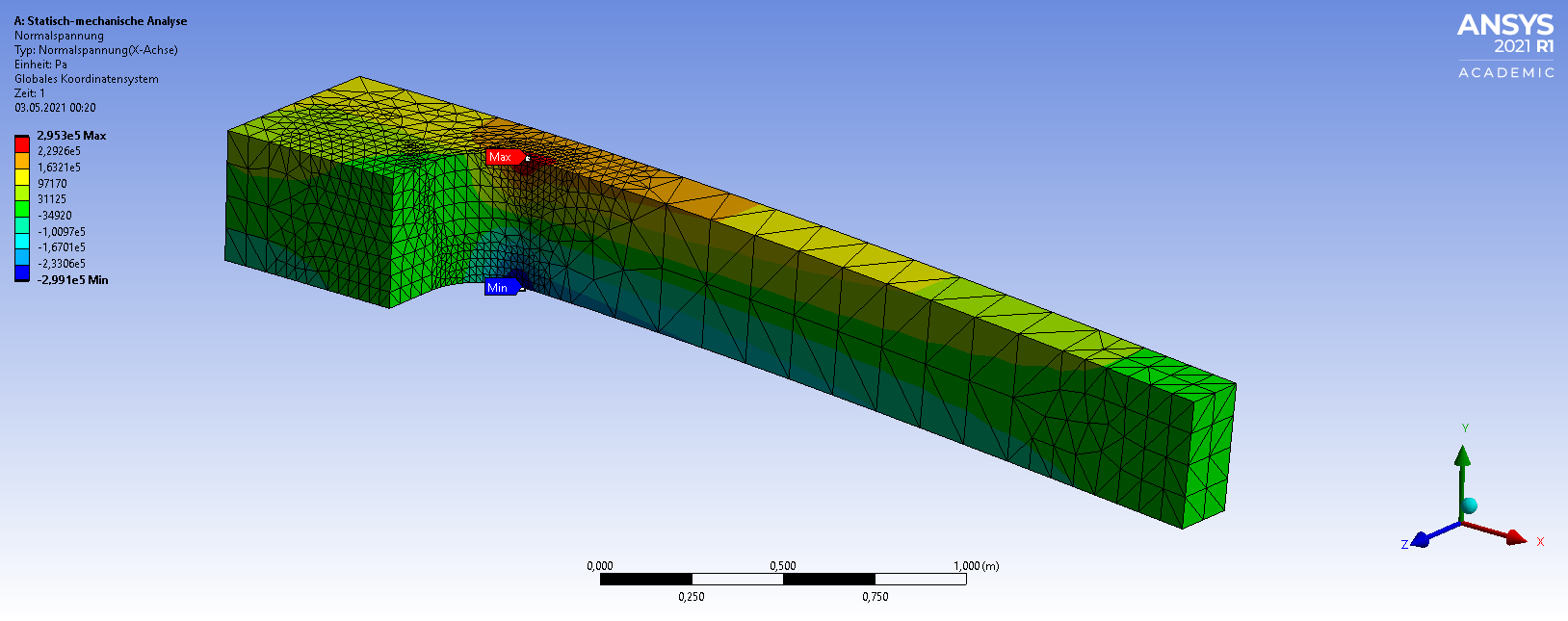
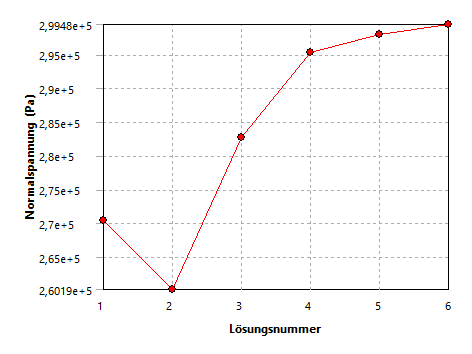
May 2, 2021 at 11:28 pmSubscriberYes exactly. Now you have a shape where the peak stress converges on the true value.
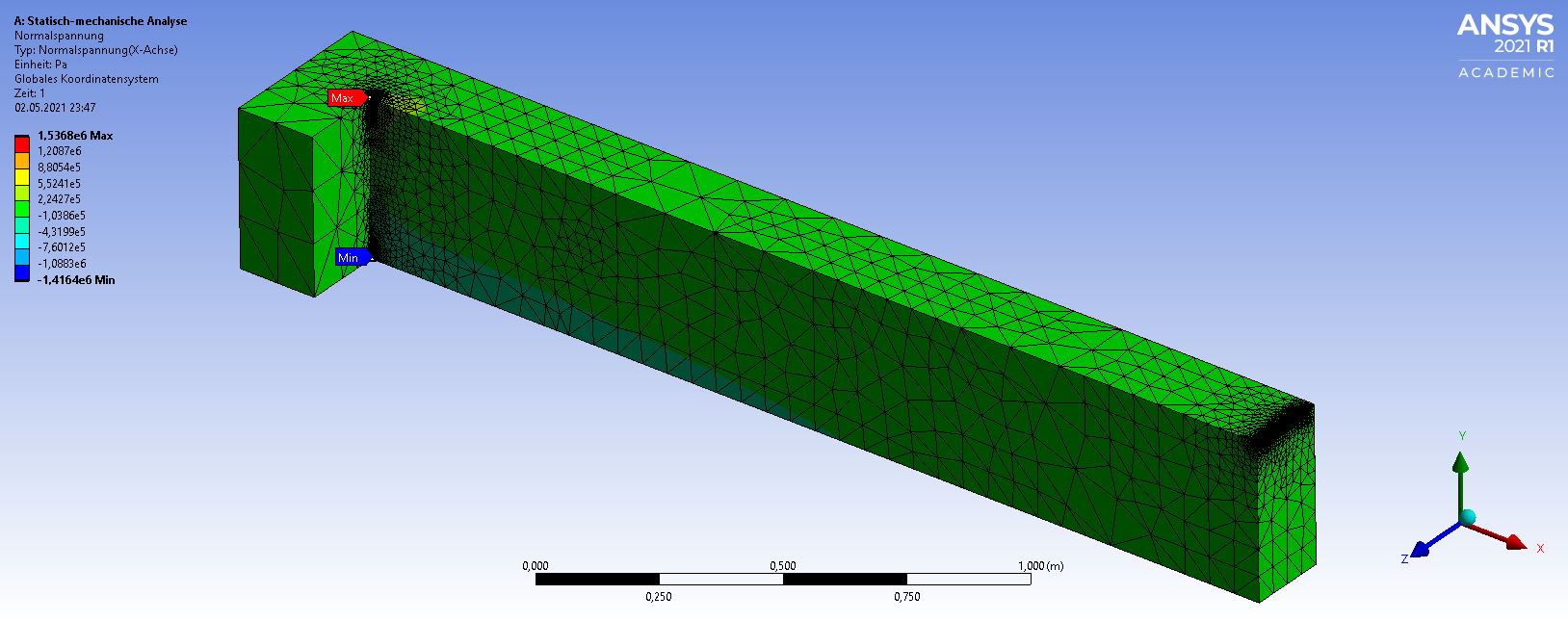
May 3, 2021 at 8:01 amSubscriberresults from Ansys are still much higher than those from algebraric calculation: 262,9 kPa. (~13% more). With more area moment of inertia, we get more tension.
May 3, 2021 at 11:07 amSubscriberPlease show details of the algebraic calculation. I expect it does not include the effects of the blend radius.
May 3, 2021 at 7:21 pmSubscriber
I guess that's true. I thought that the blend radius would be interpreted as an increase in the area moment of inertia. To get an estimate in the first approximation, I calculated the bending beam with Bernouli beam theory (Sigma=M/W) without rounding at the root. H=B=378mm; L=2268mm(up to blend edge); F=893N; Radius=189mm; L_max=3005mm
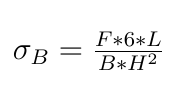 Using Bernouli beam theory, the maximum bending stress at the root should be smaller.
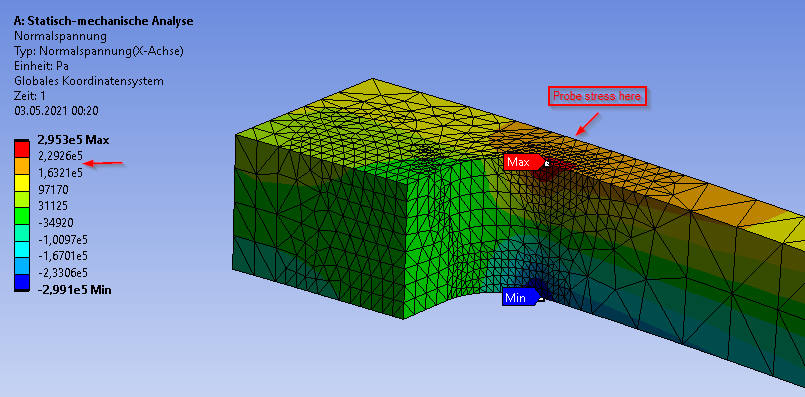
May 3, 2021 at 8:20 pmSubscriberThat equation is the root stress on a uniform cantilever. If you ignore the stress concentration and probe the stress on the continuous edge opposite the start of the blend edge, in the orange color band, what is that stress and what answer do you get from the equation?
May 4, 2021 at 5:45 amSubscriber
Orange color band from your screenshot or near normal stresscon centration in my last screenshot?
"what is that stress and what answer do you get from the equation?"
Isn't it a kind of normal stress averaged over the area? And yes the normal tension on the center line is closer to the algebraic solution than that from concentration.
May 4, 2021 at 10:55 amSubscriberThe blend creates a stress concentration. Algebraic equation computes the normal stress on a beam that has no stress concentration.
 May 4, 2021 at 7:26 pmSubscriberI tested it extensively and then extended my sample a little. Bernouli's bending beam theory provides bending stress of 2,437 * 10 ^ 5 Pa. Avarage accuracy 2,4 %, good!
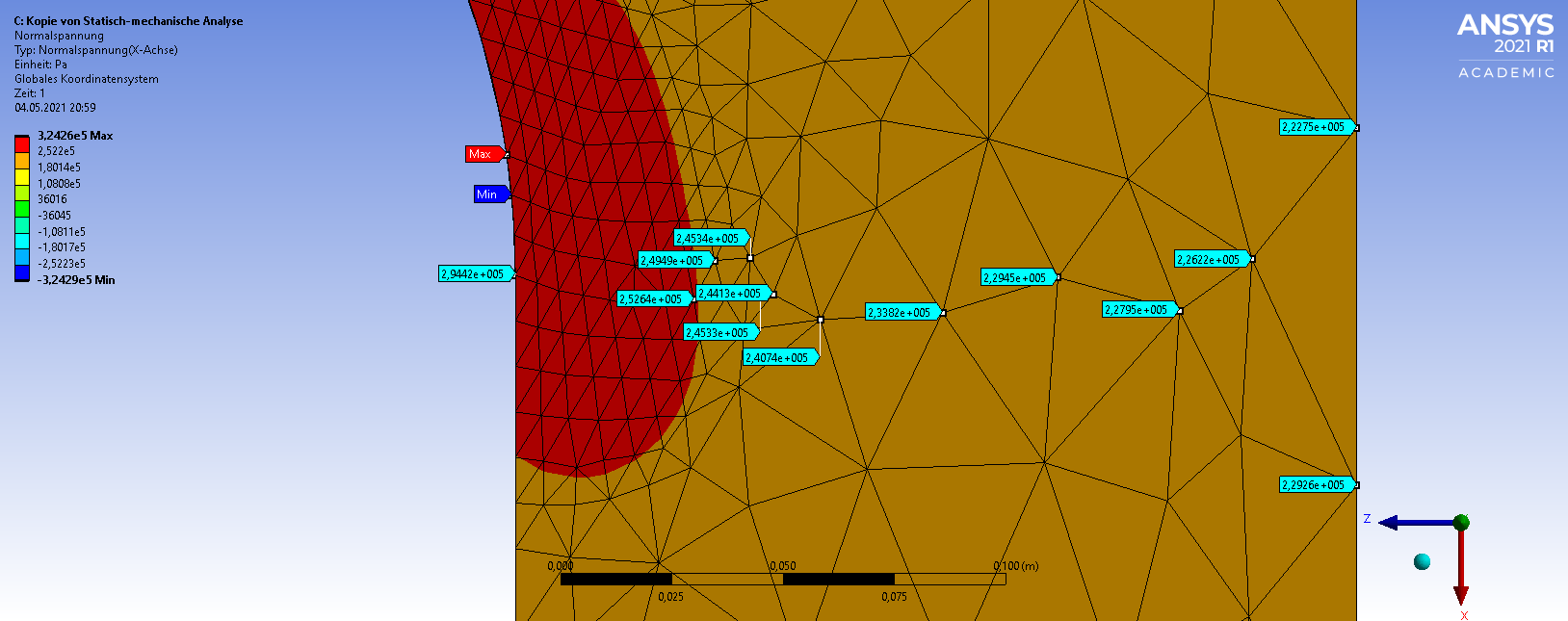 It may sound a bit stupid but, may you advise me to use a method to determine the stress concentrations algebraically / analytically.
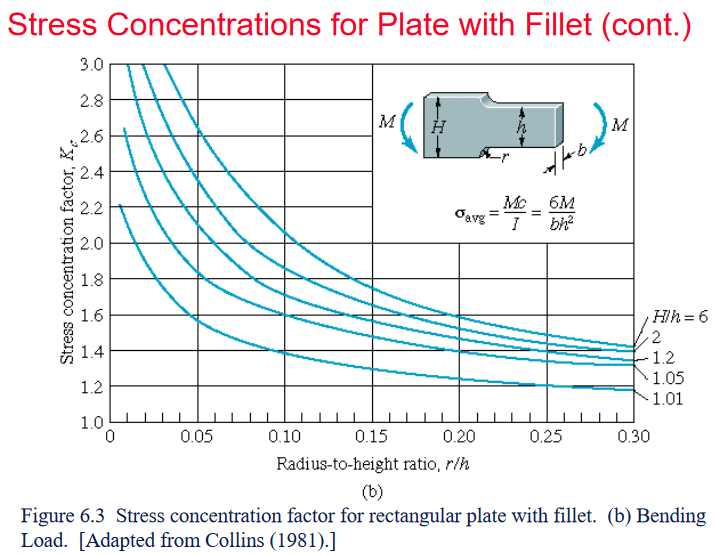
May 4, 2021 at 9:02 pmSubscriberIt's a good question. There are figures of stress concentration factors for many common geometries. Here is one reference.
https://www.ux.uis.no/~hirpa/6KdB/ME/stressconc.pdf
May 6, 2021 at 6:58 pmSubscriberThank you very much!
I have tried various things with bending stress concentration calculation. That's why a late reply.
Viewing 12 reply threads- The topic ‘Singularitys on fixed support’ is closed to new replies.
Innovation Space Trending discussions
 Top Contributors
-
peteroznewman
 6379
6379 -
scabo
 1906
1906 -
Dennis Chen
 1457
1457 -
javat33489
 1308
1308 -
Shyam Prasad V Atri
1022
Top Rated Tags
© 2026 Copyright ANSYS, Inc. All rights reserved.
Ansys does not support the usage of unauthorized Ansys software. Please visit www.ansys.com to obtain an official distribution.
-


The Ansys Learning Forum is a public forum. You are prohibited from providing (i) information that is confidential to You, your employer, or any third party, (ii) Personal Data or individually identifiable health information, (iii) any information that is U.S. Government Classified, Controlled Unclassified Information, International Traffic in Arms Regulators (ITAR) or Export Administration Regulators (EAR) controlled or otherwise have been determined by the United States Government or by a foreign government to require protection against unauthorized disclosure for reasons of national security, or (iv) topics or information restricted by the People's Republic of China data protection and privacy laws.

 You are navigating away from the AIS Discovery experience