Hi! I've often found this forum to be very helpful, so I wanted to pose a new question:
I'm attempting to produce some hand calculations that reasonably approximate Thermal Dekstop's calculation for varying day/night IR flux calculations as a spacecraft orbits a planet. Below are sample raw IR flux rates over one orbit for a nadir-pointing 1U CubeSats represented by a six-sided, black-body box with one face-centered node per surface. The simulated orbit in TD is a Basic Lunar orbit with beta angle = 25 deg and altitude = 400 km, Dark Side IR Planetshine = 5.2 W/m^2, Sun Side IR Planetshine = 1314 W/m^2.
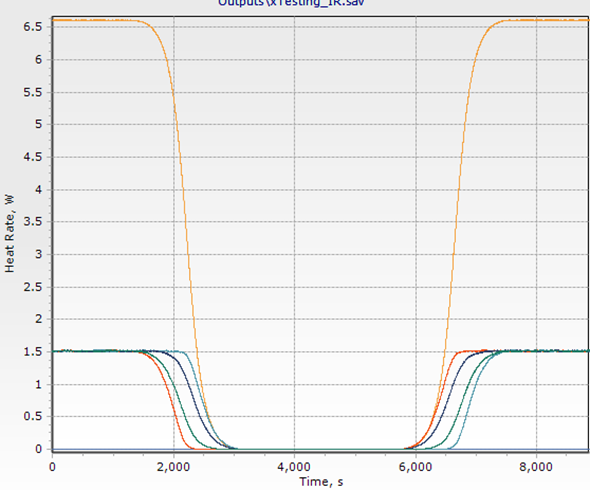
The yellow line (highest fluxes) represents the node on the nadir-facing surface, which faces the moon at all times.
I'd like to understand how the bounds are defined for when TD uses the direct input dark/sun side IR Planetshine values and how it smoothly transitions between them as the satellite approaches the terminator region.
May you please provide good insight on how the day/night IR flux values are handled for the nadir-facing surface? (Ideally any relations that help me approximate this behavior would be great)
Thanks so much!
























 You are navigating away from the AIS Discovery experience