Ansys Assistant will be unavailable on the Learning Forum starting January 30. An upgraded version is coming soon. We apologize for any inconvenience and appreciate your patience. Stay tuned for updates.
Fluids

Fluids

Topics related to Fluent, CFX, Turbogrid and more.

Representing Feed Volume As Patched Inlet For Semi-Batch Reaction In STR

    • SR786
      Subscriber

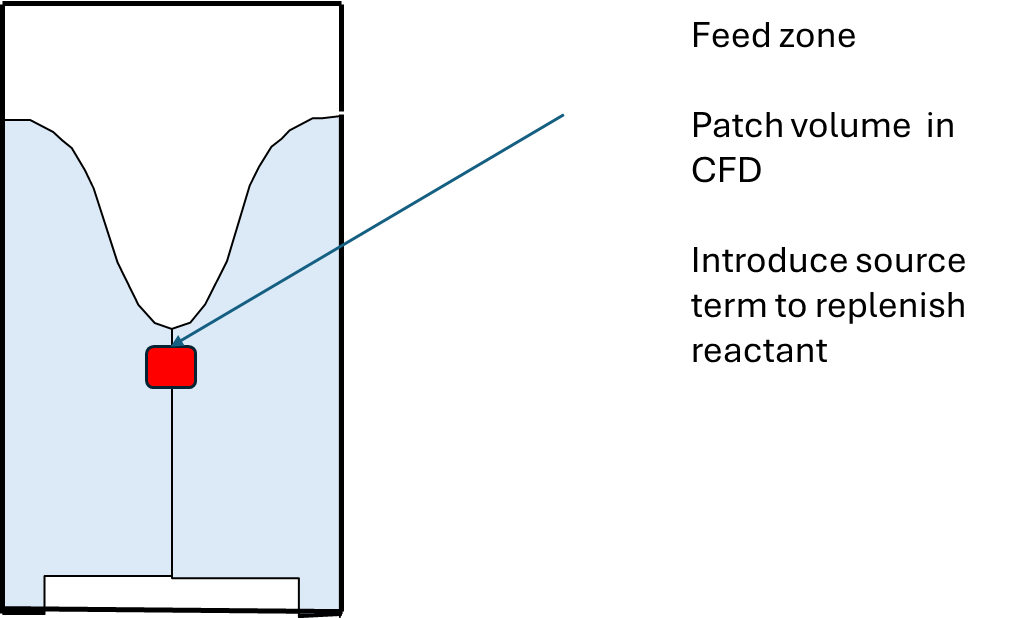
      Hello, I have ran a hydrodynamic simulation within my vessel (agitated tank with vortex) using the VOF solver. I now want to simulate feed addition for semi-batch reaction, without adding a feed pipe. From reading previous stirred tank papers (https://pubs.acs.org/doi/10.1021/ie001123v), one option is to patch a small volume representing feed zone in the tank and add source term via UDF during feed addition (see diagram below). I wanted to ask whether this is feasible and how to go about doing this?


    • Rob
      Forum Moderator

      You may want to split a cell zone for the source (not patch) if you're adding mass. If you just want to track species then patch to a cell register.  

    • SR786
      Subscriber

      So by splitting zone, source term can be introduced (mass flow rate). Then patch is used to define mass fractions of species in this zone?

    • SR786
      Subscriber

      Or do I in this new zone define a total mass source term (total mass flow rate added) and add source terms for whichever species are introduced (M_total * Y_i)?

    • Rob
      Forum Moderator

      Do you want to add mass, or just a tracer? If you're adding mass, you need a source of mass AND species at the same rate. 

      Patch would be a one off tracer addition, where you don't add any mass and just change the species mass fraction in that zone. 

    • SR786
      Subscriber


      Okay, so this is not tracer addition but instead a precipitation reaction involving CaCl2 (aq) + Na2C2O4 (aq) + H2O → CaC2O4.H2O (s) ↓ + 2NaCl (aq)

      In fluent, each aqueous solution is represented as disscoiated ions (CaCl2 → Ca^2+ + 2Cl^-; Na2C2O4 → 2Na^+ C2O4^2-)

      Calcium chloride is being fed into the reactor and sodium oxalate is pre-charged. So I wanted to ask, within the feed zone I am adding volume flow rate of 1.11 mL/s or mass flow rate of 1.11 g/s of calcium chloride solution which contains calcium ions, chloride ions and water (last species in mass balance, solved via Y_water = 1 – SUM(Yi).

      So do I add following source terms in this feed zone:


      1. Ca^2+ ion = M_tot * Y_ca
      2. Cl^- ion = M_tot * Y_cl
      3. Na^+ ion = C2O4^2- ion = 0 (Default)
      4. Total mass = M_tot

    • SR786
      Subscriber

      Also another thing I wanted to ask, I am assuming negligble influence of feed jet on local flow pattern which I have confirmed from doing a fully coupled simulation. Would it be reasonable to switch off flow equations and just have mass/species source term here without needing momentum source term?

    • Rob
      Forum Moderator

      If you don't need to worry about mass addition (ie it's a replacement of material rather than addition of) then yes you can switch off flow & just model species. If you're adding mass then you need to model flow otherwise where is the extra mass going? 


    • SR786
      Subscriber

      My simulation involves adding 20 mL of calcium chloride solution into 2 L volume of sodium oxalate in reactor, I thought because this volume change is neglible (the change in free surface height is 1% from fully coupled CFD-PBM) that I could neglect flow equations during addition period and just model species source term which will help sustain concentration and supersaturation levels in this feed zone for longer periods as compared to batch process.

    • Rob
      Forum Moderator

      If you want to add mass then you need to model it. If you want to just change a species (no added mass) then you don't need to add the mass. In your case the added mass is low, so you can either not add it & change the species, or you need to model it. Both are possible, but you need to decide which approach best suits your model.  

    • SR786
      Subscriber

      Okay no worries, 

      So for this simplified approach (assuming total liquid mass change is neglible), then I only need to add two source terms for the species being added to domain:

      1. Ca^2+ feed in
      2. Cl^- feed in

      This will ensure that the composition of two materials are being replenished within feed zone over period of feed addition time.

      Mass source is left as 0?

    • Rob
      Forum Moderator

      That should work, you'll see a slight loss in the last species in the mixture list (at a guess that's water). Mass source is zero as you're converting last species into the two ions you noted. 

    • SR786
      Subscriber

      Yes,I also do have consumption source terms (Ca and Cl) and generation source terms (CaC2O4H2O) in the feed zone based on precipitation reaction which will be in the feed zone as well. So the source terms will look like: 

      S_Ca = S_feed,Ca - S_precip,Ca
       
      S_Cl = S_feed,Cl
       
      S_oxalate = -S_precip,oxalate
       
      S_COM = +S_precip,COM
       
      and S_water will make up remaining balance
    • SR786
      Subscriber

      Okay one more thing, how do I set concentrations in the feed zone. For the inlet B.C, concentrations were set from mass fractions of species. However, for this new source term method I can only define a mass flow rate term

    • Rob
      Forum Moderator

      You source mass/species or you can Fix concentrations (double check as I've not tried it for species) in the Cell Zone panel. Be very careful with the latter as Fluent MUST respect that value and that may do interesting things to your results. 

    • SR786
      Subscriber

      Okay, thank you for the advice

    • SR786
      Subscriber

      Another option I was considering would be to instead of patching actually model the addition period through the inlet B.C within fully coupled simulation. I can then capture jet interactions with free surface, then after feed addition is stopped (only a short perod of time, 18 s) I can then change boundary conditions, let flow field readjust (i.e., jet dissipate) and then switch off flow equations and simulate rest of process (which would be a batch process).

      This method may be better as it appears there are alot of uncertainties with trying to add a feed zone, particulalry with the dynamics of the process.

    • Rob
      Forum Moderator

      That's also an option. Using simulation is "easy" working out what to include is a little more difficult. 

Viewing 17 reply threads
  • You must be logged in to reply to this topic.
[bingo_chatbox]