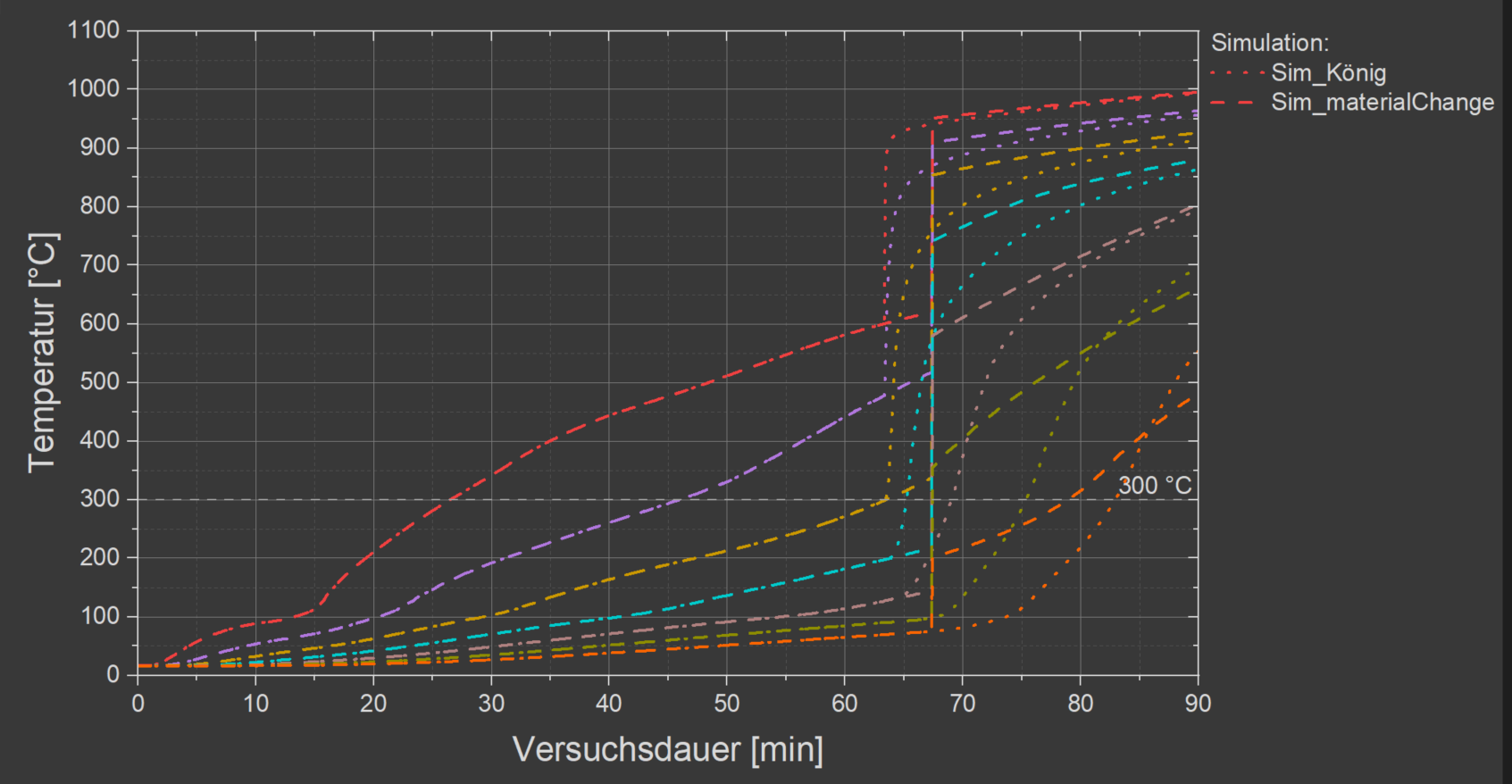
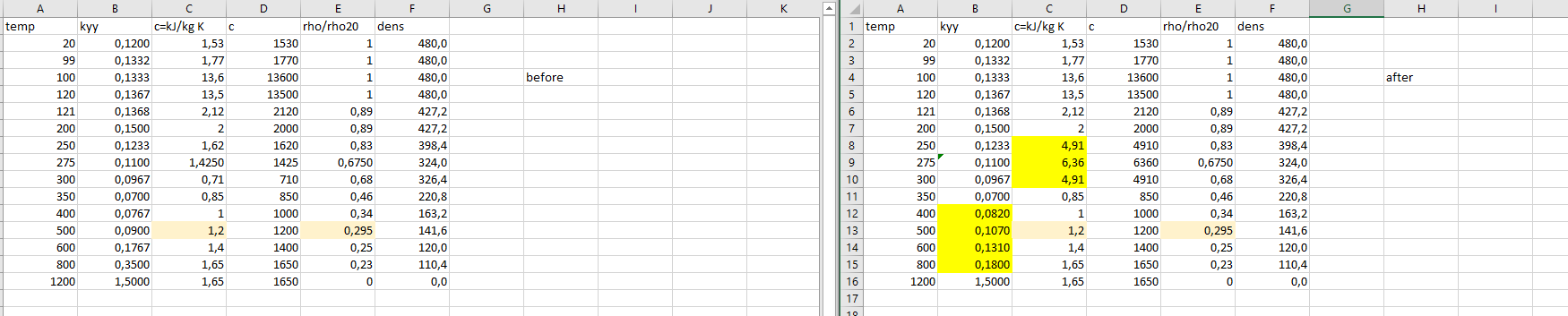
I'm doing a thermal analysis of timber with gypsum boards during fire. I want to simulate the fall-off of the gypsum board after T_timber has reached a certain temperature. My code is running and calculating correctly, but now I want to change the material property data of timber after the fall-off. I implemented the switch, but now I get a jump in my temperature-time-curve in all depths of the timber after the change even if the temperature at that point is below 100°C (the change in the data only affects the data above 250°C). I have the same temperature points and the material property data is implemented correctly. Can someone help me, why this jump occurs and how I can fix it? It doesn't make sense that the temperature at a depth of 36 mm rises all of the sudden, only because the surface is now exposed. For the surface it makes sense of course.
This is my solution code: I read the material properties before as material 3 and switch them after the trigger ( the fall off of the first layer can be ignored, currently I only use one layer and kill the second one emediately). I also get the same problem if I read the material data directly during the solution process.
def SolutionWithGypsumFalloff_AnsysComputation(mapdl, total_time,time_step,t_initial,T_ambient,h_fire,Gypsum_Node,Timber_Node,Tcrit_1st, Tcrit_timber, PD_gypsum_1, PD_gypsum_2,l_timber,save=True):
#Entering solution process
mapdl.slashsolu()
#Setting Initial temperature
mapdl.allsel()
mapdl.ic("ALL","TEMP",t_initial)
#Time stepping definition
#----------------------------------------------------------------------------------------------
mapdl.kbc(0) #ramped loads
mapdl.autots("OFF") #no automatic time steps
nsteps =int(total_time / time_step)
mapdl.nsubst(1,1,1) #no further substeps
#----------------------------------------------------------------------------------------------
depth_nodes = node_ids_at_depths(mapdl, PD_gypsum_1, PD_gypsum_2)
gypsum_1_killed = False
event_substeps = 50
event_steps_after = 24
event_steps_left = 0
gypsum_2_killed = False
times, Gypsum2_surface, Timber_surface,xnode_temp= [], [], [], [] #Collecting data
temps_by_depth = {y: [] for y in depth_nodes.keys()}
for istep in range(1, nsteps+1):
current_time = istep * time_step
mapdl.time(current_time)
#Setting Loads on Extra-Nodes
mapdl.run("D,100000,TEMP,%T_bulk%")
mapdl.d(100001, "TEMP", T_ambient)
# Set substeps: fine integration around the switch
if event_steps_left > 0:
mapdl.nsubst(event_substeps, event_substeps, event_substeps)
event_steps_left -= 1
else:
mapdl.nsubst(1, 1, 1)
#Solution for time-step
mapdl.solve()
#Collect temperature for checking
t_fire=mapdl.get_value("NODE",100000,"TEMP") #Temperature on Extra_node fire exposed side
t_cold=mapdl.get_value("NODE",100001,"TEMP") #Temperature on unexposed side correct?
T_gypsum2=mapdl.get_value("Node", Gypsum_Node, "TEMP") #Temperature gypsum surface
T_timber= mapdl.get_value("Node",Timber_Node,"TEMP") #Temperature timber surface
#Temperatures at depths
for y, nid in depth_nodes.items():
temps_by_depth[y].append(mapdl.get_value("NODE",nid,"TEMP"))
#Collecting data
times.append(current_time)
Gypsum2_surface.append(T_gypsum2)
Timber_surface.append(T_timber)
xnode_temp.append(t_fire)
#Check: Calculation during Loop correct?
#-------------------------------------------------------------------------------
print(f"Time: {current_time}s | Tfire(node100000): {t_fire:.2f}°C |T(100001)={t_cold:.2f}°C | Gypsum2 surface: {T_gypsum2:.2f} °C |Timber surface: {T_timber:.2f}°C")
#Check: Fall-off criterion met?
#-------------------------------------------------------------------------------
if (not gypsum_1_killed) and (not gypsum_2_killed)and (T_gypsum2 >= Tcrit_1st): #(T_timber>=Tcrit_timber): #
print("1st gypsum layer failure triggered. Switching exposure to timber.")
#1) Kill gypsum board
mapdl.cmsel("S", "gypsum1_board_elem")
mapdl.ekill("ALL")
#2) Kill surf element on gypsum surface
mapdl.cmsel("S", "Fire_surf_gypsum1")
mapdl.ekill("ALL")
#3) Activate surface element on timber (now exposed)
mapdl.cmsel("S", "Fire_surf_gypsum2")
mapdl.ealive("ALL")
#COnvection and radiation on timber element
mapdl.cmsel("S","Fire_surf_gypsum2")
mapdl.sfe("ALL",1,"CONV",0,h_fire) #Define convection on surface element using film coefficient
mapdl.allsel()
gypsum_1_killed = True
if (gypsum_1_killed) and (not gypsum_2_killed) and (T_timber >= Tcrit_timber):
print("2nd gypsum layer failure triggered. Switching exposure to timber.")
#1) Kill gypsum board
mapdl.cmsel("S", "gypsum2_board_elem")
mapdl.ekill("ALL")
#2) Kill surf element on gypsum surface
mapdl.cmsel("S", "Fire_surf_gypsum2")
mapdl.ekill("ALL")
#Change wood material properties to Kleinhenz values
#mapdl.prep7()
mapdl.finish()
# 2) change material number for currently alive timber solid elements
mapdl.prep7()
mapdl.allsel()
mapdl.esel("S","MAT","",2) # timber (old material)
mapdl.esel("R","TYPE","",2) # only PLANE292 solids (avoid SURF151)
mapdl.emodif("ALL","MAT",3) # switch to Kleinhenz material
mapdl.allsel()
mapdl.esel("S","TYPE","",2)
mapdl.esel("R","MAT","",3)
print("Alive elems with MAT=3:", mapdl.mesh.enum.size)
mapdl.allsel()
# 3) back to SOLU
mapdl.finish()
mapdl.slashsolu()
mapdl.antype("TRANS")
# 4) Transient-Optionen/Controls zur Sicherheit nochmal explizit setzen
mapdl.trnopt("FULL")
mapdl.nropt("FULL")
mapdl.kbc(0)
mapdl.autots("OFF")
#mapdl.nsubst(1, 1, 1)
#3) Activate surface element on timber (now exposed)
mapdl.cmsel("S", "Fire_surf_timber")
mapdl.ealive("ALL")
#COnvection and radiation on timber element
mapdl.cmsel("S","Fire_surf_timber")
mapdl.sfe("ALL",1,"CONV",0,h_fire) #Define convection on surface element using film coefficient
mapdl.allsel()
gypsum_2_killed = True
event_steps_left = event_steps_after
print("Simulation done")
if save:
mapdl.save()
mapdl.finish()
return mapdl, times, Timber_surface, xnode_temp, temps_by_depth, depth_nodes





















 You are navigating away from the AIS Discovery experience