Hello, all. I hope you had a good day.
I'm trying to understand how thermal radiation is set up for thin shells. I am having unintuitive results that I will explain.
-I have a cylindrical shell. It is set at 300K as an initial temperature. It does not touch any other solid. It is floating inside a big cylinder forced at 300K (also defined by shells). The mesh looks like this on a slice view:
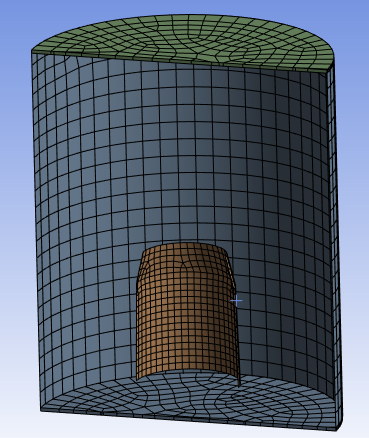
-I set thermal radiation for the outer to be this way:
Surface to surface, emissivity = 1, ambiant temperature = 200K, open enclosure, enclosure number 1, radiation from above. (the "above" being directed towards the interior of the system).
-I set thermal radiation for the cylindrical shell to be this way:
Surface to surface, emissivity = 1, ambiant temperature = 200K, open enclosure, enclosure number 1. radiation from above.
-The normals of all faces are oriented inwards. By setting "radiation from above" I then direct the radiation inward too. See below:
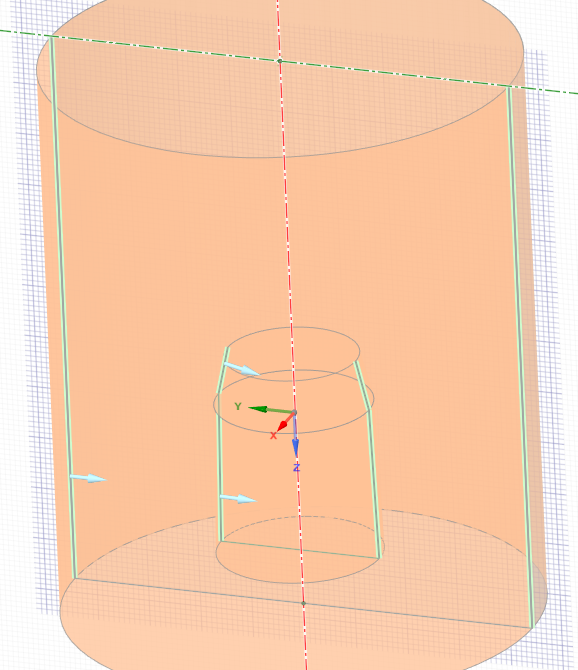
-No other thermal transfer occurs.
As you can see, my shell starts out at 300K. It is fully encased within a cylinder which is forced at 300K. In theory, the shell can only exchange radiation with either itself or the cylinder. In theory, there is no view towards the "ambiant" defined at 200K. So, we only have 300K facets that radiate with other 300K facets. No other thermal transfer occurs. Therefore, I then run a static thermal analysis. I expect the whole system to stay at 300K. Maybe, due to small numerical inaccuracies in view factor computation, it might be possible for the shell to "see" the ambiant "through" the outer cylinder, so maybe I will be a bit below 300K.
With radiation from above, the shell is mostly radiating with itself. The temperature profile of the shell is not too far off what I expect: we are standing at around 299,985K (or 26,835°C) instead of 300K (or 26,850°C)
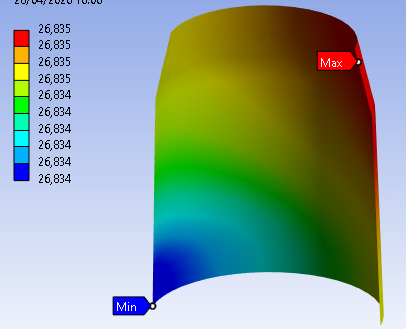
With radiation from below, that means the shell is now radiating outwards, so mostly with the outer cylinder. We lose 0,005K so it's mostly OK.
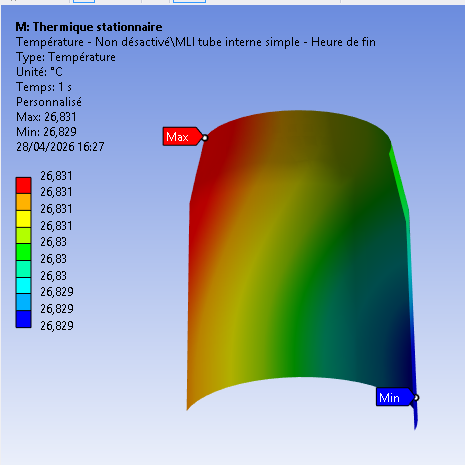
With radiation from both sides, as I understand it, radiation is emitted from both sides of the shell. And now, the temperature profile looks baffling to me. (I'll edit to show a picture). It is significantly colder, as if the shell now had a larger view factor towards the "ambiant".
My question is: what is happening here?
Best regards,
Rémi





















 You are navigating away from the AIS Discovery experience