I do a lot of combustion modeling in Fluent and often have had to fight with the Stiff Chemistry and Chemkin-CFD solvers to get a simulation to run stably, especially with the ammonia combustion mechanisms by Alessandro Stagni that I am using from the CRECK Modeling Group. Lately I've been trying to test his 2023 (https://doi.org/10.1016/j.cej.2023.144577) and 2025 (https://doi.org/10.1016/j.cej.2025.170737) mechanisms to see how wall they work for purely thermal ammonia cracking using the geometry below:
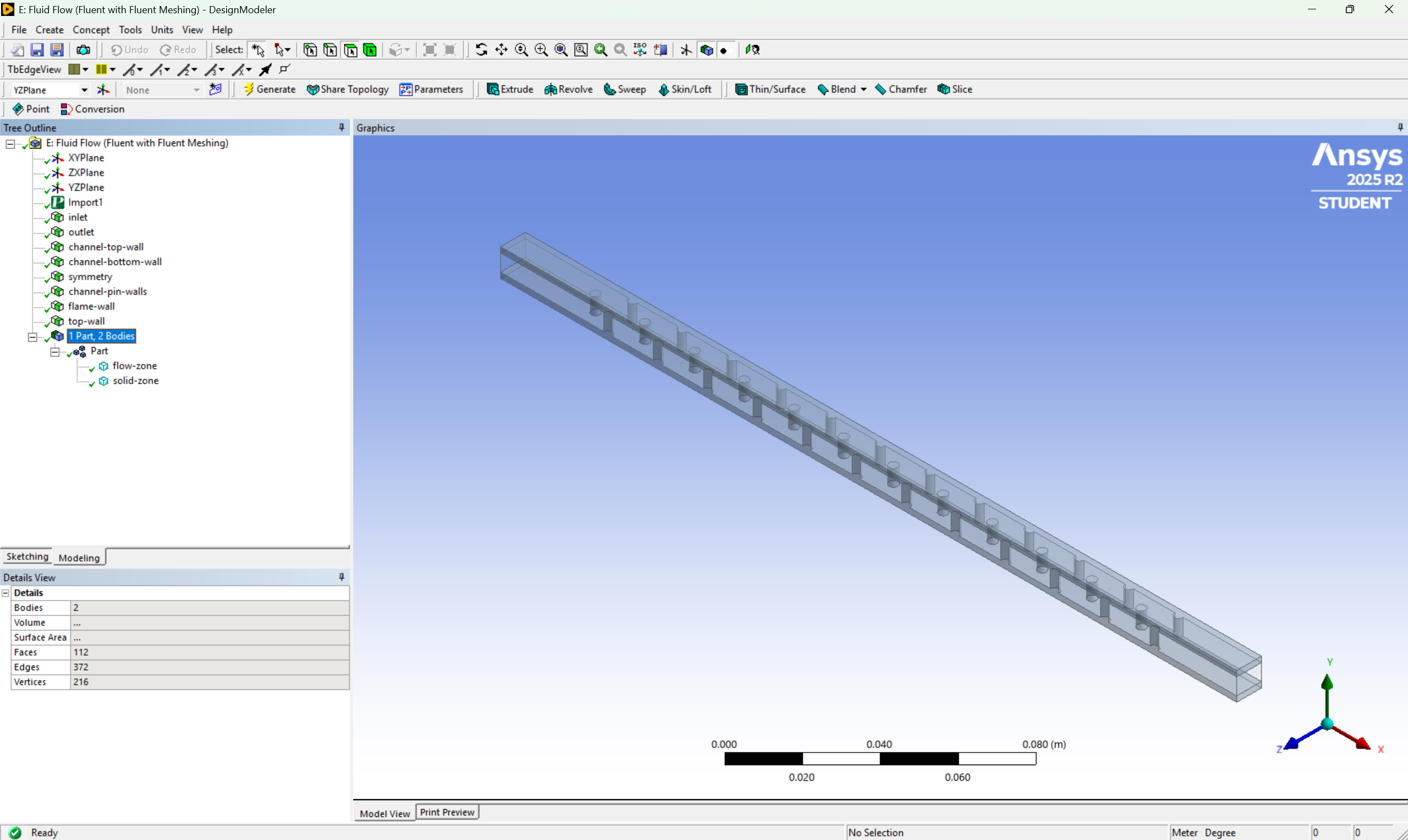
The 9mm x 6mm inlet to the channel is pure ammonia at 800 K and 5 m/s. The operating pressure is 20 bar. The bottom surface (named "flame-wall") of the solid walls will be set to a high temperature to see at what point does each mechanism show considerable cracking. I have simulated flow with the no reactions enabled and no high temperature applied to the flame-wall to then turn on the chemistry models in an attempt at calcuation stability. The mesh is over 300,000 poly-hexcore cells with 5 smooth-transition inflation layers.
The both mechanisms work okay when doing a combustion simulation, but this pure ammonia decomposition scenario is giving me major grief, especially with the 2025 mechanism. With the Stiff Chemistry solver, I get persistent DASAC failure warnings and then a SIGSEGV error a few iterations in, causing a crash. The Chemkin-CFD solver won't even get to iteration 1 without immediately throughing a floating-point error, but it won't crash Fluent. Change back-and-forth between Direct Integration, ISAT, Chemistry Agglomeration, and Dyamic Cell Clustering hasn't fixed the problem.
For general reacting flow simulations, the DASAC failures are a big pain-point of the Stiff Chemistry solver. The Chemkin-CFD solver is much more consistently stable, but I've had issues with it every so often, too. My biggest hangup with the Chemkin-CFD solver is that it won't accept mechanisms where a hydrocarbon fuel is not listed in the conventional elemental format and is instead given a placeholder name. The Stiff Chemistry solver does not have the same restriction so there are times where I would prefer to use it.
Is there any way to view and edit lower level chemistry solver settings that are not present under Integration Parameters in the Species Transport window to maybe improve the ODE integration stability of these reacting flow simulations? I've looked through the TUI in the command window and I haven't had much success there for either solver.






















 You are navigating away from the AIS Discovery experience