TAGGED: damping, response-spectrum
-
-
March 3, 2026 at 9:02 pm
matt
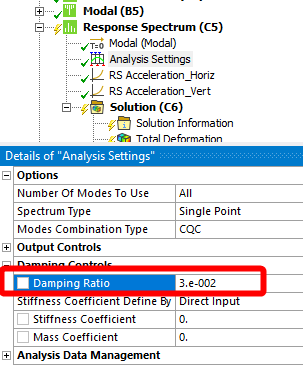
SubscriberFolks, I'm trying to understand the role of damping in a spectrum analysis in Mechanical. If the customer provides me a spectrum (Freq. vs. Accel.) that is 5% damped, I would input that to Mechanical. If using CQC or ROSE combination methods, a damping ratio can be set in Analysis Settings (image below).
Is the damping ratio field in the above image supposed to be 0.05 so that it matches the input curve from the customer? Or is the damping ratio field a different value, based on the damping characteristics of the parts being modeled?
Â
-
March 4, 2026 at 3:00 am
peteroznewman
SubscriberRevised my answer after more study. See below.
-
March 4, 2026 at 1:14 pm
matt
SubscriberWhat do you do in the case of CQC method where a non-zero damping value is required in that field. My understanding is that the damping is part of the correlation between closely spaced modes. I assume the non-zero value will add additional damping to what was baked into the input spectrum, correct? Â
-
March 4, 2026 at 4:07 pm
peteroznewman
SubscriberThe correct answer is to use the same 5% in Ansys when using the CQC method for Mode Combination for closely spaced modes as was used in the creation of the Input Spectrum. Here is my ChatGPT research (use at your own risk!)
https://chatgpt.com/share/69a86efa-a56c-8013-8041-e9161c2e5a64
Do you have closely spaced modes? Â
For critical damping ratios > 2%, modes are considered closely spaced if the frequencies are within five times the critical damping ratio of each other.

If you do, then you must use CQC or ROSE instead of SRSS Mode Combination and as you said, CQC (and ROSE) require specifying Damping under Analysis Settings.
I would be interested to read comments from analysts with experience in Response Spectrum analysis.
Here is another ChatGPT query to help explain two of the optional effects available in the RS Acceleration load details: Rigid Response and Missing Mass.
https://chatgpt.com/share/69a87dcf-3b7c-8013-892d-aa6ae7472e08

-
- You must be logged in to reply to this topic.
-
5564
-
1885
-
1403
-
1293
-
1021
© 2026 Copyright ANSYS, Inc. All rights reserved.