Ansys Assistant will be unavailable on the Learning Forum starting January 30. An upgraded version is coming soon. We apologize for any inconvenience and appreciate your patience. Stay tuned for updates.
General Mechanical

General Mechanical

Topics related to Mechanical Enterprise, Motion, Additive Print and more.

CZM fracture with Contact Debonding

    • marcin.praski
      Subscriber

      Hello everyone,

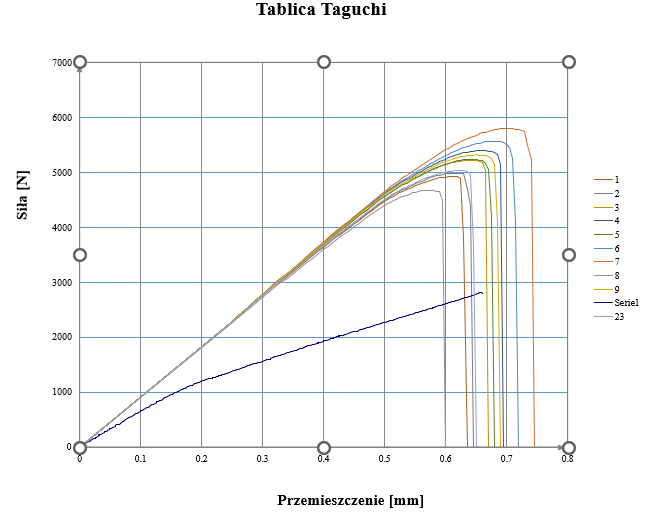
      I’m a student working on a thesis project where I performed shear tests on bonded single-lap joints (SLJ). The tests produced a force–displacement curve, and my task is to reproduce this curve in ANSYS Mechanical using CZM fracture with Contact Debonding.

      I expected this to be relatively straightforward, but I’m struggling to obtain a similar response. The simulated joint appears too stiff: the numerical force–displacement curve is much steeper than the experimental one.

      What I have tried so far: I am using fracture-energy-based debonding (CZM contact debonding). I ran a Taguchi/DOE sweep with 24 combinations of: maximum normal/tangential contact stress, and critical fracture energy for normal/tangential separation/slip.

      These parameters changed the failure behavior, but did not affect the initial curve(stiffness) of the curve.

      I also tried various contact stiffness adjustments, but these likewise did not significantly change the initial curve.

      Has anyone experienced this issue when simulating SLJ shear tests with CZM contact debonding?

      What settings or modeling choices typically control the initial stiffness in this type of model (e.g., cohesive stiffness/penalty stiffness, bondline thickness, boundary conditions, machine/grip compliance)?

    • ErKo
      Ansys Employee

      Hi

      Let us look into this and get back to you.

      thank you and all the best

      Erko

    • SHELL
      Ansys Employee

      Hello Marcin,

      Thank you for your question.

      The initial slope you should be able to get right, even before including CZM in your model. Important is to get the right elasticity data for substrates and glue and to correctly represent the geometry. 

      How do you represent the glue? I would suggest to model it with solid elements for a start.

      Also, single lap joints can have a significant amount of rotation due to the excentricity of the applied load. The less overlap and the less substrate thickness you have, the larger the nonlinear geometric effects. So large deflection effects (NLGEOM,ON) should be included.

      Best regards,

      Sascha

    • marcin.praski
      Subscriber

      Hello Sascha,
      Thank you so much for the answer.

      Im using the Fracture - Contact Debonding tool in Ansys, and in the dat file it creates a CZM script
      TB,CZM,5,1,,CBDE
      TBTEMP,22
      TBDATA,1,4.5,0.0330618,6,0.055103,0.66,0
      TBDATA,7,1.8

      My beliefe is that this creates 2D elements which simulate the debonding behaviour (please let me if Im correct) and this eliminates a need for creating addintional 3D elements with glue properties. The adhesive is extremly thin and i hoped to avoid modelling it and replacing it with, either contact behaviour or the fracture-contact debonding tool (CZM).
      The material data for both plates is from MMPDS.
      Should I disable CZM and manipulate the stiffness behaviour using contact properties?
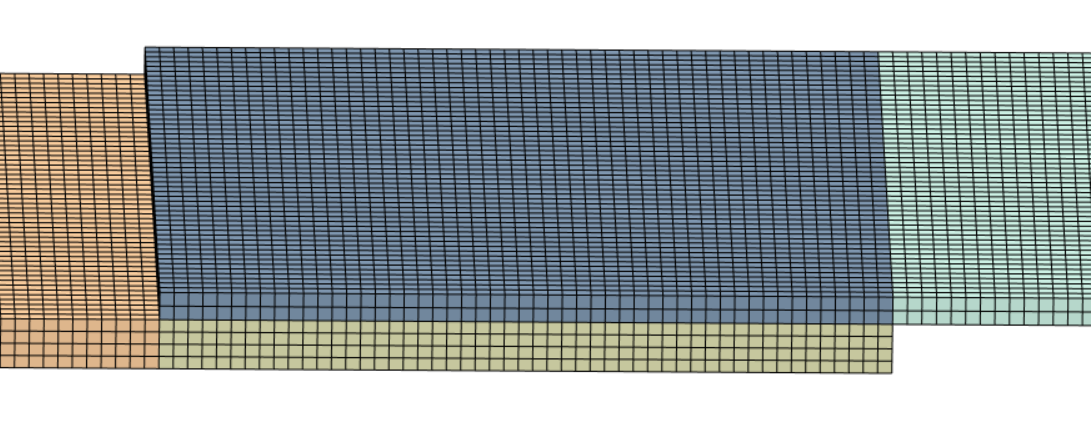
      Current contact properties:
      keyo,cid,8,2               ! auto create asymmetric contact (from Program Controlled setting)
      keyo,cid,10,1              ! Never adjust contact stiffness
      keyo,cid,12,5              ! bonded always
      keyo,cid,18,1              ! small sliding turned on by user
      keyo,cid,2,0               ! augmented Lagrange 
      keyo,cid,4,0               ! on Gauss point
      keyo,cid,9,1               ! ignore initial gaps/penetration
      keyo,cid,7,0               ! No Prediction
      rmod,tid,3,0.15     ! FKN
      rmod,tid,5,0.       ! ICONT
      rmod,tid,6,0.       ! PINB
      rmod,tid,10,0.      ! CNOF
      rmod,tid,12,0.15      ! FKT
      rmod,tid,36,3049    ! WB DSID
      rmod,cid,3,0.15     ! FKN
      rmod,cid,5,0.       ! ICONT
      rmod,cid,6,0.       ! PINB
      rmod,cid,10,0.      ! CNOF
      rmod,cid,12,0.15      ! FKT
      rmod,cid,36,3049    ! WB DSID

    • SHELL
      Ansys Employee

      Hello Marcin,

      If the glue's thickness is indeed negligible (much smaller than the plate thickness), then you can neglect it and calculate an equivalent stiffness (in the order of magnitude of E/t) and manually define that value as contact stiffness. That defines the initial slope of the traction separation law for contact-based CZM.

      Also, if you have been using linear solid elements, please consider using quadratic elements to avoid potential shear locking effects.

      Best regards,

      Sascha

Viewing 4 reply threads
  • You must be logged in to reply to this topic.
[bingo_chatbox]