TAGGED: combustion, les, unsteady-flow
-
-
January 18, 2026 at 3:09 pm
can.sumeyye
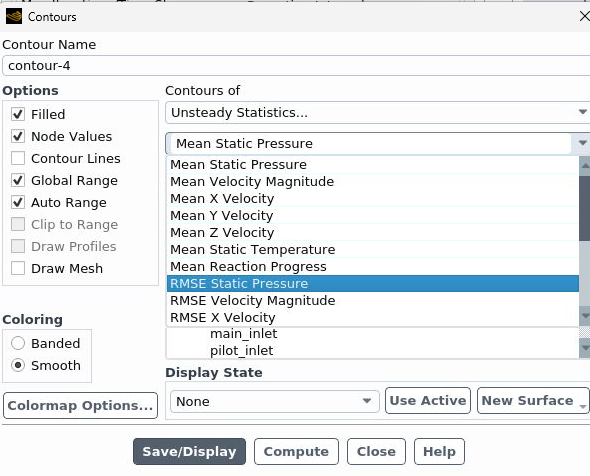
SubscriberI'm performing a LES analysis. I currently have cold flow outputs and want to check the accuracy of this LES before burning. I have experimental data for this setup, including u', axial velocity, turbulent kinetic energy, turbulent intensity, and integral length scale. I also have standard k-epsilon analysis results. I plan to use these for comparison, but I couldn't find RMS in Fluent. Under the "Unsteady statistics" heading, there's "rmse," but it contains the term "error," so I think it's something different. I also couldn't find integral length scale.ÂThank you in advance. -
January 19, 2026 at 12:45 pm
Essence
Ansys EmployeeHello,
What "error" you are referring to? Can you please share the screenshot of it?
-
January 19, 2026 at 1:52 pm
-
-
January 20, 2026 at 1:20 pm
SRP
Ansys EmployeeHi,
Integral length scale is not directly provided by Fluent. It is typically estimated based on geometry or flow characteristics. For jets or pipe flows, it is often taken as a fraction (1/4 to 1/2) of a characteristic dimension (e.g., inlet diameter, bluff body size)
-
January 20, 2026 at 4:36 pm
SamW
Ansys EmployeeIf you look into the definition of RMSE, it is probably actually consistent with what you expect. Specifically, the "error" refers to the deviation from the statistical mean for each data point, which is how rms velocity is usually considered - in regards to the velocity fluctuations (deviation from the mean), rather than the total velocity.
If you want to build an RMS velocity variable based on "total" velocity values, you would need to do that yourself. You can also look into using the TKE to approximate the RMS values based on something like sqrt((2/3)*TKE) if that sounds appropriate for your application. This can be especially helpful for RANS.

-
- You must be logged in to reply to this topic.
-
5639
-
1885
-
1403
-
1303
-
1021
© 2026 Copyright ANSYS, Inc. All rights reserved.