

-
-
January 24, 2019 at 6:20 pm
FlaviaGelatti
SubscriberHi everyone
I am working on my FE models for my PhD thesis and they keep resulting in the same anormal behavior, and can't find the solution. I hope somebody can give me a tip.
I'm modeling reinforced concrete beams with bodies simulating the support, the load is applied at mid spam.
Here is the problem: I'm using Remote Displacement (free rotation on one axis and the rest of DOF fixed) on both supports to charactize the simply supported conditions. The expected bahavior would be both support bodies rotating inwards - towards the center of the beam. But they are rotating outwards - what makes no physical sense. The attached picture shows the problem.
Although I'm using Solid185 and Link180 for Nonlinear response, this happens even in a linear analysis.
I already tried to change the location of the Remote Displacement, contact bahavior and the location of the support bodies but I had no success.
Sorry if is a simple question
Thanks in advance
Flávia
-
January 24, 2019 at 6:34 pm
jj77
SubscriberCan you send some schematic of the set up with BC (is it a 3 point bending test where the RC beam is on rollers), and where are these supports (rollers or), and the remote disp. applied? Also the truss element towards the edge (on the bottom of the RC beam) have a strange curve and then straight behaviour, like they are fixed at the end and not allowed to rotate ( I would expect them to rotate nicely and be moment free if they were beams). Perhaps something is going on there with the remote displacement.
From basic principles is the model OK, do you get the right deflections, moments, bending stresses, and so on? The axial stress at the centre of the trusses (link180), is it what it is suppose to be?
Also feel free to attach your model and we can have a closer look.
Sorry I cannot post so I add it here.
Now I am not a civil engineer, only written some code check modules and software (which is dangerous when you do not use or know the codes that well
 ), but I work with structural engineers that use Strand7,
So I have seen a couple of these curves, and normally like in your case they predict a good linear behaviour before some cracking occurs. So I think it looks good. I would do some sensitivity study on the max tensile stress limit/strength for the concrete and see if that drops the onset of failure where the slope change in the curve is seen. Other parameters might of course be important.
Now as for your question, I would fix the base (A and
 of these two supports because they are rotating in a strange way. Alternatively use compression only face supports, so they can lift of but no go down. Alternatively model the contact between that base and whatever they are resting on, not sure though if that is a bit too detailed. I hope also that you have a frictional contact between these and the bottom of the RC beam, and not bonded.
I would recommend also using solid186 for material NLA
-
January 24, 2019 at 7:54 pmSubscriber
Hi, jj77
Thanks for quick reply.
"Can you send some schematic of the set up with BC (is it a 3 point bending test where the RC beam is on rollers), and where are these supports (rollers or), and the remote disp. applied?" I attached a picture of the beam experimental scheme. The location of the Remote Displacements is exactly under de support body, right at its center (there is also a picture). I have tried to move this location up, down, far right, far left...
"Also the truss element towards the edge (on the bottom of the RC beam) have a strange curve and then straight behaviour, like they are fixed at the end and not allowed to rotate" Yes, this region is behaving in a strange way, since it dosen't have any restriction.
"From basic principles is the model OK, do you get the right deflections, moments, bending stresses, and so on? The axial stress at the centre of the trusses (link180), is it what it is suppose to be?" The results are logical during the first part of the Load versus Displacement curve of the experimental data, the linear range. But when cracking begins, and the model lose stiffness because of it, my results start to differ from the experimental data (picture attached). I belive that part of this difference must because of this anormal response. I understand that there are coefficients of the constitutive model that must be adjusted for this data fitting, but I can't adjust a material parameter based on a "weird" mechanical model. Correct me if I'm wrong.


-
January 24, 2019 at 8:01 pmSubscriber
Hi, jj77
Thanks for the quick reply.
"Can you send some schematic of the set up with BC (is it a 3 point bending test where the RC beam is on rollers), and where are these supports (rollers or), and the remote disp. applied?" Bellow there is a picture of the beam experimental scheme. The location of the Remote Displacements is exactly under de support body, right at its center (there is also a picture). I have tried to move this location up, down, far right, far left...
"Also the truss element towards the edge (on the bottom of the RC beam) have a strange curve and then straight behaviour, like they are fixed at the end and not allowed to rotate" Yes, this region is behaving in a strange way, since it dosen't have any restriction.
"From basic principles is the model OK, do you get the right deflections, moments, bending stresses, and so on? The axial stress at the centre of the trusses (link180), is it what it is suppose to be?" The results are logical during the first part of the Load versus Displacement curve of the experimental data, the linear range. But when cracking begins, and the model lose stiffness because of it, my results start to differ from the experimental data (picture attached). I belive that part of this difference must because of this anormal response. I understand that there are coefficients of the constitutive model that must be adjusted for this data fitting, but I can't adjust a material parameter based on a "weird" mechanical model. Correct me if I'm wrong.
-
January 24, 2019 at 8:20 pmSubscriber
Another try:
Now I am not a civil engineer, only written some code check modules and software (which is dangerous when you do not use or know the codes that well
), but I work with structural engineers that use Strand7,
So I have seen a couple of these curves, and normally like in your case they predict a good linear behaviour before some cracking occurs. So I think it looks good. I would do some sensitivity study on the max tensile stress limit/strength for the concrete and see if that drops the onset of failure where the slope change in the curve is seen. Other parameters might of course be important.
Now as for your question, I would fix the base (A and
of these two supports because they are rotating in a strange way. Alternatively use compression only face supports, so they can lift of but no go down. Alternatively model the contact between that base and whatever they are resting on, not sure though if that is a bit too detailed. I hope also that you have a frictional contact between these and the bottom of the RC beam, and not bonded.
Also I would consider just using on the corner where the two parts meet (support and bottom of rc beam), just to select that line of nodes on the rc beam there and apply restraint in the axial and in the load direction (thus this removes the bottom block support and the issue there).
I would recommend also using solid186 for material NLA
FInally how are the crack patterns at the onset of softening at about 10 - 15 kN of load, is it similar?
-
January 24, 2019 at 8:33 pmSubscriber
Thanks jj, I'll try these suggestions!
If I can use a little more of your experience, please: by "compression only face supports" you mean an asymmetric rigid-flexible contact?
Btw, I tried to attach my .wbpj file but I don't think it shows
-
January 24, 2019 at 8:41 pmSubscriber
Well I have not done many of these experiments myself, but I have seen a couple. I am sure you know much more about RC than me
.
Compression only I take from Strand7, and is basically a nonlinear spring support that provides stiffness in compression only, thus used a lot for rc slabs on soil (so modelling the soil). I think in ansys it is called compression or something. I will find out. Try to archive it, then zip and then attach it. (I will not probably be able to run it, but I can use symmetry to reduce it, since I only have a student licence).
Just a question, how are the crack patterns at the onset of softening at about 10 - 15 kN of load, is it similar? Or is it the steel reo. that yields there (probably not).
I see also that in some papers they use this cushion support (bonded to the beam), and apply the restrain there. It should though be axial and vertical restrains about the point of rotation, say on a line as mentioned, try that, just as they do here. In order to apply displacements, there is a FE, nodal displacement BC in ansys WB, in order to use that you need a named selection that contains these nodes.
Alternatively split these supports in the middle and just apply a vertical and through the width direction BC there of 0, assuming that you have half symmetry that restrains then the axial direction, just as in the paper below.
http://www.bipcons.ce.tuiasi.ro/Archive/199.pdf
-
January 24, 2019 at 8:59 pmSubscriber
Ahá! I did find the "Compression Only" command! I'll investigate how that works
About the crack patterns: Solid185 doesn't have a post processor like PLCrack supported by Solid65 (that I know of), so I can't actualy see the cracks. But I can track stress variation and energy dissipation throughout the loading history and is consistent with experimental data.
I manage to attach my .wbpj file on last post!
-
January 24, 2019 at 9:07 pmSubscriber
So the change in slope on the curves, at 10-15 kN, is that due to first cracking you think or, reo. yielding (if it was steel yield, I would assume much flatter/softer curve)? Think it is first cracking (yield seems to be happening at the top of the curve)? Then you seem to have a bit less of it in FEA?
I see also that in some papers they use this cushion support (bonded to the beam), and apply the restrain there. It should though be axial and vertical restrains about the point of rotation, say on a line as mentioned, try that, just as they do here. In order to apply displacements, there is a FE, nodal displacement BC in ansys WB, in order to use that you need a named selection that contains these nodes.
Alternatively split these supports in the middle and just apply a vertical and through the width direction BC there of 0, assuming that you have half symmetry that restrains then the axial direction, just as in the paper below.
http://www.bipcons.ce.tuiasi.ro/Archive/199.pdf
-
January 24, 2019 at 9:12 pmSubscriber
Tried to open it, but cannot, think you need to go to File/Archive and then zip it. Try that.
-
January 24, 2019 at 10:10 pmSubscriber
Yep, this first change in the slope is due to the beggining of the cracking fase (lots of small crack along de mid spam). Yelding of steel should happend only at the end of load capacity of the beam, because the beam was designed to fail with the steel yealding. This gives ductility to the element, and "warns" that it is failing by showning a great deal of displacement and cracking.
My model was able to replicate the yealding phase, but again, I belive I could do better if the supports were correct.
Ok, I'll also explore this option!
I re-attached the file, I think now is correct
-
January 24, 2019 at 10:26 pmSubscriber
That is good, I would also try to reduce the tensile strength (something realistic, as there can be some variation and we do not know the strength exactly I suppose), say with 5-10 %. See if that makes the curve closer to the exp. data.
Model is good now
. I know I have had the same problem many times.
I will have a look and get back to you tomorrow (it is getting a bit late here in cold Europe).
-
January 24, 2019 at 10:30 pmSubscriber
Great, thanks once again jj!
I'll explore your suggestions and see what works
Cheers -
January 25, 2019 at 11:03 amSubscriber
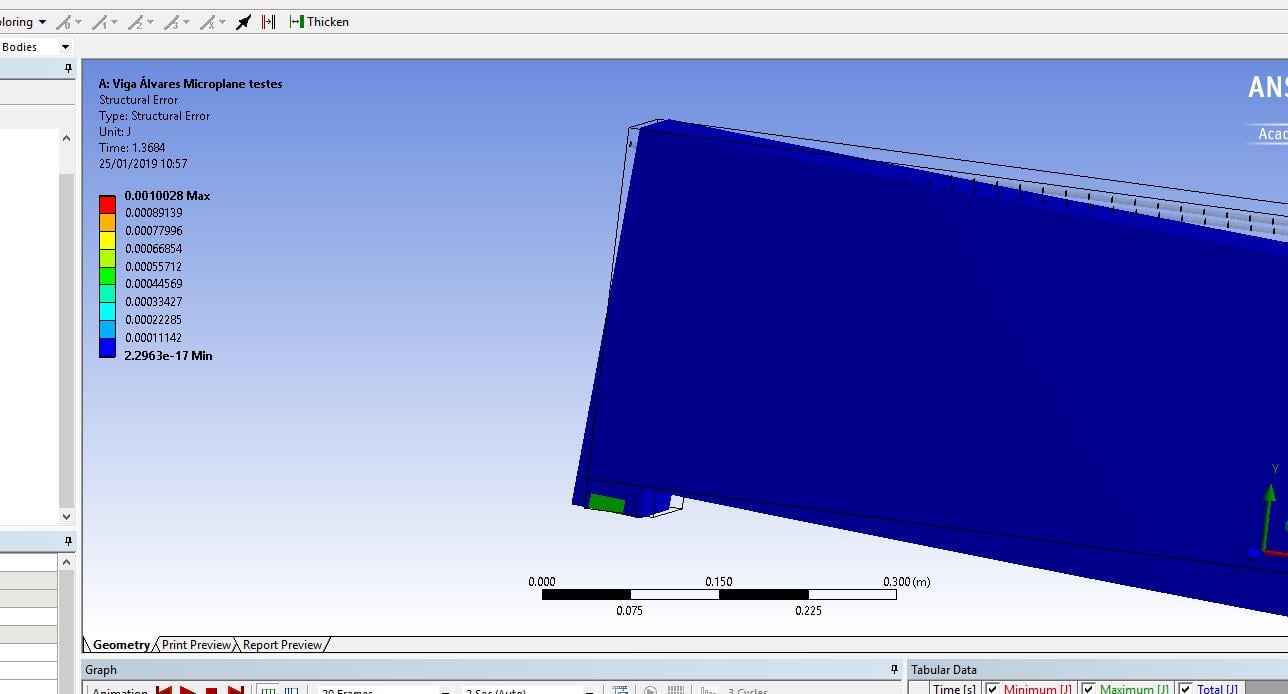
I did a test, with the bottom support face (left pad) split in half so I can restrain that edge in Y and Z (so it can rotate), used then half symmetry, to fix X on the symmetry plane at the centre (x=1300 mm), and the results look like you would like them I think. Try that and see if that gets the curve closer perhaps. If not then perhaps add the lower tensile/cracking strength, and see if that moves it. (Realised also that there is no shear reo, but perhaps that is not critical in the middle where it cracks due to bending). Finally try also a finer mesh or using solid186.
-
January 26, 2019 at 12:19 amSubscriber
Sorry for the delay, I was caught up in work
So tried some of of your suggestions, but what did the trick was the support face split! I can control much better the behavior of the support and the curve fitting is really smooth - I didn't had to change much of the material parameters.
Although I checked using symmetry it worked also for the complete model.
Thank you so much for your time and pacience!!
-
January 26, 2019 at 7:38 amSubscriber
No worries, glad I could be of some help.
Symmetry is good to use here.
A couple of more points. Realised there is no part for the compressive strength (concrete), but perhaps concrete is still there (10-15 kN, I assume 1 MPa of bending stress) in an elastic range (linear).
The remote force load. I would think if the load is a follower load/pressure, then I would use a normal pressure on one of the pads (Pressure=F_applied/Area_pad), in the symmetry model. Otherwise just use the force on the pad (Y dir.) if it is not a follower load.
Also any reference to these tests would be much appreciated, I will try and do it myself in Strand7 and see how it compares (then I can see what parameters control that curve)
-
January 28, 2019 at 10:49 amSubscriber
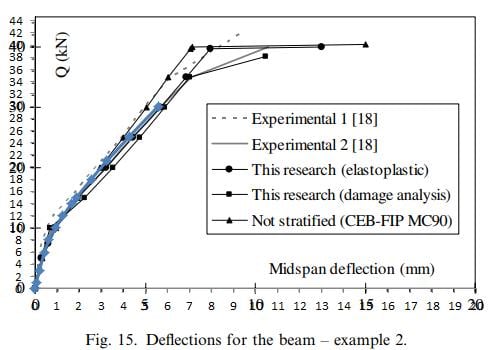
I have done this in Strand7 with the details we have discussed, and as per this paper:
A layered finite element for reinforced concrete beams with bond–slip effects
(Oliveira et al.)
, and it looks pretty good.
Blue curve are the Strand7 results.
(I am not an expert in the ansys microplane model, but the value of 0.75=ko (ko=(k-1)/(2*k(1-2v)), is for a fct of ~ 2.55 MPa, which is higher than the paper and the experiments, of 2.044 MPa. This would explain why the curve is stiffer than the experiments)
-
February 3, 2019 at 11:47 pmSubscriber
I never worked with Strand7, but the model looks very good indeed.
On the matter of k0, I think you pretty much hit the spot. Considering the material properties of the concrete of the paper (Oliveira et al.), k0 would be 0,76. Based on all the models I tested using Microplane model, I belive that this is a small difference.
I ran some tests considering what we were discussing and I compiled the results in a pdf file attached.
Basically, there are some combinations of supports and displacements that works fine for the this model. Again, the last stage of the load x displacement curve is not a perfect fit, but that would be the point were the material constants and load steps/substeps can make a great difference.
P.S.: Sorry for the delay
-
February 4, 2019 at 8:59 amSubscriber
No worries.
I hope at least that you might have heard about strand7
.
Also to mention that I used in strand7 a simple brittle max stress criteria, which I believe is similar to the multi linear elastic model in ansys.
I have exported from strand7 to ansys, so you can see the model (attached). Had to remove the MELAS and MISO data, because it was not coming out well (think MELAS can only take positive strains).
So it is not as detailed as microplane or smeared crack models. Worked good though (not saying that you should use a multilinear model in ansys, but you could try it out if you have time of course).
I tried also the microplane as you have defined in APDL, and the funny thing is that the principal stress can go much above 2.044 MPa, which is wrong, thus I think you need to use a damaged-plasticity +microplane model. There is an example in the ansys help:
Example 4.21: Coupled Damage-Plasticity Microplane Model Input
/prep7

!Define element

ET,1,215

KEYO,1,18,2  ! Activate extra degrees of freedom


! Parameter values

E = 28000

nu = .2

fuc = 30

fbc = 34.5

fut = 2.9

Rt = 1

D = 4e4

sigVc = -40

R = 2

c = 1500

m = 2.5

gamt0 = 0

gamc0 = 2e-6

betat = .4e4

betac = .25e4


! Define elastic properties of material

MP,EX,1,E

MP,NUXY,1,nu


! Define microplane model properties

TB,MPLA,1,,,DPC

TBDATA,1,fuc,fbc,fut,Rt,D,sigVc

TBDATA,7,R,gamt0,gamc0,betat,betac


TB,MPLA,1,,,NLOCAL

TBDATA,1,c,m
-
February 6, 2019 at 11:24 pmSubscriber
1) I don't know how to open the .dat file in WB. I can read in the Mechanical, but doesn't show any structure. I'll find a way as soon as I have a little time. Anyway, I'll model Oliveira's Beam so I can do some tests to (just for fun!).
2) About the Principal Stress being higher than the tensile stress:
Well, I've seem people discussing this situation a couple of times in the internet (not so rare, apparently). I don't know how much higher than 2.044 MPa the stress is resulting, but I'll take a guess here.
- It is possible that this high stress is due to extrapolation of integration points to the nodes, or interpolation. Testing on my current model (Álvares Beam), the Maximum Principal Stress can go from a top value of 3.22 Mpa up to 6.85 MPa, all depending of what kind of postprocessing you want to use as a display option for the Integration Point Results (and its average inside the bodies). E.g. if I consider the display option as "unaveraged" my Maximum Principal Stress goes automatically from 3.22 MPa to 7.02 MPa.
- Another possible explanation is that region being under a high hidrostatic pressure. Which can happen even with small strain.
- Now, there are some people who recommend to analyse the stresses using VM, because concrete depends more of the deviatoric part of the stress tensor to fail. Maximum Principal criteria would more interesting if the reinforced concrete had a pure brittle behaviour. Also, because we are dealing with a 3D problem, this Principal Stress not necessarily is equal to the uniaxial tensile test from the lab.
- Back to my model, I tried to rise the applied load to see if the Maximum Principal stress of the model would rise too, but no matter how much load I apply, the Maximum is always 3.22 MPa. What does change this value are the damage parameters of the model. On the other hand, the Normal Stress in the X direction is never higher than 2.9 MPa (in theory my tensile strengh is 2.7 MPa), so I think this makes sense.
All in all, the idea was good. I'll try the damage-plasticity model, and see how that works...
-
February 7, 2019 at 7:47 am
Amin
SubscriberHi,
I see from the attached files that the deflection of the concrete beam is not real (no colors are presented to show the distribution of the stresses or of the displacement). I came across this problem too, by using SOLID65 rather then SOLID185. I overcome this problem by Dropping the mid-side nodes, you can click on mesh ==> click on Advanced and switch the Element Mid-side Nodes to Dropped. I fixed my model with this method. I hope it can fix your results representation.
Since you use SOLID185 instead of SOLID65, you use the new technology proposed by ANSYS to model the concrete. Can you explain to me how can I use this technology?
-
February 7, 2019 at 11:44 amSubscriber
The .dat file is to be read in APDL (do not think it will make any sense in WB).
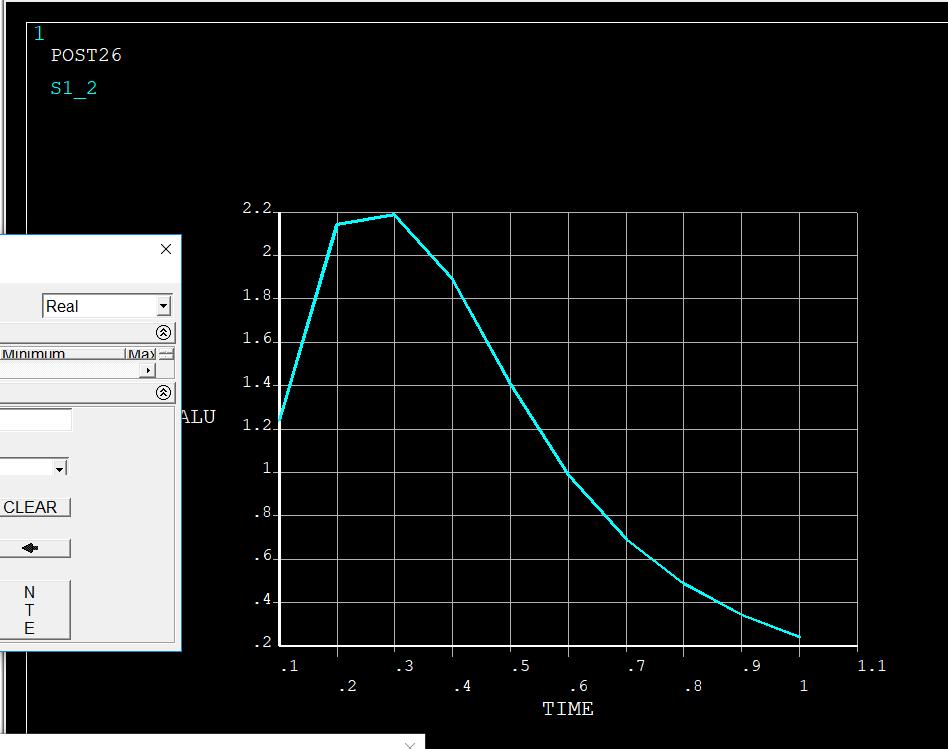
In any case the 1st principal stress should not be above 2.044, and then it should go down after cracking.
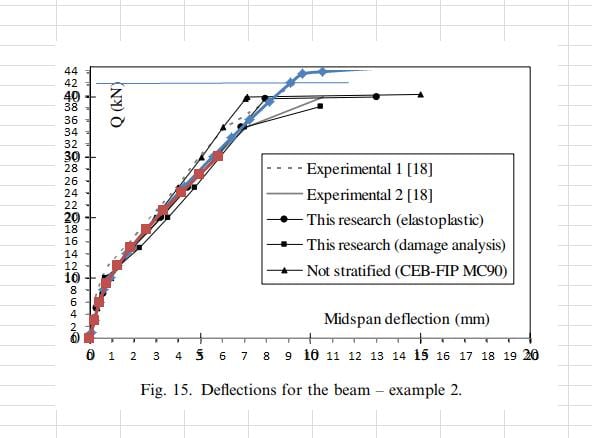
I have tried the DP Plast.-Microplane and it works quite well. Just one parameter which I do not know and influences the response (tension damage evo. par., beta_t in the help manual). I have reduced that slightly (0.15E4) since I do not know how it is obtained (cyclic tests, which I do not have) from the values given in the apdl script from my previous post.
The results are spot on (red curve, of course I have tweaked beta_t but one can get it from the paper Bt, if one knows the relation between the Mazars model and this one) and I can see the cracking at ~2.1 MPa max principal stress, and then softening due to cracking.
Think it is a interesting material and damage model, but many parameters to set
.
-
February 7, 2019 at 6:00 pmSubscriber
Can you post the snippets you used?
Using this model my displacement was around 2.7 mm and the Maximum Principal was 16 MPa, clearly I'm doing something wrong... Here is what I entered:
ET,MATID,185 !Define the element
MP,EX,MATID,29100 !Define the material properties
MP,NUXY,MATID,0.2
TB,MPLA,MATID,,,DPC !Define the material criteria for
TBDATA,1,27,31.05,2.7,1,4E4,-40 !TBDATA,1,fuc,fbc,fut,Rt,D,sigVc
TBDATA,7,2,0,2E-5,3000,2000 !TBDATA,7,R,gamt0,gamc0,betat,betac
TB,MPLA,MATID,,,NLOCAL
TBDATA,1,1600,2.5 !TBDATA,1,c,m
I based some values on the paper "A gradient enhanced plasticity–damage microplane model for concrete (Zreid and Kaliske, 2018):
A gradient enhanced plasticity–damage microplane model for concrete: (Zreid and Kaliske, 2018)
-
February 7, 2019 at 6:35 pmSubscriber
I am attaching the whole dat. file, you can see the material definition there.
You need to use also CPT elements (think 221), with some key-option, for the homeginastion of this approach.
All details are in the dat file (ET,4 is the concrete, material 4). Dat file is a text file so just open it with a text editor.
PS: I am using APDL, since I know more what is happening there.
-
February 7, 2019 at 6:35 pmSubscriber
Thanks for the tip, worked well here too.
The Microplane tech has a very interesting theory, quite brilliant if you ask me, and the model is much more stable for NL analysis than the Solid65. A few things to point out:
- A starting place to understand the theory would be "Microplane Model for Progressive Fracture of Concrete and Rock" (Bazant and Oh, 1985) and "Identification and Interpretation of Microplane Material Laws" (Michael and Ramm - 2006).
- In very simple terms the MP create a sphere in every integration point of every element. This "sphere" is characterized by a number of faces (usually 42, but that depends on the model), and the strain in the normal direction of every face of the sphere has a constitutive law that defines the uniaxial stress-strain relationship of the material. The strain at every face of the sphere at the microscopic level is related to the macroscopic level of the model, resulting in the stresses we usually see in the structures. The mathematical "jump" from the micro to the macroscopic level you can find in the papers I suggested.
- The Solid65 element suffer from numerical instability when severe crushing begins ou cracking is taking place, so is comun to turn off the crushing hability of the element by assigning fc=-1. This way the solution converge more easily. When I moved from Solid65 to Solid185 the difference was enormus, It's much more robust and it's not so dependent on the mesh. The catch is that Solid65 lose 100% of the stiffness when there is a crack. But the Mplane, because is a damage model, lose stiffness more smoothly and that helps the convergence.
- I'm still adjusting to this model, but the snippets I used for the Microplane and the Coupled Microplane are attached. JJ77 is helping a lot to interpret the results.
-
February 7, 2019 at 6:41 pmSubscriber
Yap, much more stable than concr model, because that just fails (complete brittle failure, no soft.) and there is very little stiffness left, so difficult to get it to converge. I agree it is a nice theory, I cannot just get my head around beta_t, which should be the same/similar as Mazars theory, and as in the Oliveira paper (8000), but with that value it does not work well. It seems to be about 1600, which is close to some of the data (bending RC beam) from the guys who developed the DP-micropl. model.
-
February 7, 2019 at 7:53 pmSubscriber
I'm using version 18.2 of Ansys, the coupled damage-plasticy is only available for version 19. All the papers that present this model are from 2018... I'll install now
The beta-t is not very clear for me too. But I agree that it must be some specific data
-
February 12, 2019 at 8:16 pmSubscriber
So I tried the Elastic Microplane Model (Solid185) on another beam, and the Maximum Principal Stress finally hit close to 2.04MPa, as it should be
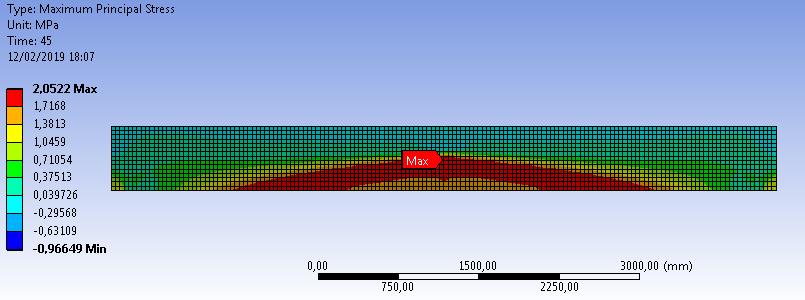
Maximum Principal Stress
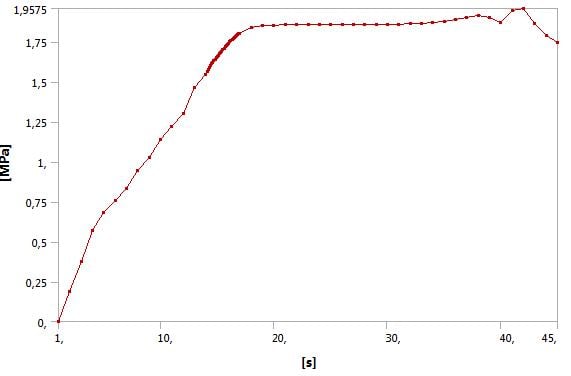
The beginning of the softening
Maybe there is something wrong with my model for the beam we were discussing. Just wanted to share to results! Thank you once again
-
February 13, 2019 at 11:11 amSubscriber
Very Nice.
In the end what was the k0 =0.76?,k1,...... parameters you sued for this test?
(did they need to be tuned, or are there expressions like for k0 for all 6 parameters C1-C6)?
And did it agree well with the Oliveira/Alves data?
-
February 14, 2019 at 4:00 pmSubscriber
I used the same parameters we were using before, I really just changed the beam (load and dimensions).
I'm on my way to model Oliveira beam now.
Out of curiosity, I was doing some tests with the coefficients and the Microplane model is most responsive to the Damage Threshold value (gama_mic 0), or Critical Equivalent strain energy. Much more than the K parameters. By adjusting this value to each model is possible to seach for the ideal response with the Maximum Principal Stress equal to the tensile strength of the material.
E.g. for another beam I modeled the ideal gama_mic 0 was 7e-5, but I had to adjust the other damage coefficients to adjust the loadXdisplacement curve and at the same time have a Maximum Principal equal to the Ft.
-
December 5, 2019 at 7:32 pm
vaibhavtaranekar
SubscriberHi , could you guide me how to calulate the Parameters from c4-c6 for the microplane model?
-
December 6, 2019 at 9:10 pmSubscriber
Hi
The parameters represent the following:
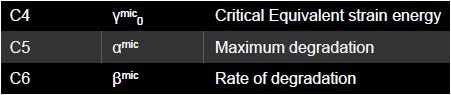
They are the input parameters of the Damage Model applied to your structure. They will control when the damage begins (C4), how much damage the element can withstand (C5) and at what rate the degradation will occur (C6).
There are some usual values for these parameters (e.g. in the article "Identification and Interpretation of Microplane Material Laws" by Leukart and Ramm, 2006), and based on what I've read there is a component of trial and error to adjust the values to your model.
I don't know what kind of material you are using in your simulation, and of course that affects the values, but for concrete the following initial guesses will probabily work fairly well:
C4 = 6e-5 (the lower the value, sooner will occur the damage. In the case of concrete, the crack)
C5 = 0.5 (ranges from 0 to 1. The higher the value, more damage the element can withstand during the loading)
C6 = 100 (ranges from 0.3 to 3000 according to some material I've read. The higher the value, the fast the damage will evolve)
For my models I'm using an optimization routine (in Matlab) to numericaly adjust these parameters to my experimental data.
I hope this helps
-
December 8, 2019 at 9:16 amSubscriber
Thank you for your reply, i am using reinforced concrete for my simulation and applying cyclic loading on it. I have modelled the concrete using SOLID185 and steel using LINK180. The cyclic reponse pattern is quite similiar as i want but still trying to match the with the experimental. I tried using SOLID65 but the graph wasn't proper due to lack of damage parameters.
Have you tried the coupled damage plasticity model yet? I tried it for my model by using your snippets from your other post however the solution does not run. Can you please provide me your updated snippets for CPT215 model for ansys 19.2?
I also wanted to know if the use of REINF elements make any major difference in the analysis and if you have used them in your analysis.
Here's my 19.2 model for your reference. Please have a look if you have time. https://drive.google.com/file/d/14h-aGEMlJZKBhzoz7dJ6Yw-FhuMh55pw/view?usp=sharing
The resulting forces of the simulation are very high as compared to the experimental analysis. Here's my post regarding that /forum/forums/topic/cyclic-loading-on-reinforced-concrete-column/
Thank you again, I appreciate your help and your involvement in the student community.
Cheers! -
December 9, 2019 at 10:36 am
ranma
Subscriberhi, can you explain me how to calculate the parameters k0, k1 and k2? i found a lot of different formulas, and i tried using all those, but in the end my model doesn't seem to work: i keep getting an error on maximum displacements, and when i try to look at values of stress i find values too high for tension, very similar to compression stress. (i'm modeling concrete)
-
January 9, 2020 at 8:07 amSubscriber
Hi
The parameters represent the following:
They are the input parameters of the Damage Model applied to your structure. They will control when the damage begins (C4), how much damage the element can withstand (C5) and at what rate the degradation will occur (C6).
There are some usual values for these parameters (e.g. in the article "Identification and Interpretation of Microplane Material Laws" by Leukart and Ramm, 2006), and based on what I've read there is a component of trial and error to adjust the values to your model.
I don't know what kind of material you are using in your simulation, and of course that affects the values, but for concrete the following initial guesses will probabily work fairly well:
C4 = 6e-5 (the lower the value, sooner will occur the damage. In the case of concrete, the crack)
C5 = 0.5 (ranges from 0 to 1. The higher the value, more damage the element can withstand during the loading)
C6 = 100 (ranges from 0.3 to 3000 according to some material I've read. The higher the value, the fast the damage will evolve)
For my models I'm using an optimization routine (in Matlab) to numericaly adjust these parameters to my experimental data.
I hope this helps
Could you guide me on how to determine the c4-c6 parameters for concrete subjected to cyclic loading? i can see the hystersis curve developing on changing the values but i am not able to determine the accurate values for this.
-
March 22, 2020 at 3:09 am
Islam
SubscriberHi vaibhavtaranekar,
Did you find any accurate method for calculating C4, 5, and 6? as I am also trying to model the cyclic load response of concrete using the microplane model.
Thanks in advance
-
April 1, 2020 at 3:33 pmSubscriber
The value of C4 must be calculated using the excel file provided in the above post. The remaining C5 and C6 parameters must be adjusted as per problem to fit the curve required. Hence you will have to use hit and trial method.
-
- The topic ‘Remote Displacement – Beam model’ is closed to new replies.


- LPBF Simulation of dissimilar materials in ANSYS mechanical (Thermal Transient)
- Convergence error in modal analysis
- APDL, memory, solid
- Meaning of the error
- How to model a bimodular material in Mechanical
- Simulate a fan on the end of shaft
- Nonlinear load cases combinations
- Real Life Example of a non-symmetric eigenvalue problem
- How can the results of Pressures and Motions for all elements be obtained?
- Contact stiffness too big

-
peteroznewman
 4427
4427 -
scabo
 1494
1494 -
Dennis Chen
 1376
1376 -
javat33489
 1209
1209 -
Shyam Prasad V Atri
1021



© 2025 Copyright ANSYS, Inc. All rights reserved.

 You are navigating away from the AIS Discovery experience