Hello,
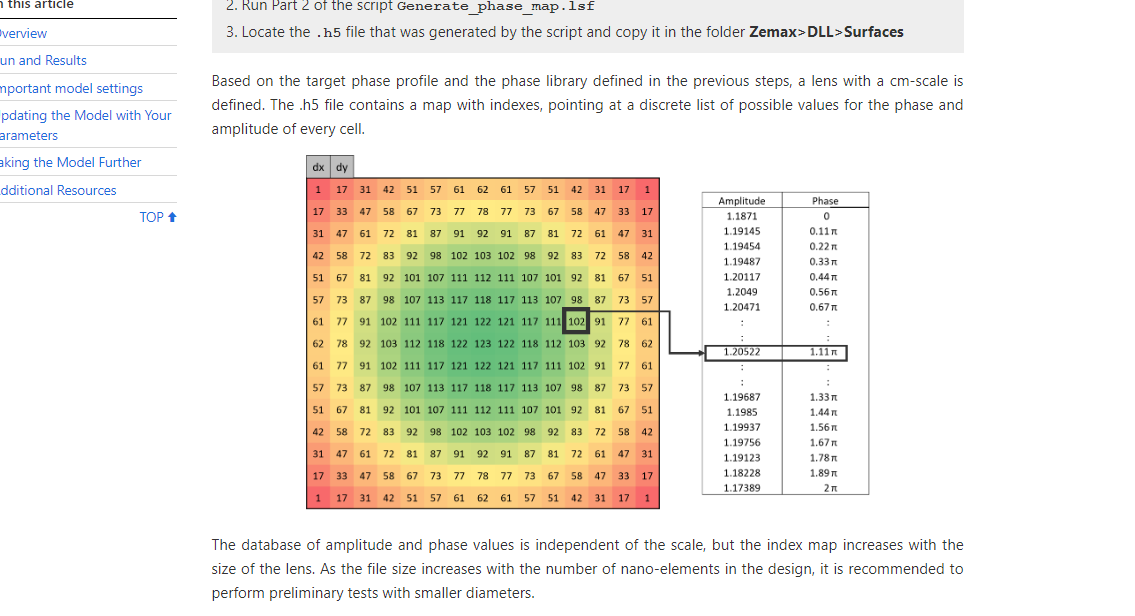
Thanks for posting your question. The image you are referring to is just for illustration purpose: it shows how the data is stored in the .h5 file: we first have 2 vectors (on the right of the image), giving the amplitude and phase for each meta-atom and the 2D matrix on the left gives the index (which meta-atom) used as a function of the position. When we import this file in OpticStudio, the models can then know what phase/amplitude to apply depending on where the rays hit the metalens. Again, this is more an illustration, I don't think it shows real data.
Regarding your other question, this model allows you to use the metalens as an optical element in OpticStudio that can be used in ray tracing simulation. Previously, we had to generate the EM fields output of the metalens (either by direct simulation or field stitching in FDTD - see the small scale metalens example / https://optics.ansys.com/hc/en-us/articles/360042097313) and propagate in OpticStudio using the POP module. This will limit the size of the metalens we can model due to the memory and time requiired to run the simulations. The phase gradient model allows to model much larger metalenses.
 This topic has been answered!!

















 You are navigating away from the AIS Discovery experience