The article I'm taking the values from assumes D1 as 0, but I've read in this community that for hyperelastic materials it is better to set a value for D1 that closes such as 0.001 since the material cannot be fully incompressible.
Beside this, I'd like to ask you if it is right the following assumption: since I have to model the behaviour of a hyperelastic material, before finding in literature the values of the material I am interested in, I tried a general approach suggested by a video in which an elastomer sample (Mooney-Rivlin) was taken from the engineering data sources (see the image)
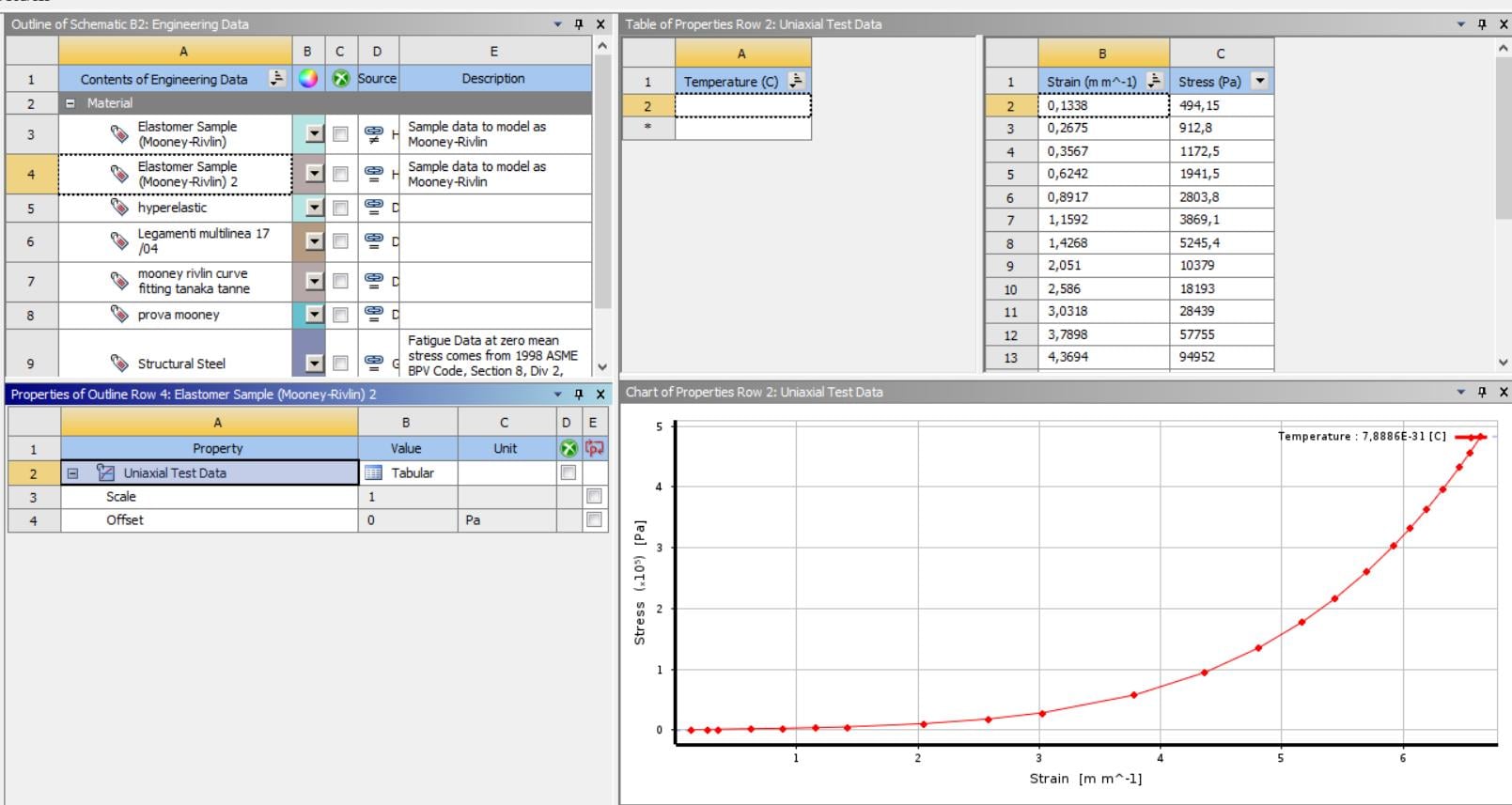
and a 5 parameters Mooney Rivlin model was used for the curve fitting in order to get the values for all the parameters, even if the test was uniaxial by defalut.
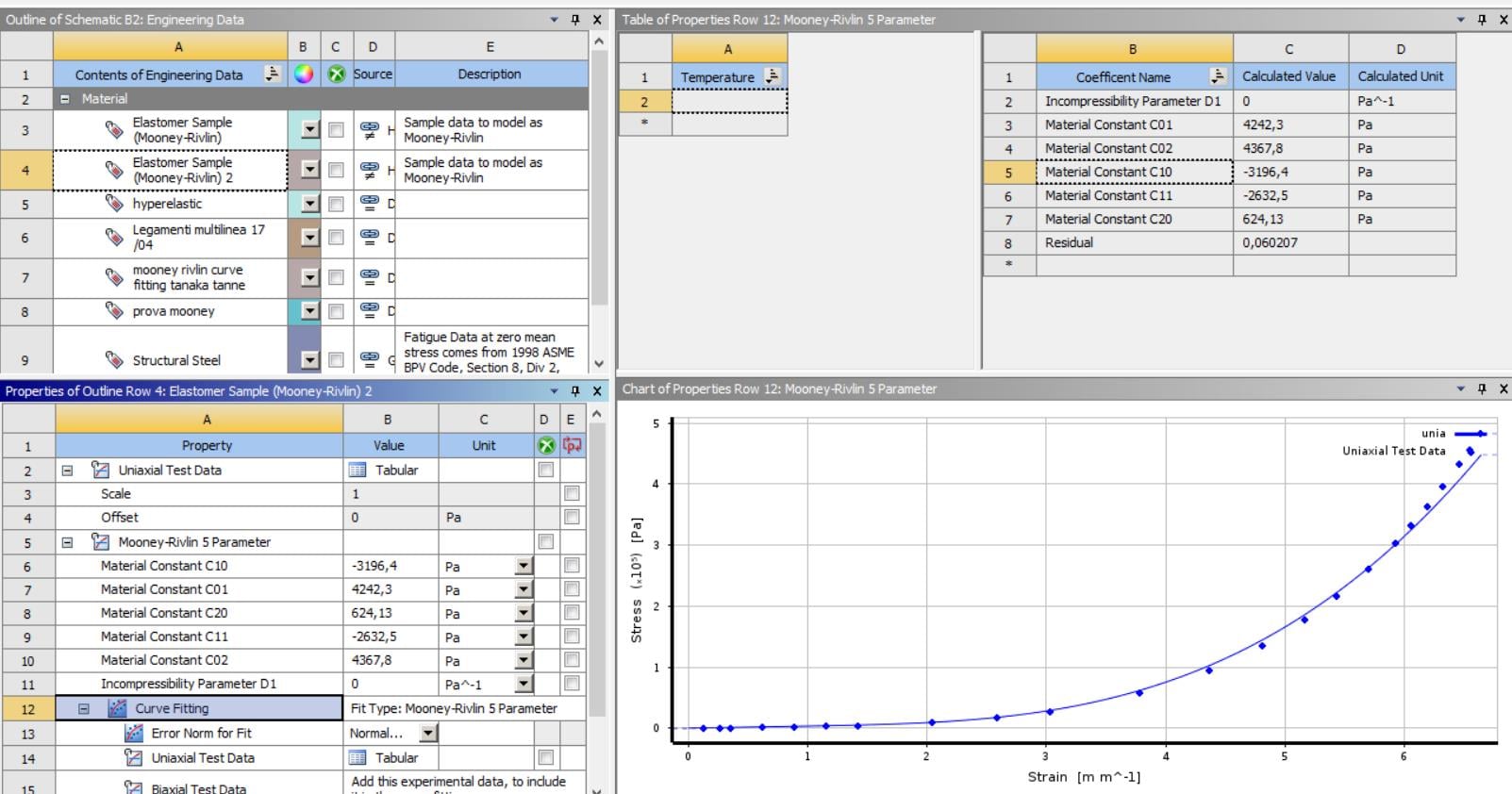
Thus, if the test is uniaxial the parameters c20, c11, c02 are correct? Can I use this model for a hyperelastic material which has a great deformation?
Thank you!


















 You are navigating away from the AIS Discovery experience