Ansys Assistant will be unavailable on the Learning Forum starting January 30. An upgraded version is coming soon. We apologize for any inconvenience and appreciate your patience. Stay tuned for updates.
General Mechanical

General Mechanical

Topics related to Mechanical Enterprise, Motion, Additive Print and more.

Modal Analysis – Boundary Conditions for Simply Supported Beam

    • smehboob
      Subscriber

      Hello


      I am facing a problem in workbench modal analysis results. I had models a simple steel beam of length 1.044 m and cross sectional dimension 0.023 x 0.005 m. E = 2.05E+11 N/m^2 and poisons ratio = 0.3. Density = 7830 kg/m^3. 


      Theoretically i have calculated its first three bending modes and their frequencies are f1=10.65, f2=42.58 & f3=95.81 Hz respectively. 


      In FE Model, beam length is along the x-axis while its width (0.023m) is along z-axis and depth (0.005m) along y-axis. I had applied boundary conditions at both extreme ends as follows to let the beam behave as simply-supported: 


      UX=UY=UZ= 0 & RX=RY=0 , RZ= Free 


      With all these conditions i am getting first three modes as:


      f1=16.283, f2=44.887 & f3=98.13 Hz


      Why the Theoretical and Numerical values are not equal or at least there should be very less difference between them?


      Is there any problem with the boundary conditions or something else?


      Looking for the solution.


      Thanks


    • BenjaminStarling
      Subscriber

      I would start by freeing the RY degree of freedom and seeing what effect that has.


      Have you modelled your beam as a beam element, shells or as solids? Your beam is extremely slender based on the dimensions you have given.

    • smehboob
      Subscriber
      Hello, i had modeled a steel beam of dimensions as Length = 4000 mm, Cross section = 250 x 150 mm, E=2E+11 N/m^2, Density = 7850 kg/m^3.
       
      Boundary conditions:
      Left support is applied using Remote Displacement option with X=Y=Z= 0 & RX=RY = 0 and RZ = Free
      Right support is applied using Displacement option with X=Z= Free & Y=0
       
      Please note, beam is along X-Axis.
       
      There is a difference of theoretical and FEM results. First two bending natural frequencies are almost comparable as you can see below while in higher modes like 3rd and 4th there is significant difference in results.


      I am confused, how it would be done, so that i can get all FE results according to theoretical values? I guess there is something wrong with the boundary condition.
       
      With same boundary conditions, if a more slender beam is considered like 1044 mm length and 23x5 mm cross section then all theoretical and FEM results comes almost equal for each natural frequency.
       
      Looking forward for the solution if someone could help in this matter.
       
      Thanks

    • smehboob
      Subscriber

      As far as the problem of modeling simply support condition for a beam is concerned, is resolved using the following guide line and validated using the analytical value of maximum deflection for simply support condition. 


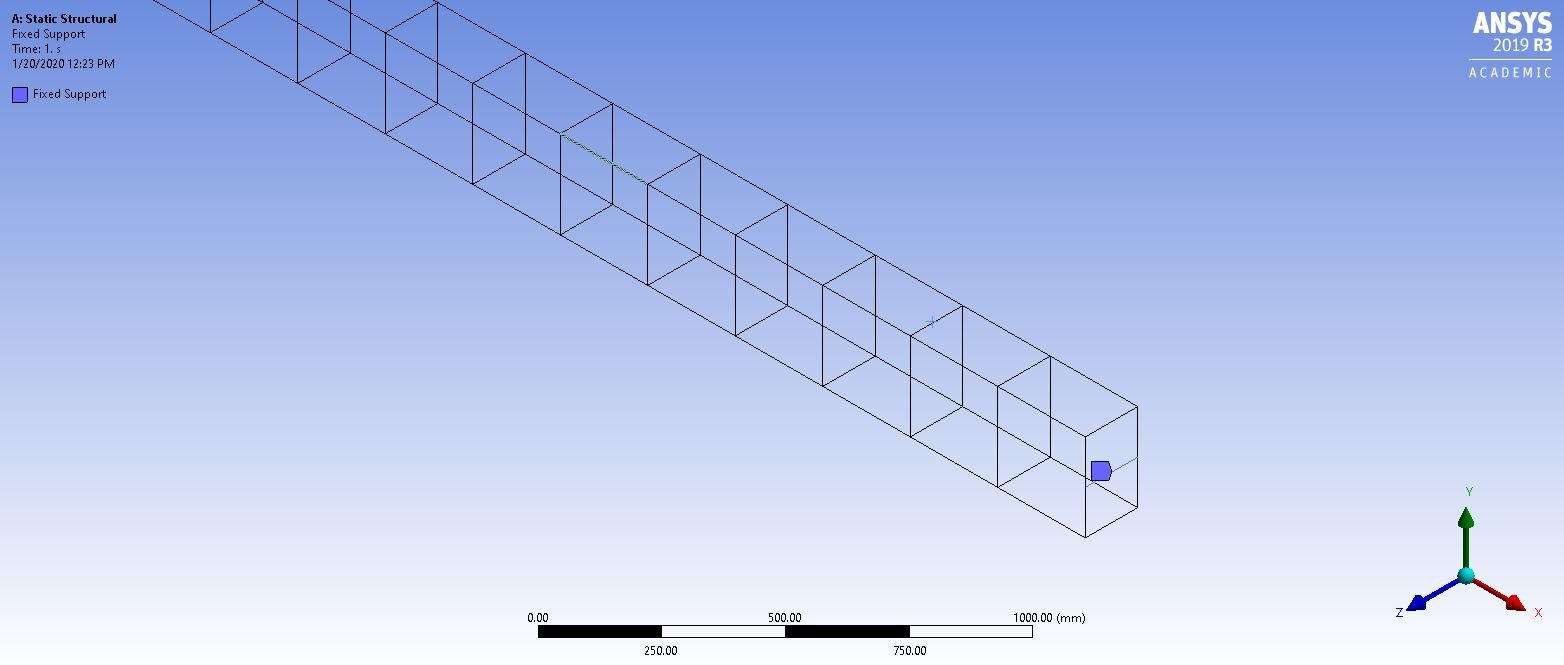
      First, both extreme faces of beam were signed a reference line (shown in figure below) which will be later on selected for applying support conditions. Using set of options: Plane>Sketch>Face split.


      Support Condition Closeup View


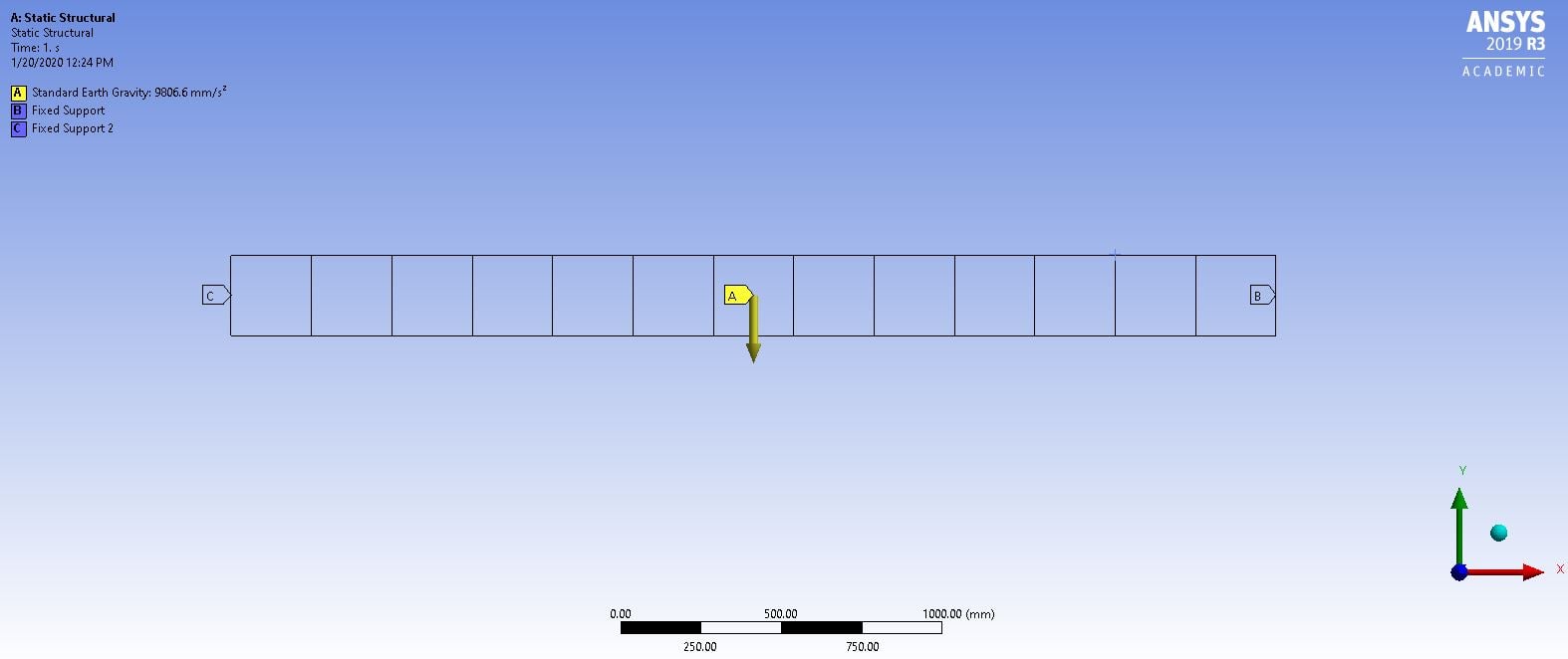
      Similar, BCs are assigned at both ends as shown below:


      BCs at both ends


      Now, general static analysis under standard gravitational load is performed and the numerical results are:


      Deflection of beam


      Theoretical Deflection at mid span of beam should be 0.107 mm which is almost equal to numerical value i.e., 0.11 mm


      So now BCs is properly applied.

Viewing 3 reply threads
  • The topic ‘Modal Analysis – Boundary Conditions for Simply Supported Beam’ is closed to new replies.
[bingo_chatbox]