-
-
January 20, 2023 at 10:17 am
Boonyanuch Suksawang
SubscriberHello,
I've been using Static Structural module to conduct the stress analysis of lattice structure under quasi-static compression.
The model was imported as Abaqus.inp file voxel hexagonal mesh.
The tensile yield strength of the material is 68 MPa.
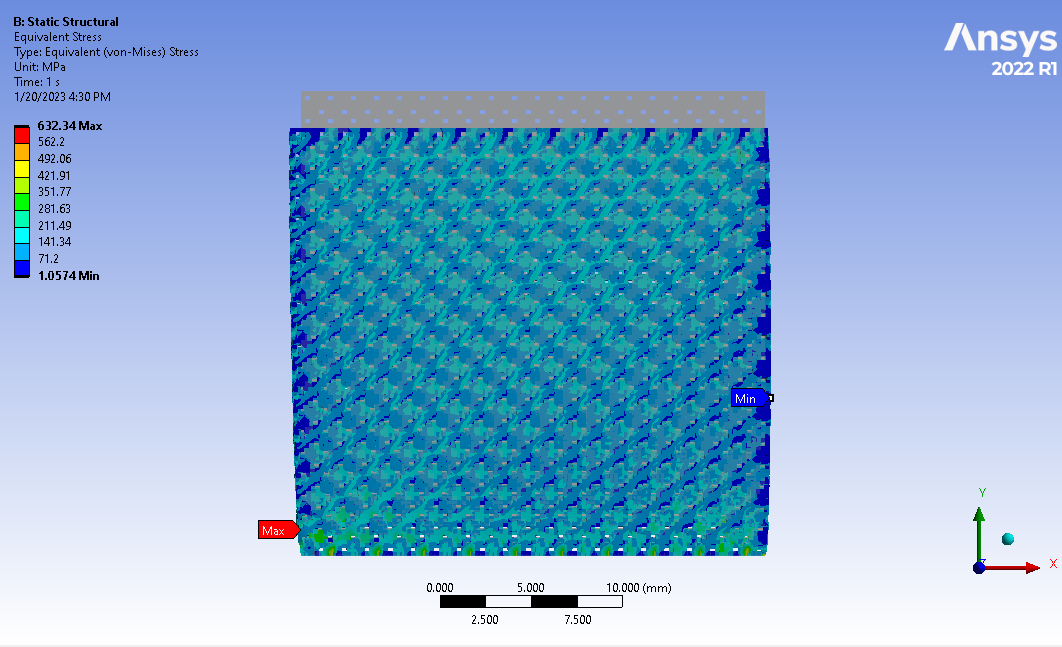
The solution rendered maximum stress far beyond the material's yield strength. I saw an article that suggest using APDL command snippet ERESX, NO.
I tried using that command and it only worked once.
What did I miss?
Thank you in advance. -
January 20, 2023 at 2:37 pm
Sai Deogekar
Ansys EmployeeHello,
When ERESX, NOÂ is used, the nodal solution is reported to be the same as the value at the integration point nearest to the node. Usually nodal values at 'extrapolated' from the values at the integration points.
I am not sure why that command worked once and is not working a second time.Â
But the stress values seen in the figure are way higher than the yield stress (almost 10 times). Irrespective of whether the nodal values are reported to be same as the values at the integration points or they are extrapolated from the integration points, I don't think the equivalent stress in your model will go below 68 MPa.
Is there a specific reason why you don't want the stress in the model to exceed the material's yield strength? Maybe the applied compression is so high that it actually generates high stresses. I am not sure if there is a plasticity model included to model actual yielding (if there is only an elastic model defined for the material, then the yield strength defined is used only to calculate the Factor of Safety during postprocessing; simply having a yield strength defined does not automatically model plastic behavior).

-
January 20, 2023 at 2:47 pm
Boonyanuch Suksawang
SubscriberHello, SaiD
Thanks for your reply
I didn't included the plasticity in the material model. So I think that's the reason why the command didn't work.
The reason that I don't want the stress exceed the material's yield strength is that I want to see the time point in the simulation where the structure would fail in the compression process.
Or is there better practice? I would also include plasticity in the material model using bilinear isotropic hardening.
Thank you in advance.
-
-
January 20, 2023 at 3:14 pm
Sai Deogekar
Ansys EmployeeHello,
Maybe you can try reducing the amount of compression that is being applied to the model? That way you simulate a small strain-range and you can probably pin point the strain at which the stresses become equal to the yield stress. I am assuming this is what consitutes failure in your case. If not, and the failure criteria is different, you might have to include a plasticity model to accurately capture the behavior of the lattice at higher strains.
-
January 20, 2023 at 3:34 pm
Boonyanuch Suksawang
SubscriberDoes including ultimate strength in the material model help with this issue? Or will the stress in the simulation still exceed the material's ultimate strength?
-
-
January 20, 2023 at 3:43 pm
Sai Deogekar
Ansys EmployeeIf you do not include a damage or failure model, then the ultimate strength is again used only to calculate the factor of safety during postprocessing.Â
Unless you include a plasticity model or a damage/failure mode, then material will continue to behave elastically at every load, even though in real-life the material might be failing or yielding. So it is necessary to model the material correctly in order to get an accurate response from the lattice structure.
-
January 20, 2023 at 4:05 pm
Boonyanuch Suksawang
SubscriberIs there any failure mode you suggest in that case?
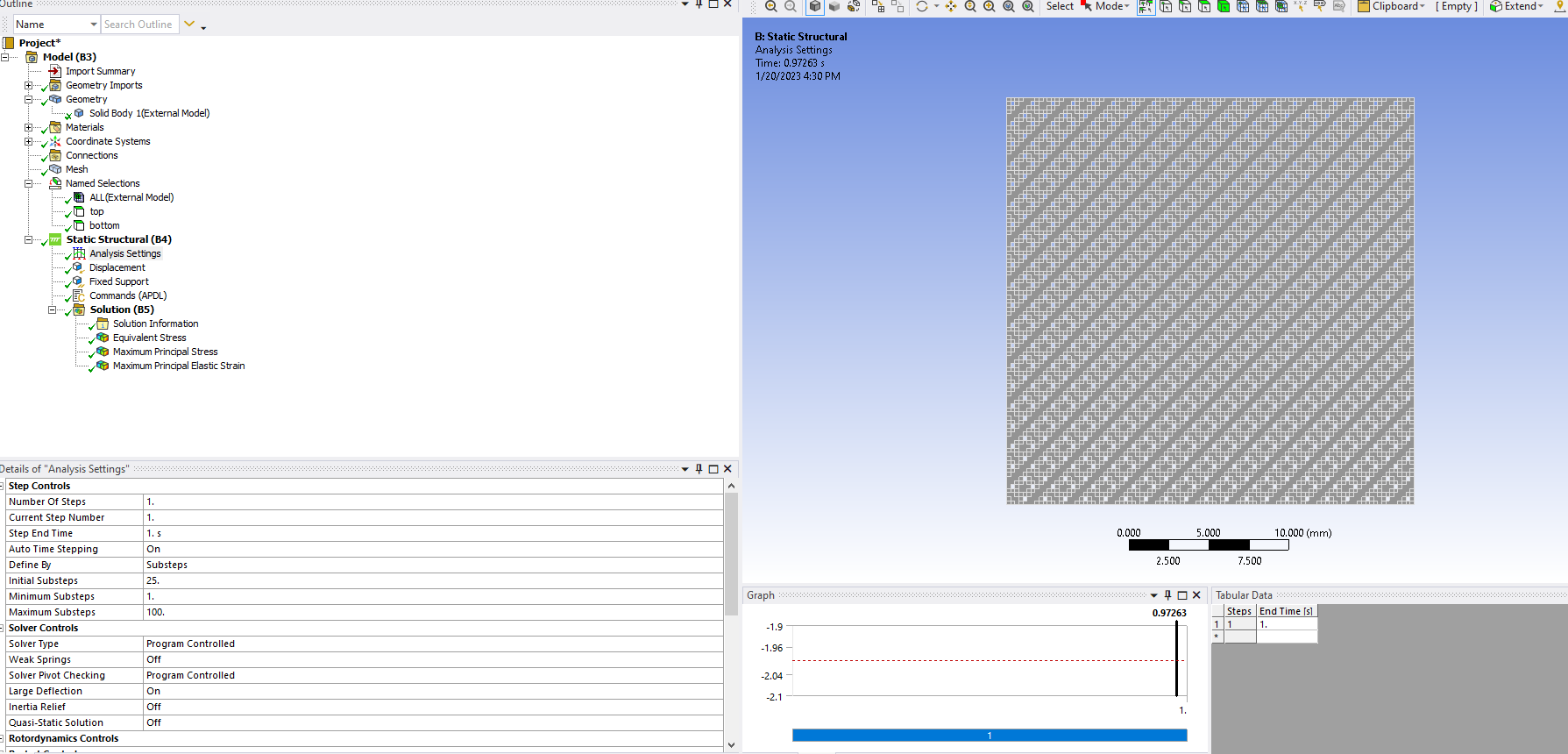
The material is 3D-printed resin.The model have fixed support at the bottom surface with displacement on the top surface to simulate quasi-static compression.
Or should I use ERESX, NO after include plasticity model in the material?
Or should I just pinpoint the strain at which the stress go beyond the yield strength?Â
Sorry if the questions are too much.
Thank you in advance.
-
-
January 20, 2023 at 4:03 pm
Boonyanuch Suksawang
Subscriber-
Â
-
January 24, 2023 at 12:48 pm
Sai Deogekar
Ansys EmployeeHi,
Sorry, I have limited knowledge about the damage mechanisms in resin. You will probably have to search in the literature to understand which damage models are able to represent damage and failure in resin material well. Once you know what, you can refer to the Ansys Help documentation to see how to implement such a damage model in your simulation.
-
- The topic ‘Max. Von Mises stress exceed material’s yield strength even after using ERESX,NO’ is closed to new replies.
-
6495
-
1906
-
1458
-
1308
-
1022
© 2026 Copyright ANSYS, Inc. All rights reserved.