Fluids

Fluids

Topics related to Fluent, CFX, Turbogrid and more.

Intrinsic FSI in Fluent

    • Van Toan Nguyen
      Subscriber

      Hello everyone!
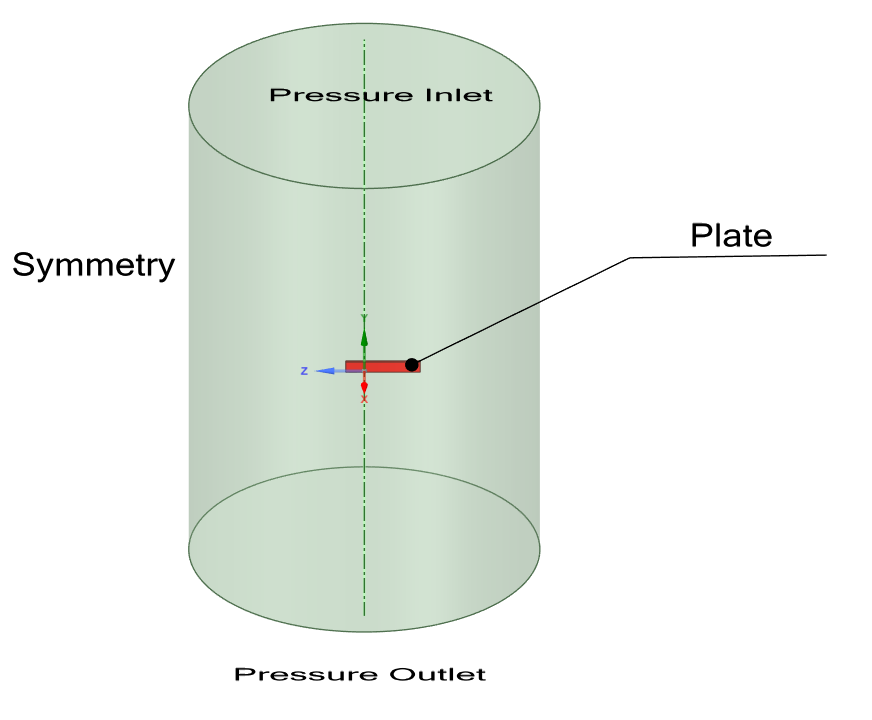
      I have a problem that needs to be simulated as follows: a sheet made of soft material rotates around the Y-axis in air. I intend to use  to solve this problem. The rotating domain (sliding mesh) is applied to the region surrounding the sheet, while the remaining region is stationary. However, I am not sure how to specify the rotational motion for the solid region (is “solid motion” applicable?). And how should the dynamic mesh be set up?

      Thank you very much.

    • Federico
      Ansys Employee


      Hello, 

      are you prescribing the rotational motion or are should the motion respond to the fluid forces surrounding the solid?

      For prescribed motion, you can use identical Mesh [edited] Motion for both the Solid and rotating Fluid cell zones. Just make sure there is a mesh interface between the stationary and rotating fluid zones.

      For motion response, you can use the 6DOF solver in Dynamic Mesh: 14.6.5. Six DOF Solver Settings


    • Van Toan Nguyen
      Subscriber

      Thank you for your response.
      Some text was missed.
      This plate undergoes two types of motion:
      (1) rotational motion (constant angular velocity)
      (2) deformation due to fluid forces (two-way FSI).

      I intend to use intrinsic FSI to solve this problem.


    • Federico
      Ansys Employee

      In that case, you can implement both suggestions from above!

      In the Dynamic Mesh Zones definition, you will set the fluid-side of the solid wall with Intrinsic FSI. 

      See Chapter 29: Modeling Fluid-Structure Interaction (FSI) Within Fluent for more details.

    • Van Toan Nguyen
      Subscriber

      As I understand:
      - For the fluid domain:
      + The rotating domain uses Frame Motion (set angular velocity, ω) and is defined as Deforming in the Dynamic Mesh Zones settings. The fluid side of the solid wall is set as Intrinsic FSI.
      + The fixed domain does not require any settings in the Dynamic Mesh Zones definition (stationary as default).
      - For the solid domain:
      + Frame Motion is used (set angular velocity, ω).
      Since 6-DOF cannot be used with Intrinsic FSI, Smoothing and Remeshing can be applied.
      Is this a transient problem? Can we use Mesh Motion instead of Frame Motion? (It may be more complicated and could fail during simulation.)

      • Federico
        Ansys Employee

        I am sorry. I did write Frame motion in my previous response but you should use Mesh Motion. Apologies for the confusion. I will edit the post above to correct this. Both the solid and rotating fluid regions should have this as cell zone conditions.

        Intrisinc FSI does not support yet steady-state deformation, so this would indeed be a Transient Analysis.

    • Van Toan Nguyen
      Subscriber

      I'm using Fluent 2024R2 and unfortunately the Mesh Motion simulation functionality is not compatible with the Intrinsic FSI method. 


    • RS
      Ansys Employee

      The Mesh Motion simulation functionality is not compatible with the Intrinsic FSI method. According to the documentation, mesh options are not supported for intrinsic FSI problems. The Intrinsic FSI type can only be selected in the Dynamic Mesh Zones dialog box for the side of a two-sided wall that is immediately adjacent to the fluid cell zone. Additionally, the structural model is not compatible with mesh adaption, the mesh morpher/optimizer, and other features.

      When to use Intrinsic FSI

      Kindly go through limitations of Intrinsic FSI. Shared below link from Online Fluent User's Guide and Fluent Theory Guide

      29.1. Overview and Limitations

      16.1. Limitations

Viewing 6 reply threads
  • You must be logged in to reply to this topic.