Ansys Assistant will be unavailable on the Learning Forum starting January 30. An upgraded version is coming soon. We apologize for any inconvenience and appreciate your patience. Stay tuned for updates.
Ansys Free Student Software

Ansys Free Student Software

Topics cover installation and configuration of our free student products.

Input the acceleration load

    • gayoon
      Subscriber

      In transient analysis, I input ground motion record to high rise structure. 


      I would like to ask about boundary condition at the basement of structure in Ansys workbench. There is fixed support or something else like displacement, remote displacement? 


      Besides acceleration, is earth gravity applied to the structure? How can I get the peak acceleration at the base as same as the acceleration of input data?


      Besides transient analysis, is there any tool I can use for getting seismic response in 10-15 seconds? Explicit Dynamics or Response Spectrum?


      Thank you.

    • PSiedlac123
      Subscriber

      As You are performing seismic simulation with Gavity prestress you would like probably to use systems connected in following manner:
      Static Structural - Modal - Response Spectrum


      In all systems You have the same base - in example Fixed support


      Static Structural - apply dead loads to obtain prestress


      Modal - Perform as prestresses using results from Static Simulation


      Response Spectrum - apply base acceleration RS to all fixed supports


      and enjoy a solution in seconds rather than wait hours using Full dynamic from Transient
      If You accept assumptions of this approach . 

    • gayoon
      Subscriber

      PSiedlac123 thank you for your advise.


      I want to use the Transient analysis and I don't have output same result basement and acceleration.


      So how can analyze the acceleration load?


      This is input data


      Basement output acc.


    • peteroznewman
      Subscriber

      Gayoon,


      What are you plotting for output?  It looks like Total Acceleration. Don't do that because it is only positive values.


      Plot Directional Acceleration, which can have positive and negative values like the input data.


      My other advice is that the Input data does not seem to have sufficient number of data points. It was not sampled at a fast enough rate.  You want at least 10 and preferably 20 points per cycle of the highest frequency of interest.


      What is the highest frequency of interest in the Modal analysis?

    • gayoon
      Subscriber

      Thank you for your advice, Peteroznewman. 


      Firstly I checked the simplified model. 


      I input the acceleration and checked the acceleration probe (at each floor)


      I don’t understand why each floor has the same acceleration and the acceleration at base is so low, compared with upper floors. 


      I think that th fixed support is not reasonable boundary condition or I missed something


      Could you help me to check my model? Thank you so much!


      https://www.dropbox.com/s/xc4vm6r3ayrrdj5/Question.zip?dl=0

    • peteroznewman
      Subscriber

      Gayoon, I don't think you should be using Frictional Contact. You have two columns that are sliced up and have a Frictional contact between them. When you do a Modal analysis, the Frictional contacts are converted into Bonded Contacts and the buildings sway in Mode 1 at about 24 Hz and wobble in Mode 2 at about 136 Hz.
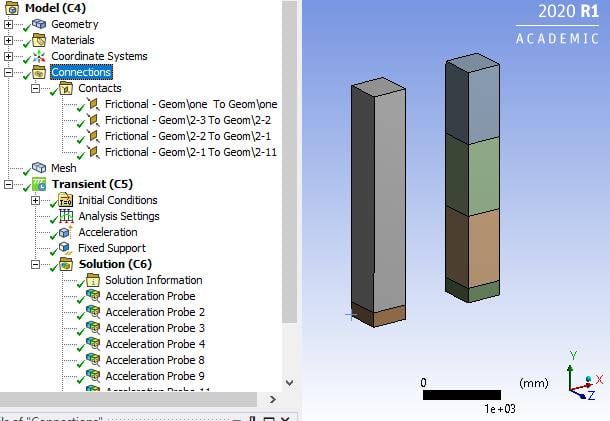


      But when you are in Transient Structural, the Frictional Contacts behave as slip planes. The acceleration is purely X and there is no -Y component to represent Gravity, so there is no normal force, so there is no frictional force keeping the top of the building connected to the base.


      I suggest you convert the Frictional Contact to Bonded Contact for the Transient Structural analysis, but if you do that, both towers become incidental.


      If your goal was to introduce lateral flexibility at different levels of a building, where the blocks are considered rigid, you could do that in the X axis by inserting a Translation Joint at each slice, delete the contacts, and insert a spring between the blocks in the X direction with your desired spring rate. Now you will get a single mode in the first tower, since there is only one moving mass, while the the second tower will have 3 modes because there are three moving masses.


      Looking at your acceleration load, the sampling frequency is about 15.6 samples/second. This sampling rate is too low for exciting structures that have a first natural frequency of 24 Hz. The rule is a minimum of 10 and preferably 20 samples per cycle of the highest frequency of interest. That means the acceleration should have a sample rate of 240 Hz. You have 15.6 Hz. I have downloaded seismic data from the internet and it was sampled at a higher frequency than 15 Hz.


      Now if that modal frequency is irrelevant because you want to do the lateral springs, you might end up with a structure that has mode 3 < 1.5 Hz and so your acceleration load is adequate for that structure.


      I hope PSiedlac123 takes a look and replies with more comments.

    • Randel Ilumin
      Subscriber

      Hello. I would like to ask how about in the case of using APDL? How to apply acceleration and how to consider boundary conditions at the ground level. Also, how about the effect of gravity load? I tried to develop a command but I'm not really sure about this. I really need help. Thank you.

      /SOLU

      FILE = ‘accelvalidate1’

      DT = 0.01

      SKIP = 0

      /INQUIRE,NUMLINES,LINES,FILE,TXT

      READ = NUMLINES - SKIP

      *DEL,ACCEL,,NOPR

      *DIM, ACCEL,TABLE, READ - 1, 3

      *TREAD,ACCEL,FILE,TXT,,SKIP

      ANTYPE, TRANS

      TRNOPT,FULL

      TIMINT,ON,STRUC

      ACEL,0,9.806,0

      KBC,0

      OUTRES,ALL,1

      OUTPR,BASIC,ALL

      NT = READ

      NSUBST,1,,,1

      *do,i,1,NT

      TIME,i*DT

      CMSEL,ALL

      NSEL,S,LOC,Y,0

      DDELE,ALL,ACCX

      DDELE,ALL,ACCY

      DDELE,ALL,ACCZ

      D,ALL,ACCX,ACCEL(i,1)

      D,ALL,ACCY,ACCEL(i,2)

      D,ALL,ACCZ,ACCEL(i,3)

      ALLSEL

      SOLVE

      *enddo

Viewing 6 reply threads
  • The topic ‘Input the acceleration load’ is closed to new replies.
[bingo_chatbox]








