The concrete material is defined using a modified Drucker-Prager material model (TB,CONCR,,,,DP) or a Menetrey-Willam material model (TB,CONCR,,,,MW).
Exponential softening (TB,CONCR,,,,HSD2) is used with either concrete material model.
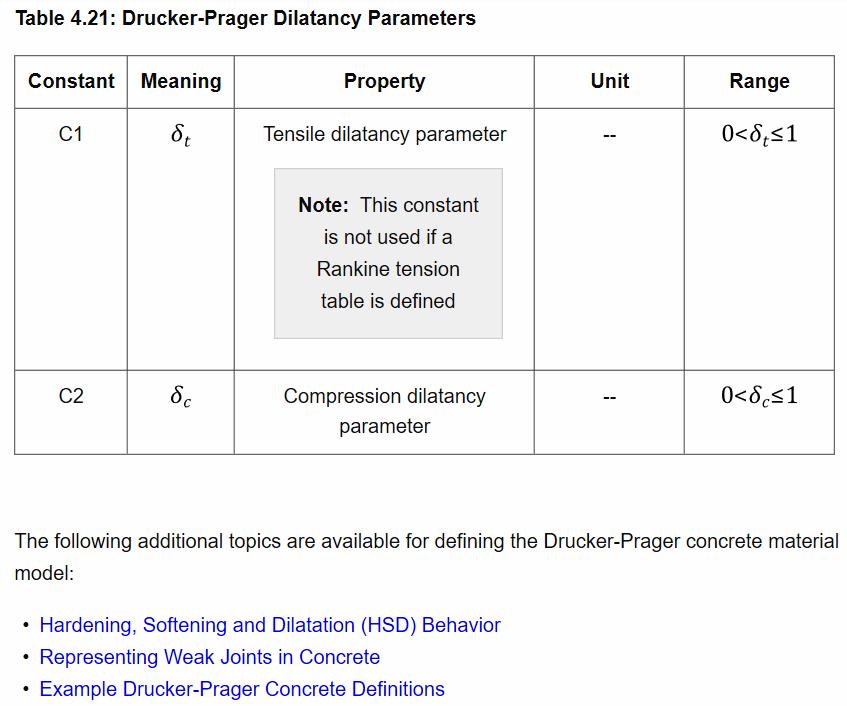
When using the composite Drucker-Prager with Drucker-Prager tension surface, dilatancy parameters are optional. The composite Drucker-Prager with Rankine surface requires a compression dilatancy parameter.
If you define dilatancy parameters, the following considerations apply:
To define dilatancy parameters, define the material data table (TB,CONCR,,,,DILA) and input the following constants (TBDATA):


















 You are navigating away from the AIS Discovery experience