

-
-
October 18, 2021 at 12:34 pm
jojimat33
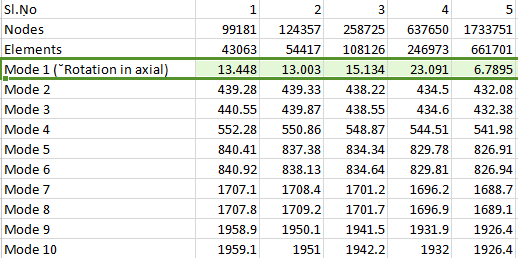
SubscriberI am doing a modal analysis of a motor rotor assembly where upon increasing my mesh size, the first mode (rotation along axial) is fluctuating and not converging. How to find a good mesh for this?
October 19, 2021 at 2:27 pmAniket Chavan
Forum Moderatorare the mode shapes the same?
-Aniket
How to access Ansys help links
Guidelines for Posting on Ansys Learning Forum
October 19, 2021 at 6:30 pmdlooman
Ansys EmployeeIs axial rotation constrained? Sometimes a rigid body mode produces a non-zero contact due to penalty based contact. If mode 1 is actually a rigid body mode (no constraint of axial rotation) try switching to MPC based contact to reduce the artificial rotational constraint of penalty based contact.
October 20, 2021 at 6:03 pmSubscriberThe mode shapes are the same. The other modes are converging, but only the first mode is not converging as seen from the results
October 20, 2021 at 8:03 pmSubscriberAxial rotation is kept free as I have used a Cylindrical support at bearing support face with tangential as free.
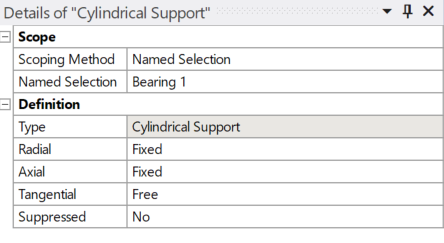 As you said Mode 1 might be rigid body mode. Could you give me some more idea on "switching to MPC based contact to reduce the artificial rotational constraint of penalty based contact"? Does MPC based contact completely remove the first mode with axial rotation ?
Viewing 4 reply threads
As you said Mode 1 might be rigid body mode. Could you give me some more idea on "switching to MPC based contact to reduce the artificial rotational constraint of penalty based contact"? Does MPC based contact completely remove the first mode with axial rotation ?
Viewing 4 reply threads- The topic ‘Does Modal analysis solution depend on mesh size ?’ is closed to new replies.
Innovation Space Trending discussions
 Top Contributors
-
peteroznewman
 6495
6495 -
scabo
 1906
1906 -
Dennis Chen
 1458
1458 -
javat33489
 1308
1308 -
Shyam Prasad V Atri
1022
Top Rated Tags
© 2026 Copyright ANSYS, Inc. All rights reserved.
Ansys does not support the usage of unauthorized Ansys software. Please visit www.ansys.com to obtain an official distribution.
-


The Ansys Learning Forum is a public forum. You are prohibited from providing (i) information that is confidential to You, your employer, or any third party, (ii) Personal Data or individually identifiable health information, (iii) any information that is U.S. Government Classified, Controlled Unclassified Information, International Traffic in Arms Regulators (ITAR) or Export Administration Regulators (EAR) controlled or otherwise have been determined by the United States Government or by a foreign government to require protection against unauthorized disclosure for reasons of national security, or (iv) topics or information restricted by the People's Republic of China data protection and privacy laws.

 You are navigating away from the AIS Discovery experience