-
-
May 23, 2020 at 11:27 pm
Andreyteston
SubscriberÂ
Hello, members.
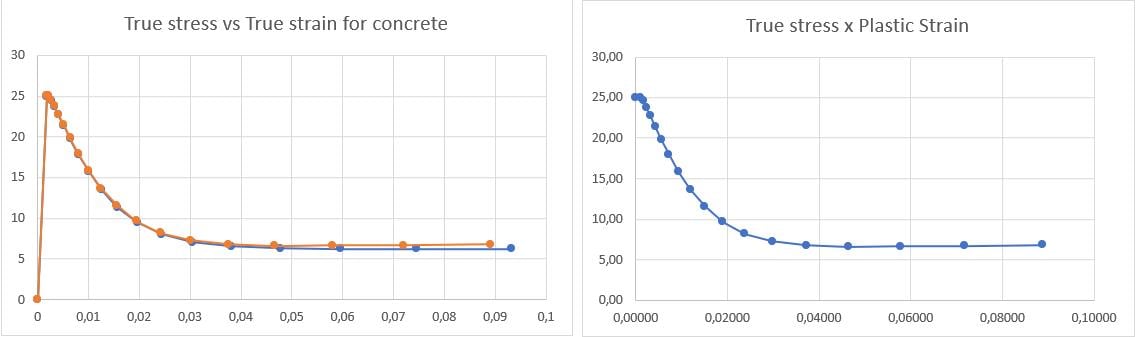
I would like to use the constitutive model for concrete by Tao (2013), that have a descending part after the maximum stress on stressxstrain relationship. I am attaching one picture here. I would like to formulate this relationship in order to represent the residual stress offer by the confinement effect.Â
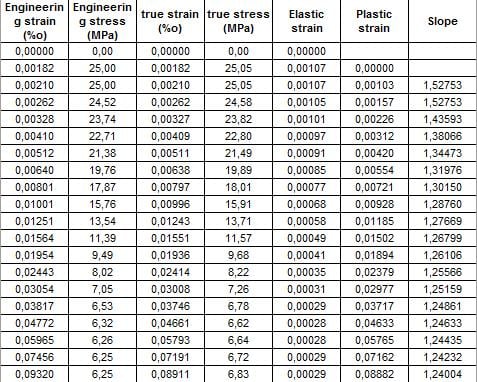
However, the software has been returning this error: "TB,MISO table for material 2 at temperature 0 has a tangent slope value less than zero". I am also attaching the textfile here.
I wonder if any member may help me to solve this problem.
Regards, Andrey
-
May 24, 2020 at 10:48 am
Aniket Chavan
Forum ModeratorAnsys employees can not download attachments from the student community, but it seems like you have a negative slope to your material model
check this thread:
/forum/forums/topic/how-to-define-multilinear-stress-strain-curve-in-ansys-apdl/
-Aniket
How to access Ansys Online Help Document
How to show full resolution image
Guidelines on the Student Community
How to use Google to search within Ansys Student Community
Â
-
May 26, 2020 at 3:49 am
Andreyteston
SubscriberHello, Aniket.
Thank you very much for this help. However, unfortunately, using the model NLISO, I could not apply my stress strain relationship because the model requires few parameters.
Through this discussion, I would like to make initial questions about modeling constitutive relationship of concrete.
1. In past posts I have read that Multilinear isotropic hardening plasticity (MISO) and Multilinear kinematic hardening plasticity (KINH) do not support negative slopes. Is there any model for input the constitutive relationship stressxstrain for concrete on compression?
2. For the constitutive relationship stressxstrain for concrete on tension, I need use micro plane model (elastic micro-plane model with damage or coupled damage-plasticity micro-plane model with CPT215)?
3. May I define the constitutive relationship stressxstrain for concrete for both cases using Menetrey-Willam model. Have you any example using APDL commands?
I wonder if any member may help me to solve my doubts. Or, if any member has tutorials or materials for I would like to learn.
Regards, Andrey
I have been reading about my doubt in this post:
/forum/forums/topic/softening-behavior-in-drucker-prager-concrete-model/
-
May 27, 2020 at 2:03 pm
Andreyteston
Subscriber
My first point in the material on Ansys is the yield stress of concrete with corresponding plastic strain equal to zero.
The descending curve represent the residual stress of concrete in confinement, by Tao (2013) "Finite element modelling of concrete-filled steel stub columns under axial compression". I am modeling a circular concrete filled steel tube.
Regards, Andrey
Â
-
May 27, 2020 at 3:34 pm
Rohith Patchigolla
Ansys EmployeeHello Andrey,Â
Yes, MISO and KINH models do not support negative slope.Â
I don't think you can provide a stress-strain data as input for either Microplane or Drucker Prager or Menetrey-William model. Perhaps you can adjust the material parameters of one of these 3 models, such that they match your stress-strain curve.Â
Best regards,
Rohith -
May 27, 2020 at 8:18 pm
Andreyteston
SubscriberHello, rgpatchi .
Thank you very much for your contribution.
I am going to study these three models that you have recommended for me.
I have been trying use the Multilinear Elasticity (MELAS), however, for use this model I need to use the element SOLID95 rather than SOLID186.
Could you give me a contribuition about this the model MELAS and, the difference between SOLID95 and SOLID186?
Regards, Ândrey
-
May 28, 2020 at 7:36 am
Rohith Patchigolla
Ansys EmployeeHello Andrey,Â
I believe, MELAS also has the limitation of negative slope.
Regarding the difference between solid95 (currently in the feature archive) and solid186,
SOLID186 uses URI (Uniform Reduced Integration) element formulation by default. SOLID95 uses full integration. To get the same behavior, we can switch SOLID186 to full integration with KEYOPT(2)=1 OR switch SOLID95 to URI with KEYOPT(11)=1. Solid186 element represents the latest technology and all things being equal it is the recommended element type by ANSYS.
Also, if you have a look at SOLID95 documentation, you can find the below comment.
"Although this archived element is available for use in your analysis, ANSYS, Inc. recommends using a current-technology element such as SOLID186 (KEYOPT(2) = 1, or KEYOPT(2) = 0 for nonlinear analyses)."
Hope this helps.Â
Best regards,
Rohith
Â
-
June 9, 2020 at 8:12 pm
Andreyteston
SubscriberHello, rgpatchi!
I would like implore apologies because the long time for return you. One more time, thank you very much for your contribution.
I have understanded the difference between SOLID95 and SOLID186, thank you.
I have been created simple models in order to test the element MELAS. In this tests, there isnt's warnings and erros about negative slope. On the other hand, reading about this model, I have found in ANSYS help :"This behavior, unlike the other options, is conservative (path-independent). The plastic strain for this option should be interpretedas a "pseudo plastic strain" since it returns to zero when the material is unloaded", therefore, I would like obtain your help.
This means that material behavior will be linear even that my analisys will be non linear?
-
June 22, 2020 at 8:14 am
Rohith Patchigolla
Ansys EmployeeHi Andrey,Â
Sorry for my late reply.Â
MELAS model can be thought of as a poor man's version of small strain hyperelasticity.
So, the material behavior is nonlinear-elastic.Â
Best regards,
Rohith -
June 22, 2020 at 2:20 pm
Andreyteston
SubscriberHello, Rgpatchi.
Thank you for this answer.
Does this mean that in a static analysis the behavior of the material hasn't plastic deformations? Â
Regards.
ÂndreyÂ
-
- The topic ‘Constitutive model (stressxstrain relationship) of concrete with part descending curve’ is closed to new replies.

-
6495
-
1906
-
1458
-
1308
-
1022
© 2026 Copyright ANSYS, Inc. All rights reserved.