-
-
March 19, 2020 at 8:50 am
gopikrishna
Subscriberi need to simulate a round bar for creep in which one end is fixed and other is applied by a tensile load. the problem is my simulation is not converging. i have tried changing substeps, applied fine mesh, rechecked creep constants and units still problem exists. please help me to sort out this problem.
-
March 19, 2020 at 8:51 am
gopikrishna
Subscriberplease help guys
-
March 19, 2020 at 12:50 pm
peteroznewman
SubscriberANSYS staff are not permitted to open attachments. Please insert the images into your post. You can leave them attached also. as that is easier for me to open.
-
March 19, 2020 at 1:10 pm
-
March 20, 2020 at 4:29 am
gopikrishna
Subscribersir i have inserted the images.
-
March 20, 2020 at 12:37 pm
peteroznewman
SubscriberDoes it fail to converge at the beginning or does it start and fail to converge at the end?
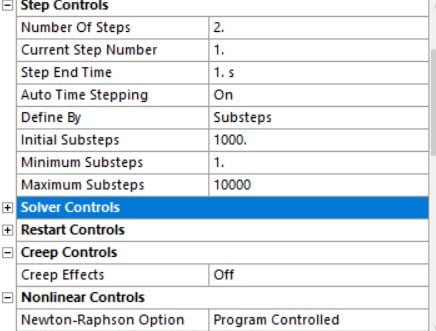
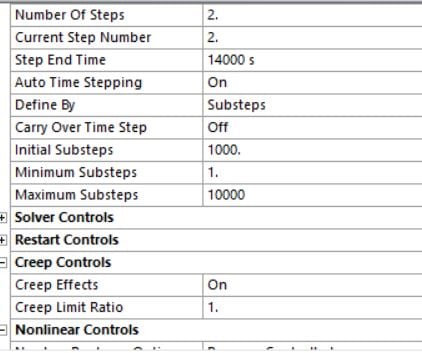
What happens if you set the Initial Substeps to 1000?
-
March 20, 2020 at 1:27 pm
-
March 20, 2020 at 1:28 pm
gopikrishna
Subscribersir , is negative creep constant can be a problem for convergence??
-
March 20, 2020 at 5:29 pm
peteroznewman
SubscriberI went to the ANSYS Help system, and found the equation for Norton so that I understood the creep model in another discussion.
ANSYS Help > Home > Mechancial APDL > Material Reference > Nonlinear Material Properties > Rate Dependent Plasticity > Creep
The Combined Time Hardening entry says only C1 > 0 and C5 > 0.
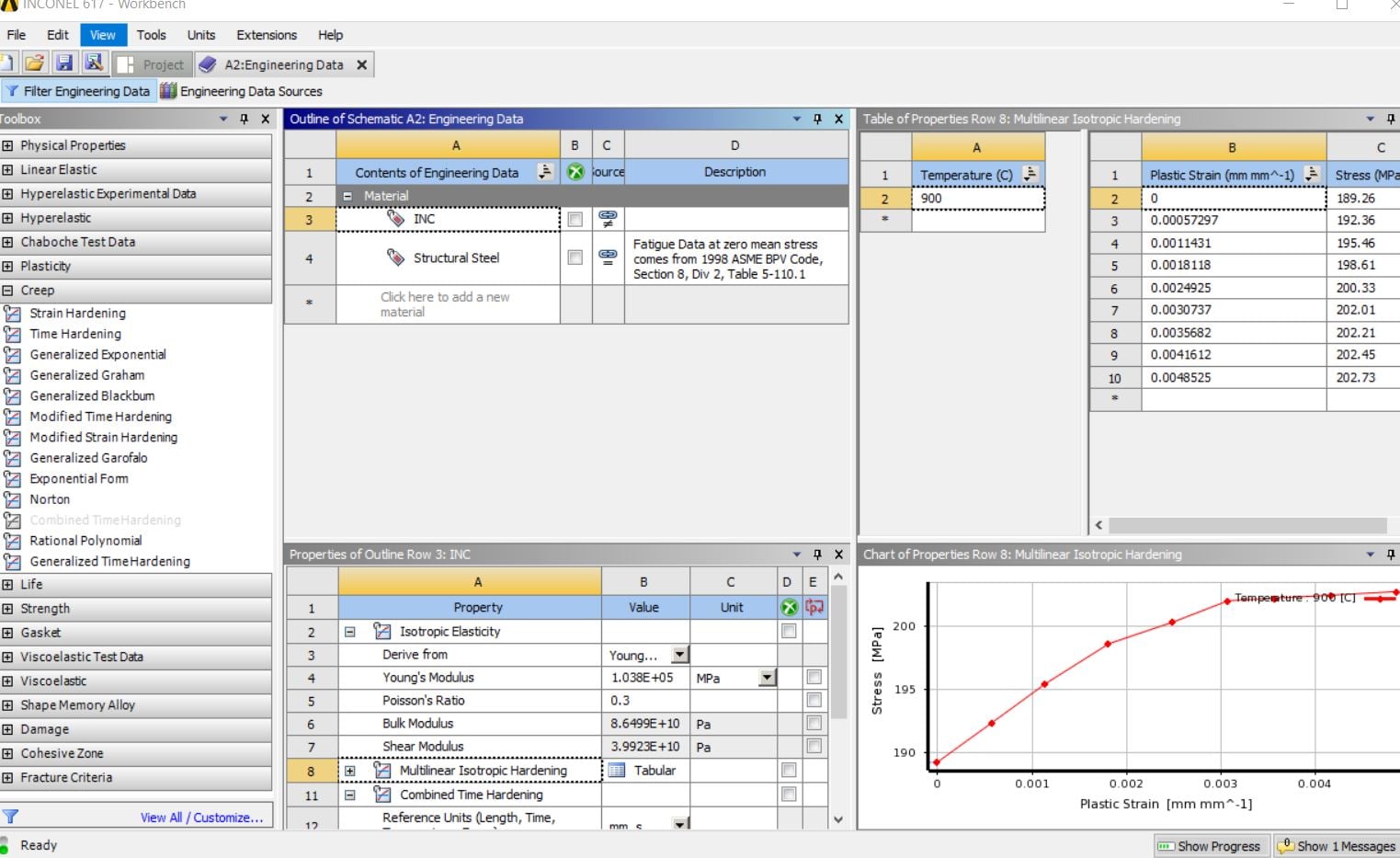
Where did you obtain the creep constants? What units of stress are required to use those constants?
It seems your solution begins, so you have some results.
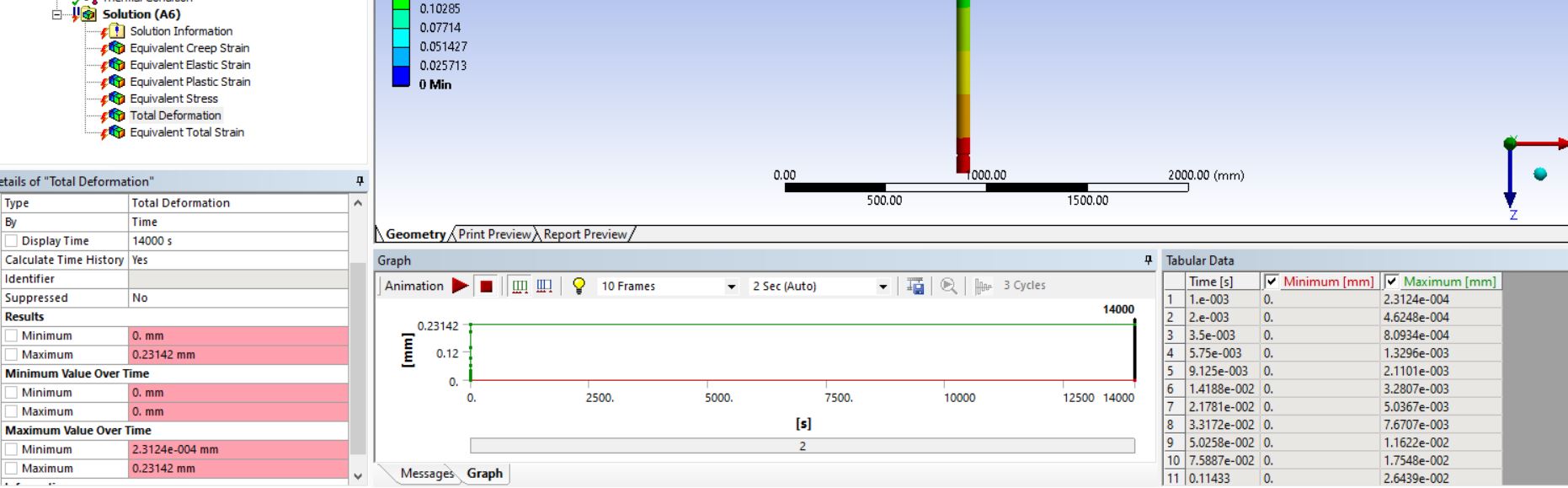
Please reply with a snapshot of the graph of maximum displacement vs. time.
-
March 21, 2020 at 12:14 pm
gopikrishna
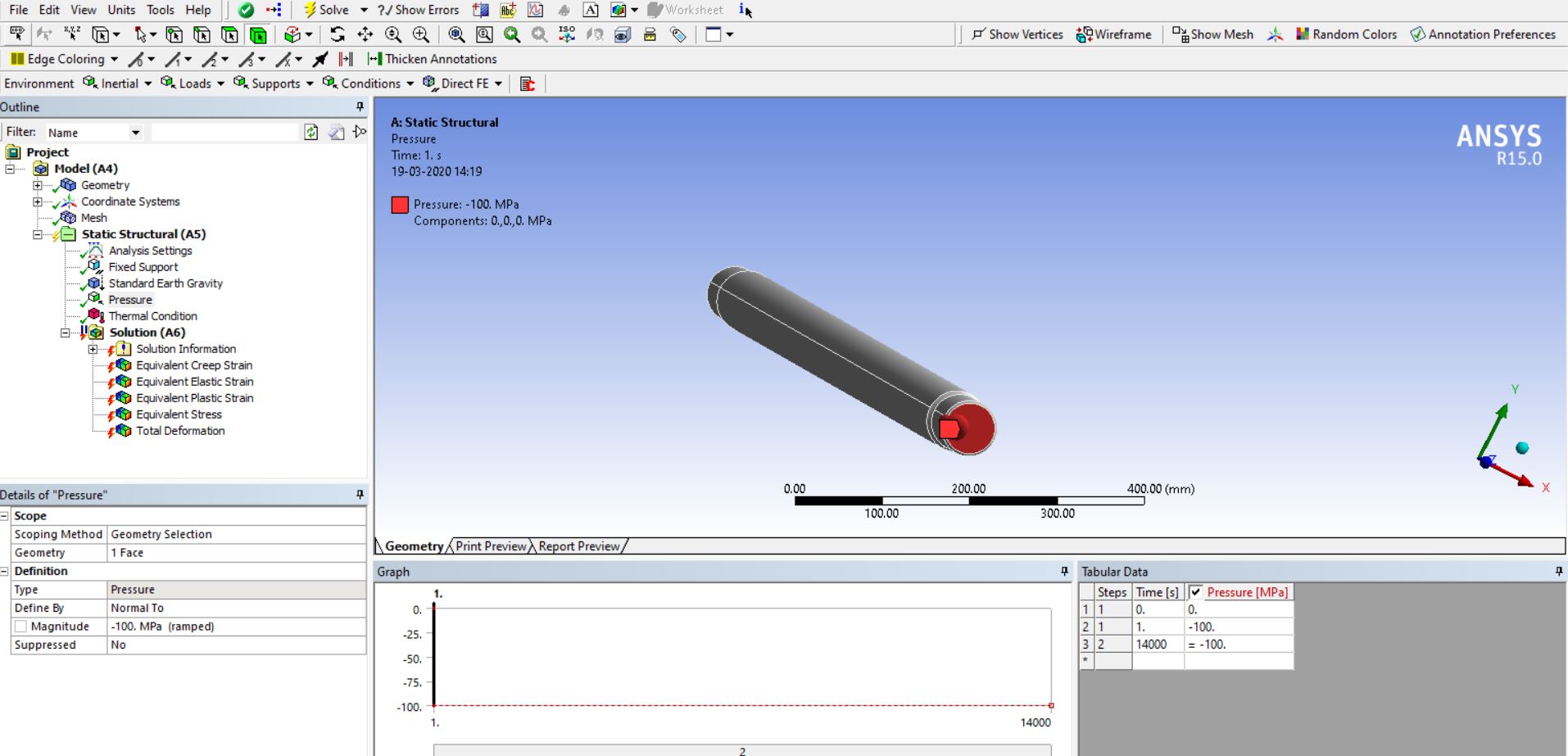
SubscriberSir, i took the values for strain and time from strain vs time plot and transferred those values to APDL. Then using curve fitting in APDL i solved and got the values. My stress value is 18 Mpa and temperature is 900 degree celsius for a time of 14000 hours
-
March 21, 2020 at 12:14 pm
-
March 21, 2020 at 12:17 pm
-
March 21, 2020 at 4:26 pm
peteroznewman
SubscriberTry setting Minimum Substeps to 1000 since the solution converges a few initial steps.
-
March 23, 2020 at 9:47 am
gopikrishna
Subscribersir, still not converging. Any other solution??.
-
March 23, 2020 at 11:20 am
peteroznewman
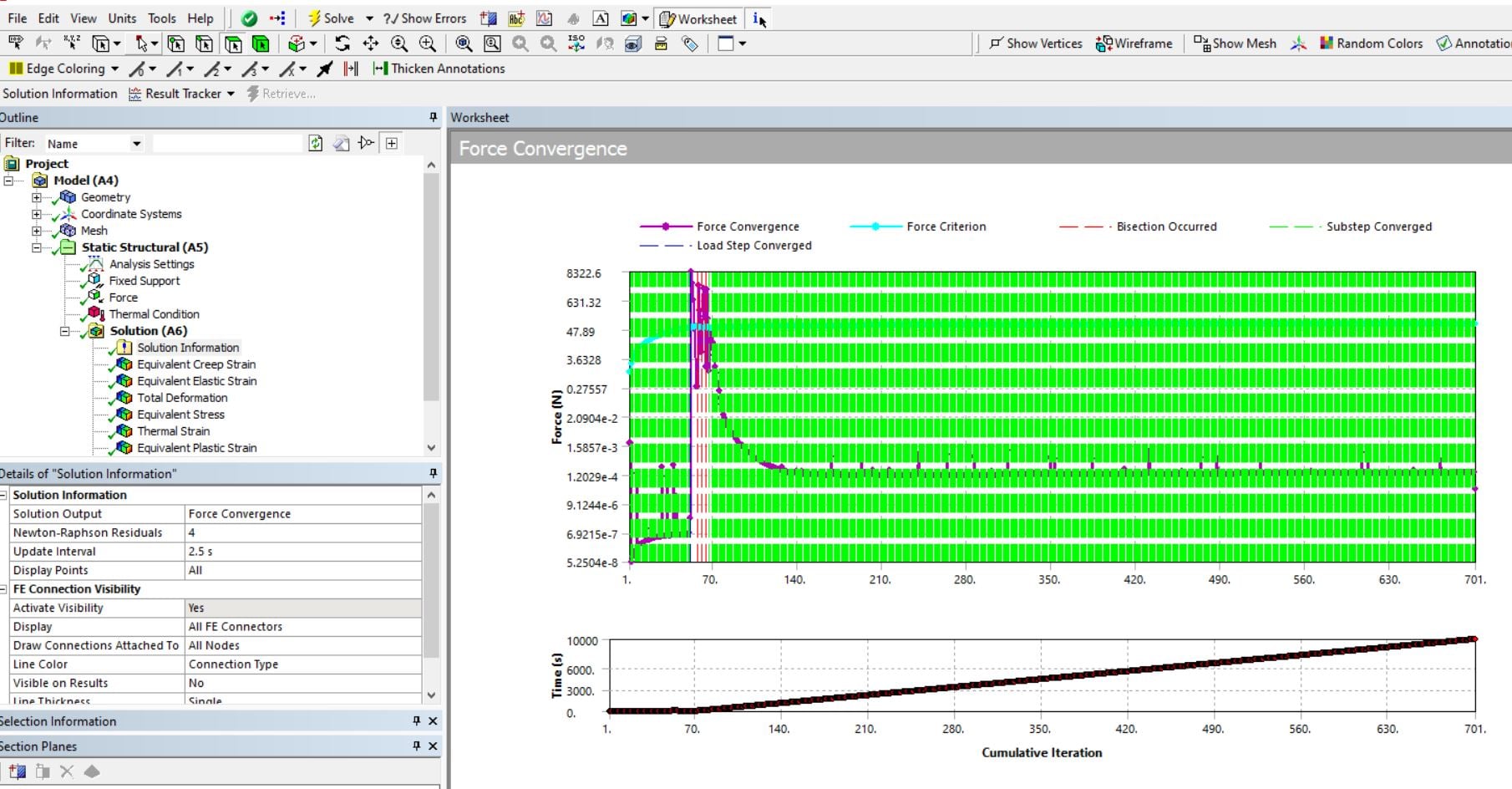
SubscriberWhat is the error description on the Solution Output?
-
March 28, 2020 at 7:54 am
lroblek
SubscriberHow did you get the Combined time hardening coefficients? Via APDL Material models? You have fixed C4=0, so I assume you don't have temperature dependant model.
Try to fix C2=1, C4=0, C6=1 and C7=0 (fixed stress and no temperature dependancy) in the Curve fitting tool and try to run the simualtion again. The creep behaviur curve should be nearly the same (you can compare to the current one that you have). Put fixed values in the Coeff Value, Fix them and click Solve to get new values for the creep simulation.
-
March 30, 2020 at 9:00 am
-
March 30, 2020 at 9:01 am
gopikrishna
Subscribersir same error its showing
-
March 30, 2020 at 9:01 am
-
March 30, 2020 at 5:07 pm
-
March 31, 2020 at 10:40 am
-
April 3, 2020 at 8:40 am
gopikrishna
Subscribersir actually the data is got is only strain vs time data...can you please tell me how to derive creep constants for norton equation
if i try to get the data from APDL i need creep strain rate vs time data that i dont have...can you pls share me the way i can derive these constants for norton.
-
April 6, 2020 at 11:42 am
gopikrishna
SubscriberSir, how i can send you my model to check the actual mistake??
-
April 6, 2020 at 12:19 pm
peteroznewman
SubscriberWhen a nonlinear static structural model fails to converge, that can be the expected outcome of the simulation. For example, if the material is Bilinear Isotopic Hardening, with 0 Tangent Modulus, it is perfectly plastic above the yield strength. If a force is the applied load, once the force is high enough to turn the entire section plastic, there is no static equilibrium above the force increment that just converged, every force above that will fail to converge. There is no mistake in the model, that is the natural end of the simulation for a problem where the ultimate load was unknown.
Your model converges for many time steps, then stops converging. Look at the results. Plot the force vs time curve. What does it look like?
-
April 7, 2020 at 7:15 am
gopikrishna
SubscriberSir, what is the significance of creep limit ratio. what if i put creep limit ratio as zero, because if im assigning creep limit ratio as zero solution is converging!
sir also if we get the creep constants for a material, then with that creep constants can we simulate the model for any stress, temperature, and time values?? i mean the same creep constants can be applied for a specific material for any of its creep simulation??
-
April 7, 2020 at 11:28 am
peteroznewman
SubscriberPlot the force vs time curve. I want to see that before I say anything more.
-
April 8, 2020 at 3:37 pm
-
April 8, 2020 at 3:42 pm
gopikrishna
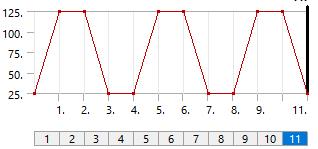
SubscriberSir if i want to do a coupled simulation of thermal cycling with creep, how can i do it. Since creep constants depends on temperature, so during thermal cycling temperature is continuosly changing..can you explain please!
-
April 8, 2020 at 7:46 pm
-
April 9, 2020 at 6:43 am
gopikrishna
Subscriberthank you sir, but what about creep constants?? it depends on temperature, therefore it can vary with temperature. So if im doing thermal cycling, temperature is continously varying. In my case temperature is varying between 900 to 400. So should i choose creep constants for 900 or 400 or in between some value and carry out simulation??
-
April 25, 2020 at 3:26 pm
gopikrishna
SubscriberSir, whether we will apply damage evolution law for creep simulation??. because in the real case necking is happening at the heat affected area at the center of the bar. In simulation the way it is failing by creep is complately different.
-
June 23, 2020 at 11:30 am
krishna1983
Subscriber@Gopikrishna, I am fresher to Ansys Creep analysis. I need some help from you.
I have a reactor, material is 1.25cr-0.5mo. The design temperature is in creep range. So i need to perform creep analysis to obtain creep strain. I have rupture data from ASTM DS-50.
My material model is Norton (for secondary creep). Then how i derive creep constants from APDL. Kindly explain.
Besides, could you please share your model, so that it will be helpful for my project.
Your help is appreciated.
-
October 14, 2020 at 2:10 pm
Patti
SubscriberHello Gopikrishna,I think I actually have the same problem you have once regarding the constant of norton law. nYou wrote that you find another way to identificate the constants. Can you please tell me how you did it?.I got creep test data deformation vs. time or creep strain vs. time. nI tried to fit the creep curve in APDL (Norton) but it doesnt worked. Error during solution. Only Modified Time Hardening and Generalizied Time Hardening worked. But with the constant of these creep law - the simulation doesnt converge.nnMaybe you can help?nThanks in advance.n
-
- The topic ‘unable to converge creep simulation in workbench’ is closed to new replies.

-
6495
-
1906
-
1458
-
1308
-
1022
© 2026 Copyright ANSYS, Inc. All rights reserved.